
Temple Bar London: A Journey Into Its Macabre Dark History
Walking near St. Paul’s Cathedral, you may notice Temple Bar London: one of the old London city gates. This historic area is beautiful area to walk and take in the legendary sights.
But did you know that where Temple Bar stands today isn’t even the original location? And that if you were to walk under the same arch in the 17th century, you could have been pelted by a severed head?
Let’s look at the most interesting Temple Bar London history, from the weird to the curious to the downright gruesome.

Roman London City Gates
To understand why this city gate stood here, we have to go back to Roman London.
5 city gates were initially built on the most important roads in and out of London: Ludgate, Bishopsgate, Negate, Cripplegate, and Aldgate.
The London Wall connected these gates, and over the centuries more gates were built as more roads were built.

As London expanded beyond the London Wall, they stretched the boundary to gates, called “bars.” These bars separated the jurisdictions of London and Westminster, effectively expanding the boundary.
There were more bars than just Temple: there were also bars at Holborn, Smithfield, and Whitechapel.
In the beginning of these bars, they likely would have been wooden posts with chains: nothing fancy, just effective. They would have been at all major roads going out of the City.
But as the road stretching between Westminster and the City of London became more important, so did the bar that stretched over the road.
The Original Temple Bar London: Fleet Street
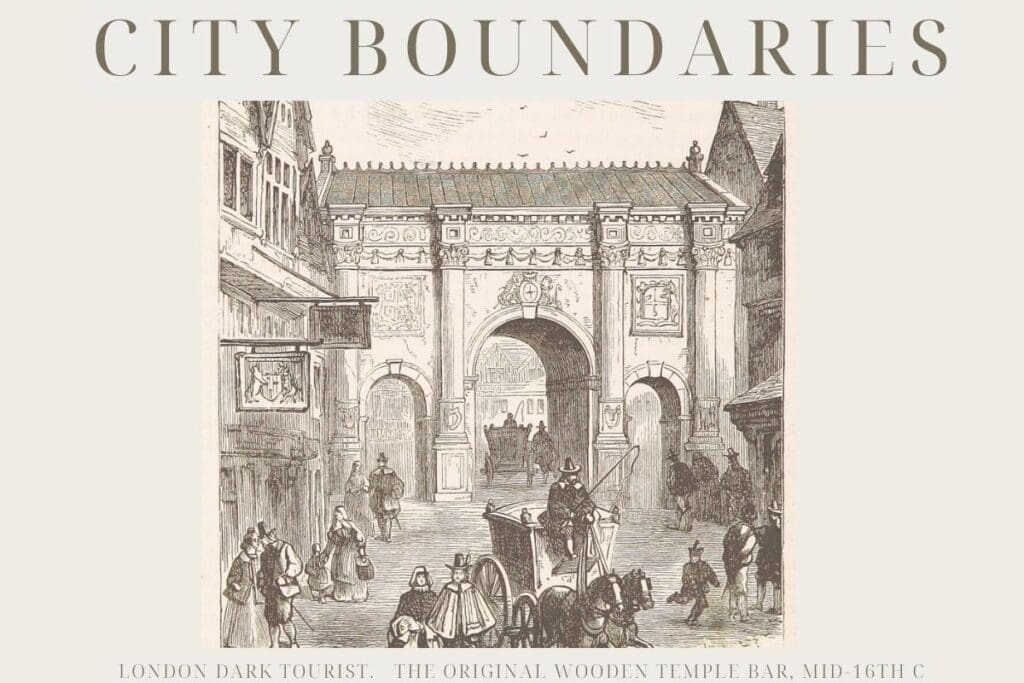
Though there are no remaining illustrations of what the very first Temple Bar would have looked like, we can imagine it as a simple gate – probably made of wood and iron chains – that was likely rebuilt several times over the centuries.
One version was made of wood, constructed during the reign of James I (pictured above).
As trade expanded, it served an important purpose: collecting taxes on goods moving in and out of the city.
It would have been an inspection point for merchants moving their wares in and out of London, who were subject to taxes to pay for road maintenance.
London Temple Bar After the Great Fire
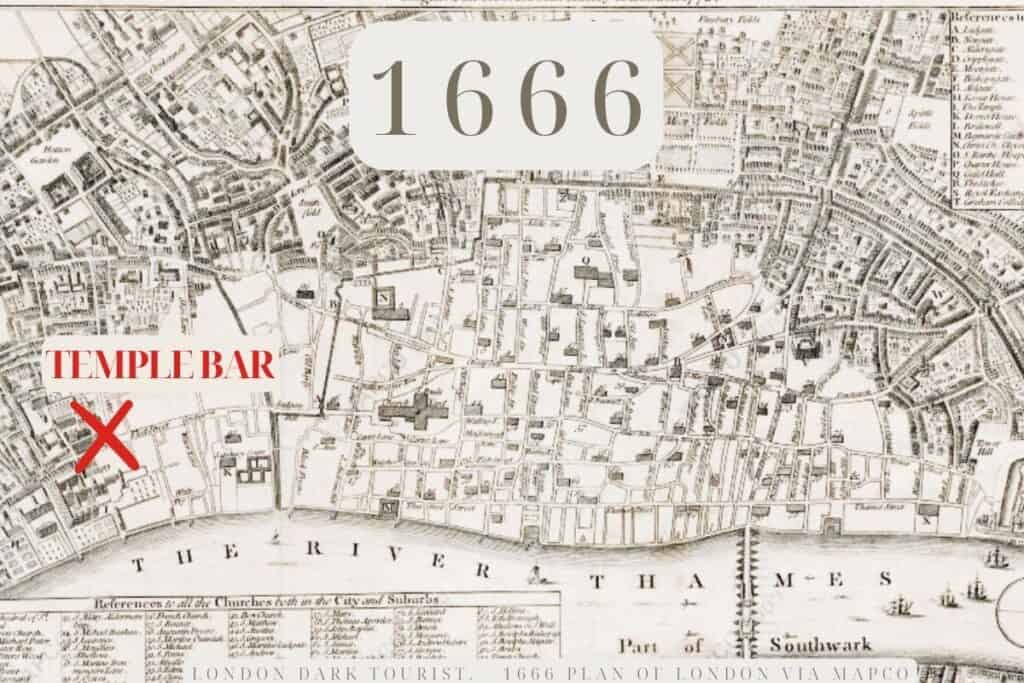
The Great Fire of 1666 swept away 4 of the 7 city gates, but it didn’t reach as far as Temple Bar.
But after the Great Fire, London underwent huge redesign and redevelopment. Those rebuilding the city thought it was time for a more impressive entrance to the City from Westminster, so they commissioned artists and architects to redo this important city gate.
Though there’s no concrete evidence that famous architect Sir Christopher Wren designed the new Temple Bar, it’s often attributed to him.
He was responsible for so much of the redevelopment of the city – designing structures like iconic St Paul’s Cathedral and Monument – that it’s entirely possible and probable that he designed it.
The building structure, however, was left to Joshua Marshall and Thomas Knight, who had worked with Wren in the past.
London Temple Bar’s Original Location

The result of their endeavors was a massive arch of Portland Stone stretching across where Fleet Street meets The Strand, and it’s pretty much the same arch you see today.
There is one main arch, which spanned the road for vehicle traffic, along with two flanking arches for pedestrians.


But not soon after its construction, Temple Bar would become known for something way more intriguing than paying taxes: it would become known for the rotting heads perched on top.
Temple Bar London History: Horrifying Heads
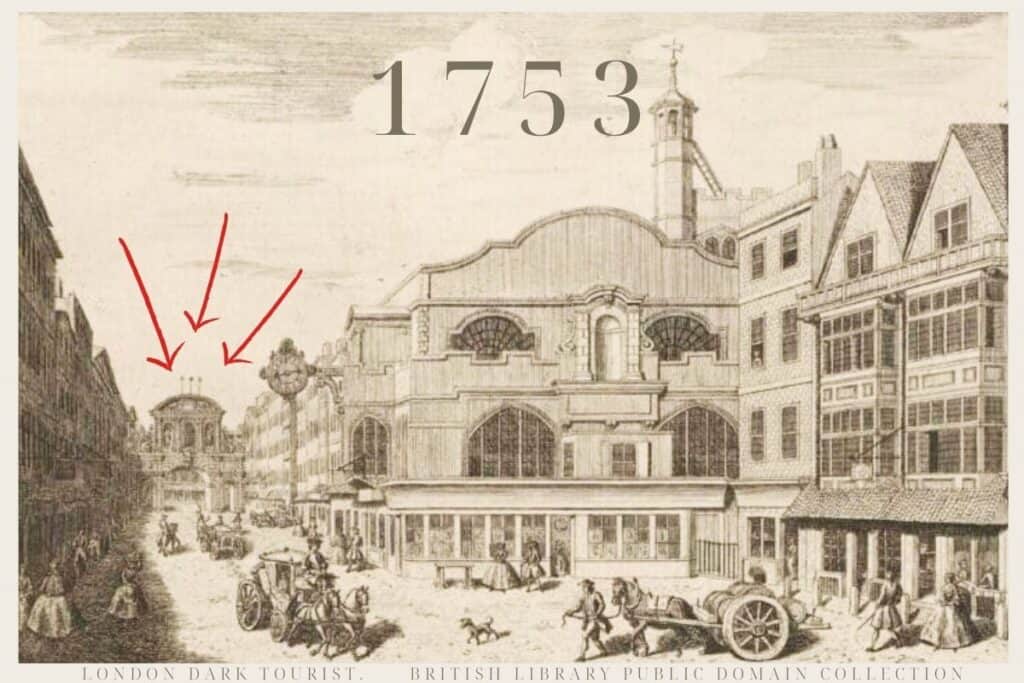
Since this newly constructed city gate was such a grand entrance, it would have looked quite imposing as you drew near from the city outskirts.
King Charles II knew this, and he decided to double down on the drama of the city structure: he ordered that traitor’s heads be displayed on top after their executions.
The first of these traitor’s heads to adorn the top of Temple Bar were the perpetrators of the Rye House Plot, who conspired of the to assassinate King Charles II & his brother.
After this uprising, seven men were hung, drawn and quartered. A further two were hung, two were just plain beheaded, and one was burned at the stake.
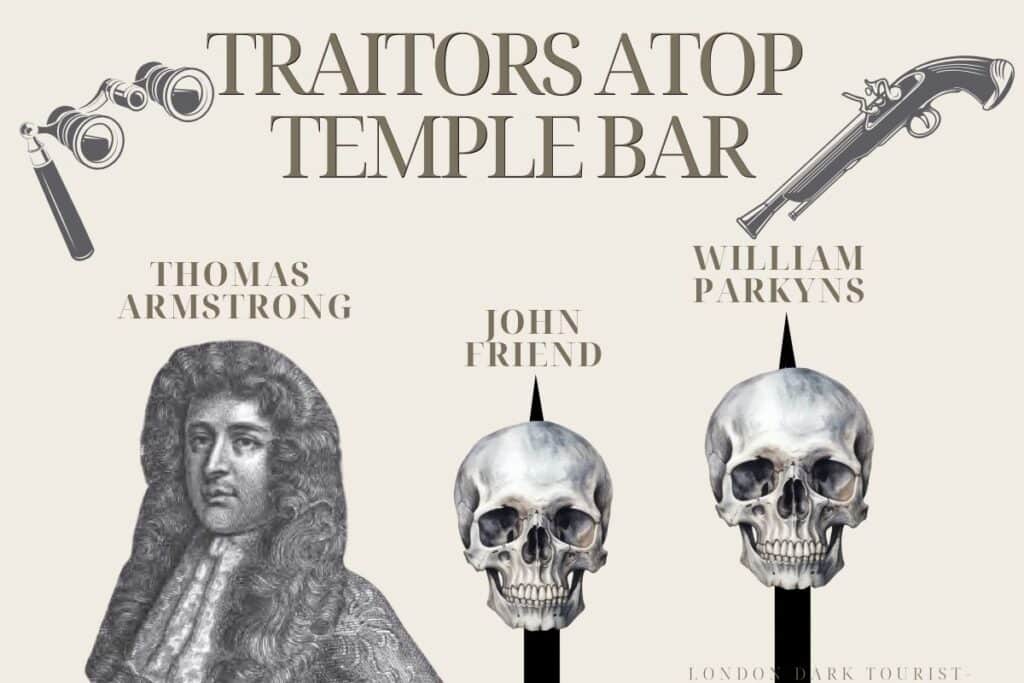
The heads of Thomas Armstrong, John Friend and William Parkyns were doused in tar or salt (to keep the birds away), then set atop iron spikes on top of Temple Bar.
The decapitated heads served as a warning to all those entering the City of London: don’t cross the King, or you’ll lose your head. And although it would have been terrifying, Londoners were curious. Merchants hired out looking glasses below, so Londoners could get a better view of the heads.
Some also used them as target practice, firing shots at the heads from below.
Did any of this make traitorous behavior any less likely? Probably not. This was an era full of gruesome punishments and ways to die in London, even for royalty.
London Heads Are Falling Down

Over the years many more traitorous heads would decorate Temple Bar. But they didn’t naturally stay up there forever.
So what happened to the heads? Some of them sort of fell apart, some of them blew away in storms, and some fell on passersby.
A newspaper editor’s wife in 1772 gave an account of the falling heads.
She recalled: “There were two; I saw one fall. Women shrieked as it fell; men, as I have heard, shrieked. One woman near me fainted. Yes, boys, I recollect seeing human heads upon Temple Bar.”
Temple Bar London’s Relocation
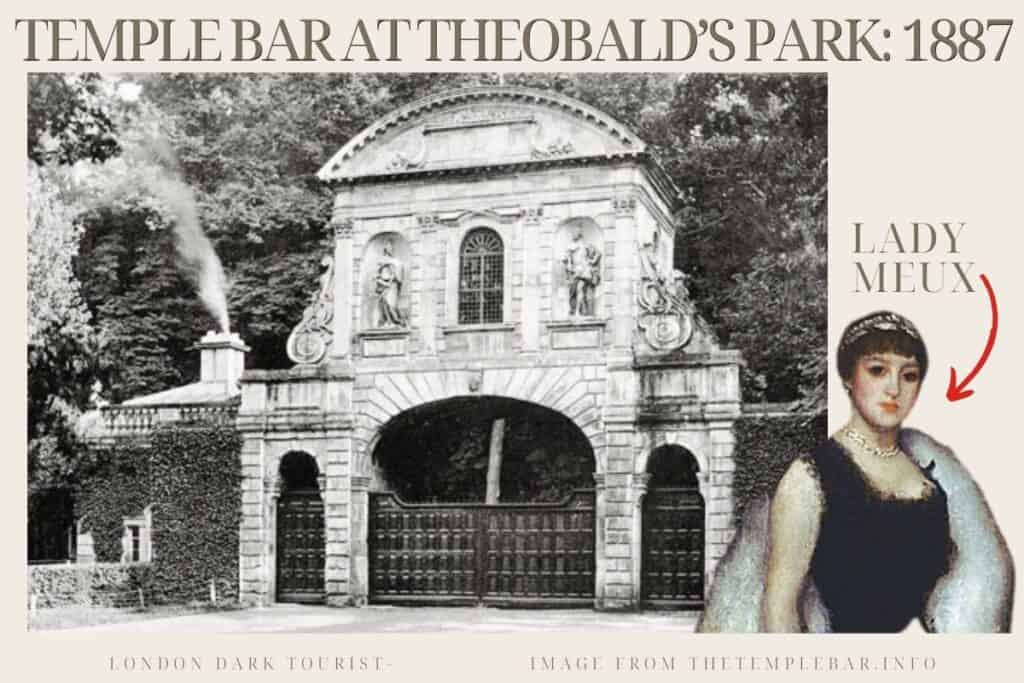
As the city expanded both in footprint and in population, Temple Bar began to restrict the flow of traffic with its narrow arch.
Consequently, it was disassembled and moved around a lot; first to storage, then to the front yard of an eccentric heiress called Lady Meux (who apparently was also a barmaid and played the banjo – she sounds like an absolute delight!).
Lady Meux was “new money,” having married into fortune, and installing the iconic landmark in front of her home may have been an attempt to buy respectability.
It stayed there, in front of her stately home in the countryside, from 1889 until 2004.
(Her former home in Cheshunt was, until recently, a luxury hotel).

London City Gates’ Return to London
In the 1970s, a trust was created to move Temple Bar back to London, and they only took 30 years to accomplish it (Brits love nothing more than bureaucracy and red tape, so this isn’t surprising).
In 2004 it was moved back to the City, and now sits near St. Paul’s Cathedral in Paternoster Square (Paternoster= “our father”).

You can visit Temple Bar today and view it from below in the square.
Even though it’s not the original location, it’s incredible to imagine it as the grand entrance to the city, and even more incredible to imagine human heads perched on top.

Occasionally the rooms above are open in the autumn for tours via Open House London Open House London.
Lady Meux supposedly threw wild parties in this apartment at the top of the Bar, and if you ever get the chance to see inside, you should definitely take it.
Temple Bar London History of Hauntings
Is Temple Bar haunted? Like most London locations with a gory history, it’s had its fair share of ghost lore.
Temple Bar is known for the ghost of Sir Henry Hawkins, who was a 19th century criminal judge.
His spirit is seen along the lanes of Temple and Paternoster Square, heading toward Temple Bar and disappearing into the stone walls. Does he have a secret hidden in the caverns of the bar?
Faces have often been spotted in the upstairs windows by passersby.
Could it be Lady Meux, who’s still partying away in the afterlife? I’d like to think so.
More on Weird London History and Crime
Titanic Artifacts: The 11 Best Places Around the World to See Sunken Treasures
10 Rillington Place Today: Notorious Murder House Then & Now
Secrets of a Serial Killer: Uncovering the Truth About John Reginald Christie
The Workhouse Howl & 13 Other Devastating Facts on Life in the Workhouse
Titanic Museum Southampton: Tour & 9 Treasures of the Collection
10 Ghastly Royal Deaths and What Happened to Their Corpses
London Charterhouse Square: Are There 50,000 Bodies Buried in this Lovely Garden?
13 Famous Victorian Prisons of the Past: Shackles, Plague and Daring Escapes
London Necropolis Railway: 6 Shilling Ghost Train to the Afterlife
8 Quid for a Grave-Robbed Corpse: How the London Burkers Turned to Murder
The Moorgate Tube Crash: Why Did 43 People Lose Their Lives?


