Dark Secrets Of Plague, Power & Peril At The London Charterhouse
You’re taking a lunchtime walk through Farringdon, searching for a bench to sit and enjoy the spring London sunshine.
You find a pretty garden in which to eat your Pret meal deal, sit down, and dig into your Coronation Chicken sandwich. But then you see the signs.
You’ve wandered into the London Charterhouse at Charterhouse Square. You’re eating on top of a plague pit.
Beneath your feet lie 50,000 skeletons that all contain the pathogen that causes the Black Death.
This may sound like a movie plot, but it’s not: it’s real London history right under your nose (and your shoes).
Thousands of Londoners pass by this spot everyday, and have no idea about the incredible story of Charterhouse Square and surrounding buildings.
Let’s look at the 800+ years of Charterhouse history, why it’s an infamous plague pit, and explore the dastardly deeds (and deaths) of its former occupants.
The Key Location of Charterhouse Square London

Why has this site seen so many crazy events and deaths? Charterhouse history comes down to one key thing: location.
It sits right on the border of the City of London, and during medieval times, there was a massive wall and gates enclosing the City from everything that laid outside.
The London Wall is important to Charterhouse history because it effectively separated this property from everything going on inside London: fires, plagues, revolts, etc.
Let’s go back to the beginning and see exactly why this location was both strategic and tragic for the occupants of the Charterhouse.
A Brief Charterhouse History
To understand why London Charterhouse sits atop a plague pit, we have to go a bit further back in history, before the Charterhouse was established.
1100s: St. Bartholomew the Great Hospital
Just inside the London wall lay St. Bartholomew’s Hospital.
A monk established the hospital in 1123 in conjunction with the Priory of St Bartholomew. It’s still there today, and is the oldest continuously operating hospital in the world.
Like it is today, it sat on the border of the City of London, where walls would have separated the inner City of London from everything outside of it.
1346-1353: Bubonic Plague Sweeps London
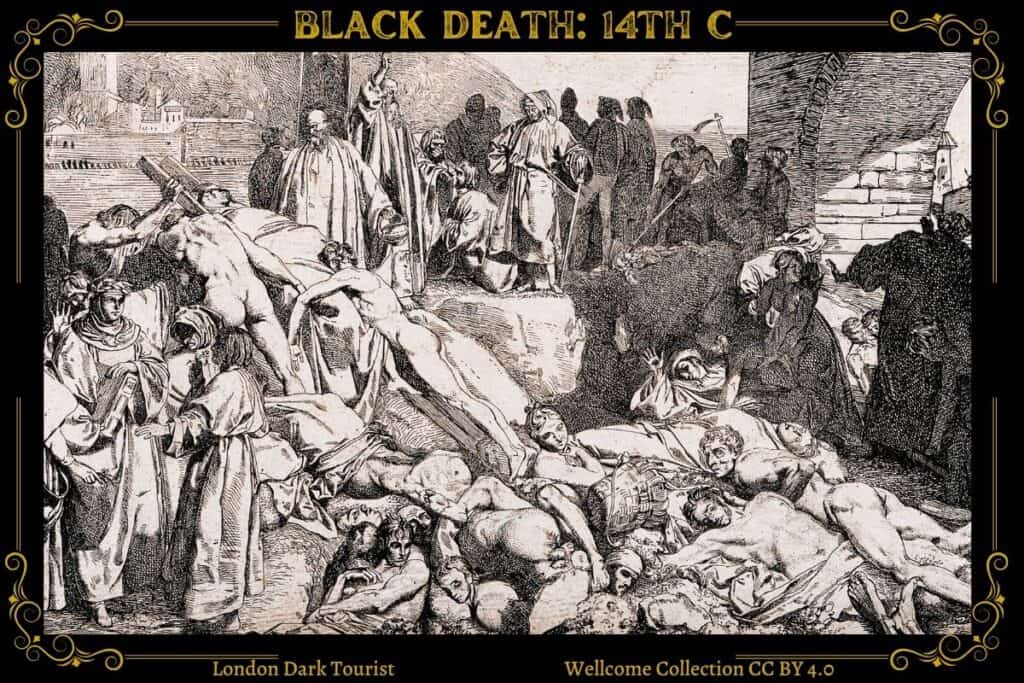
When the bubonic plague swept Medieval London beginning in 1346, the nearby hospital was a natural place to care for the sick. But this plague was so brutal and so deadly that half of the entire population perished.
Anyone who died within the City of London – either in hospital or elsewhere – was taken outside the city gates (maybe as an attempt at controlling infections, though the contagion of the bubonic plague was not understood at the time).
What was right next to the hospital AND right outside the city gates? What is now Charterhouse Square.
It was an empty plot of land, so the corpses were piled into a mass grave.
1371: London Charterhouse Founded

The Charterhouse was founded as a Carthusian (Catholic) priory in 1371.
Not much is known about this period in its history – only that it was developed as a priory for Catholic monks and lay next to – and maybe on top of – a massive plague pit.
It seems the priory went along the next few hundred years without many issues. But big changes were coming to all religious institutions when Henry VIII came to the throne in the 16th century!
1500s: Charterhouse London & The Reformation
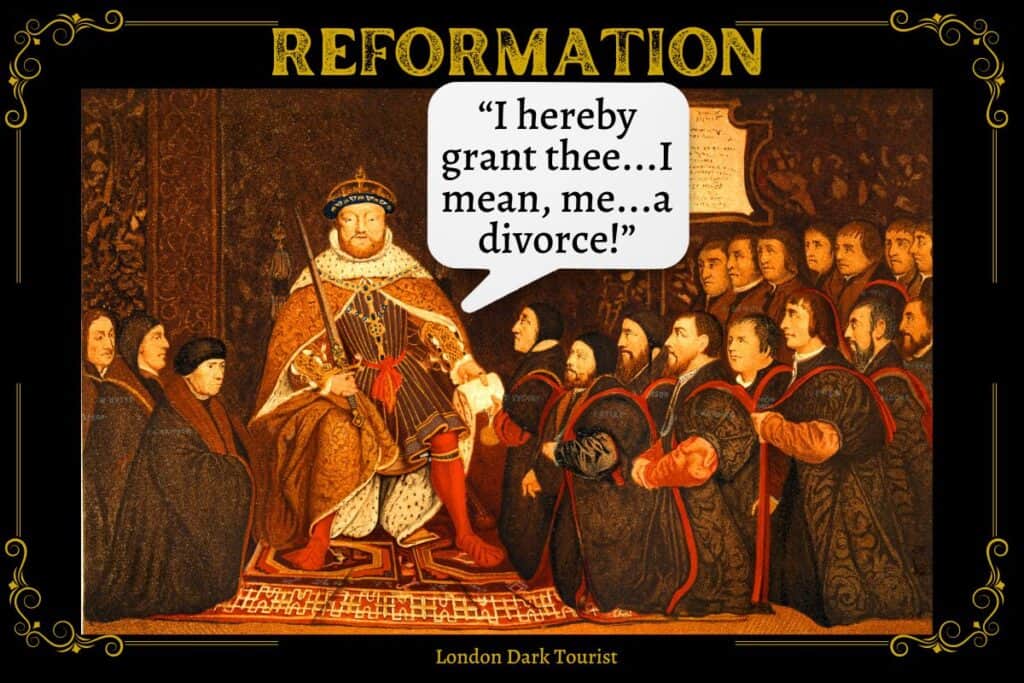
If you’re not privy to what the Protestant Reformation was, here’s a TLDR: a Catholic priest named Martin Luther started calling the massively powerful Roman Catholic church out on its bullshit, and the movement gained steam throughout Europe.
Back in England, Henry VIII, who wanted a divorce, couldn’t be granted one under the current Pope. So what did Henry do? He took advantage of the current social movement and formed his own Protestant church called the Church of England.
Naturally, he made himself the head of his own church so he could grant his own divorce. And then he demanded all Catholic institutions be dissolved and plundered to fill the royal coffers.
As a result, all Roman Catholic organizations in England – including the priory at the London Charterhouse – were dissolved. But they didn’t go down without a fight.
1535: The Carthusian Martyrs’ Brutal Executions
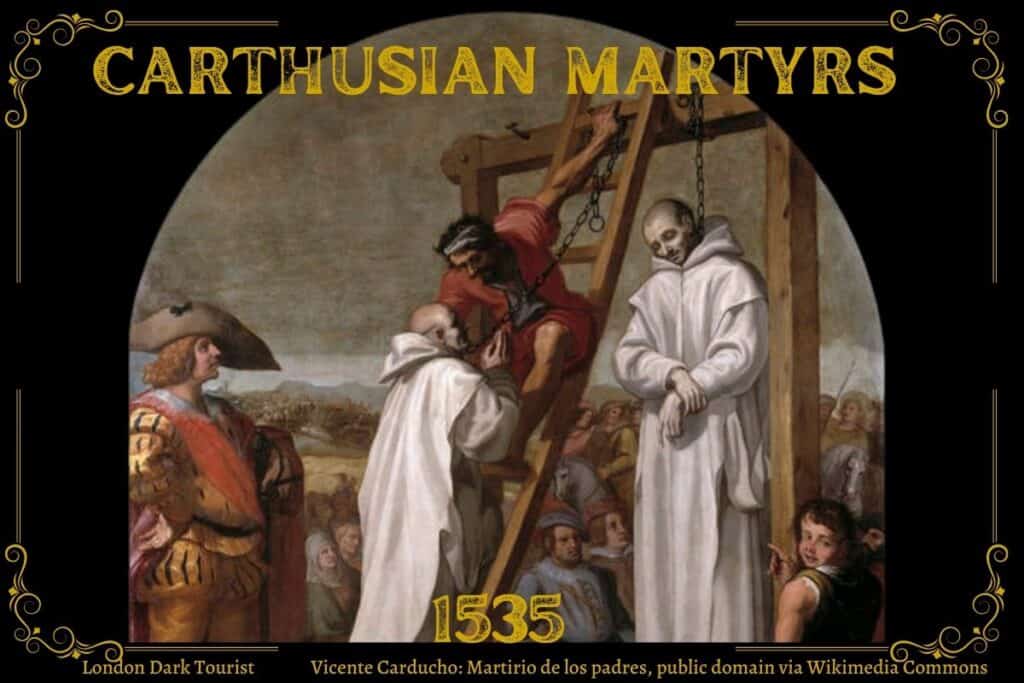
The monks of the London Charterhouse refused to bow down to Henry VIII as the head of the church. They believed that honor belonged to the Pope, and they didn’t want to convert to Protestantism.
The result was a series of brutal and ghastly executions.
The first three monks were hanged at Tyburn, and the second three were bound upright in chains for 13 days before being hung at Tyburn.
The next group were hanged in chains until they died. The fourth group were chained inside Newgate Prison, with some claimed by disease, some by starvation, and some by heatstroke.
There was a lone survivor of this group who had evaded capture, but he was finally apprehended and “made an example of.”
The final monk, John Houghton, was hanged at Tyburn, cut down while still alive, disemboweled, then quartered. His body parts were displayed throughout the city to remind citizens of Henry VIII’s power as the head of the church.
All of the monks of the London Charterhouse would become known as the “Carthusian Martyrs” because of their deaths in the name of religious belief.
Today, the street nearby bears their name: “Carthusian Street”.
16th Century: Charterhouse London After the Reformation

After the monks were executed, the Charterhouse was used by the monarchy for storage of Henry’s hunting equipment and other random royal necessities.
In 1545, it was bought by a private owner who demolished the church and turned it into a grand mansion house.
Over the next few decades it passed to another owner, the 4th Duke of Norfolk, Thomas Howard.
But, as all residents of the Charterhouse are seemingly cursed, Howard was soon imprisoned at the Tower of London for scheming to marry Mary Queen of Scots.
He was put under house arrest at the Charterhouse after his release from the Tower, and apparently got bored because he did a ton of renovations which forever changed the property.
Howard wasn’t destined to enjoy his elaborate home; new evidence came to light and he was executed in 1571 by beheading at the Tower Hill.
It’s said that on some dark nights inside the Charterhouse, you can see his ghost ascending the grand staircase, head in hand.
1600s: Thomas Sutton Establishes School, Hospital & Almshouse

In a turn of fortune, the next owner of the Charterhouse was a wealthy philanthropist. Thomas Sutton made his fortune in coal, and purchased the Charterhouse.
In his will, he bequeathed funding to establish and maintain a school, hospital and almshouse on site.
Finally, some good news for the Charterhouse occupants! All endeavors flourished with this new scheme.
The Charterhouse School became a well-regarded institution, the hospital was known for excellent care, and the almshouse supported up to 80 male pensioners.
Modern Day: Bodies Discovered Inside
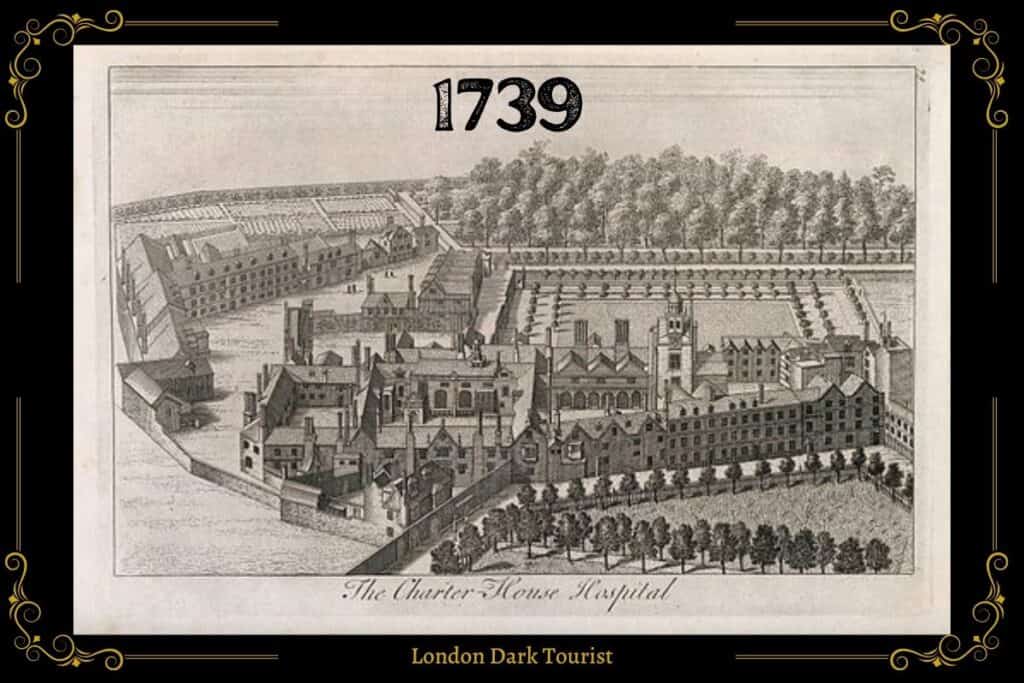
From the 17th century until the 20th century, the Charterhouse served its intended purpose. It functioned for centuries as a helping hand in the community.
Though it was damaged by bombs in WWII, it was meticulously restored and rebuilt.
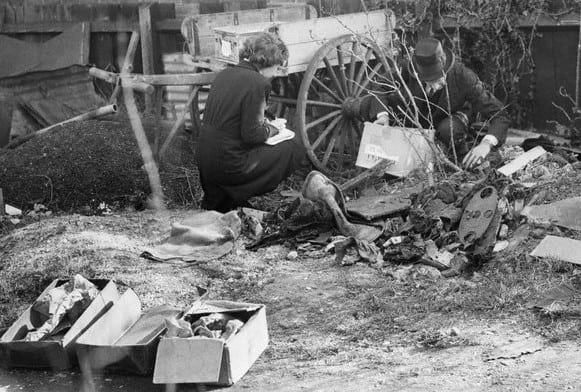
During that restoration, some archaeological work was carried out. Workers discovered a lead coffin in the altar which contained the remains of the priory founder – Walter De Manny – from the 1370s.
This discovery was vital in understanding the early history of the Charterhouse and its founding.
2014: Discovery of the Charterhouse Square Plague Pits

In 2014 while digging through Central London for the Crossrail Project, workers discovered something a bit larger than one lead-sealed coffin.
Beneath the earth of Charterhouse Square, 13 skeletons were uncovered. DNA and other analysis revealed they were from the 1300s, and all contained the pathogen that caused the Black Death.
Although only 13 skeletons were unearthed, it’s estimated that as many as 50,000 bodies were buried here in the 14th century alone.
Though records had always told us that there was a plague pit in this location, the sheer size of it and number of bodies had never been known.
In this same time of the construction of the Elizabeth line, other plague pits were uncovered, the research undertaken has given historians vital clues to what this period in London’s history was really like.
London Charterhouse & Charterhouse Square Today
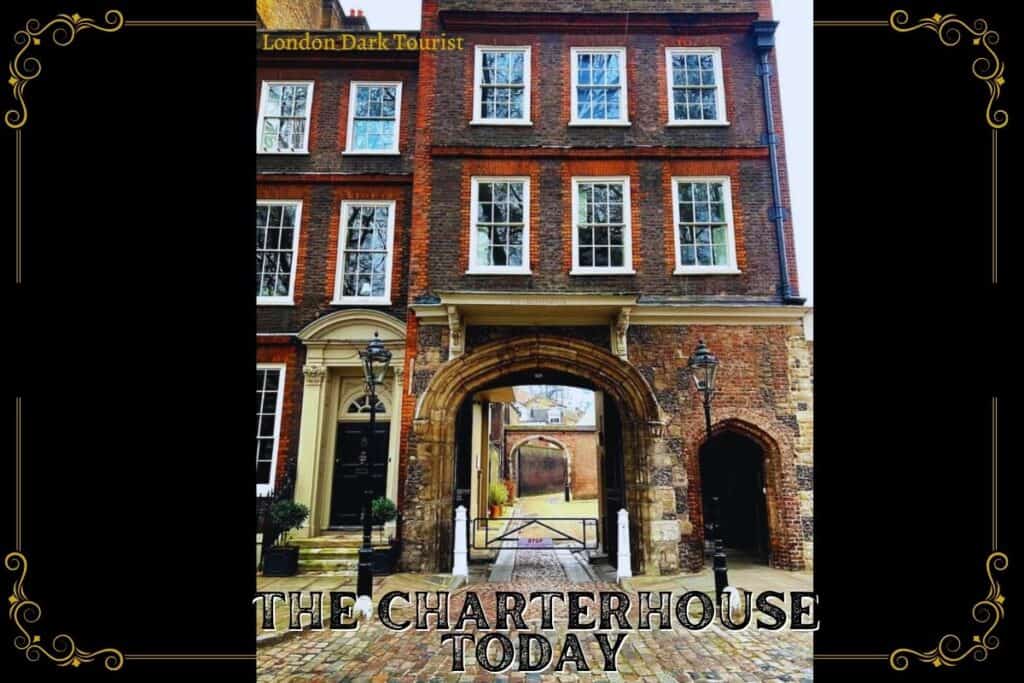
The open land surrounding the Charterhouse–Charterhouse Square– is remarkable because since those burials, that particular piece of land has never been built on.
Charterhouse buildings remained, and London has modernized all around this area. But if you were to X-ray this open field, you’d see bodies upon bodies, stacked in three layers from the 14th to 15th centuries.
2017: Charterhouse Museum
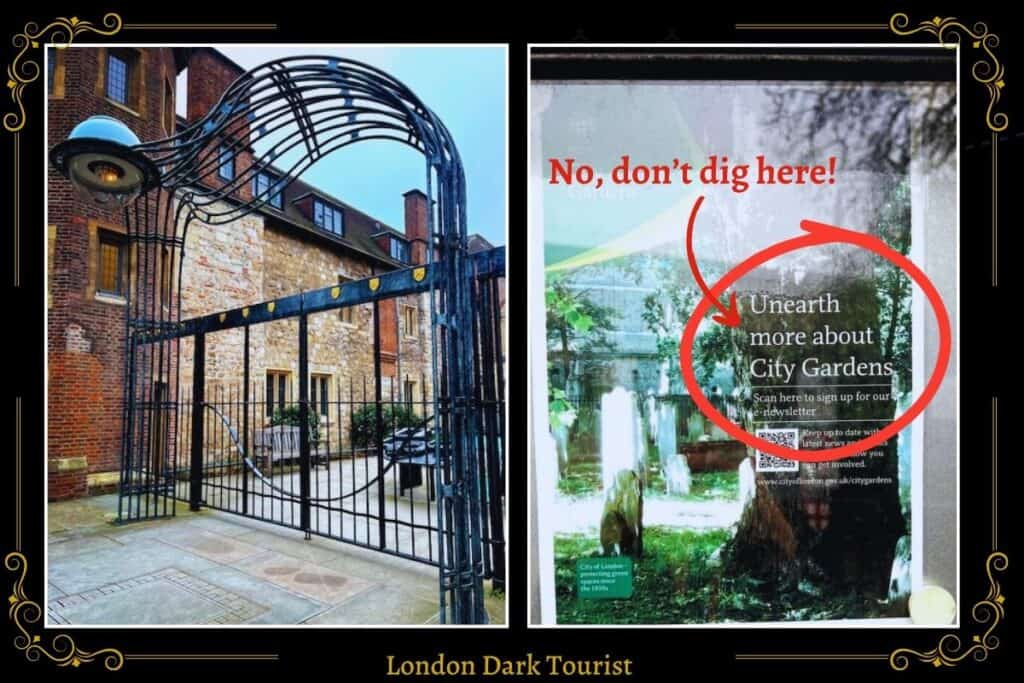
Today you can go inside the Charterhouse Museum (opened to the public in 2017) to see glimpses of the past and learn more about its incredible history.
Some parts of the Charterhouse complex remarkably still operate in their intended way, as there is still a pensioner housing scheme on site.
The hospital is gone, and the school is no more, but the legacy of the Charterhouse, and all of its history, lives on in this little corner of London.
Charterhouse Hauntings
You may not be surprised to hear that the most commonly sighted spirit at the Charterhouse is that of a monk. He floats across the Square and into the buildings, silently in flowing robes.
Is it the spirit of the monk whose corpse they found inside the lead coffin? No one knows.
Another commonly seen spectre is the headless form of Thomas Howard – remember, that guy who tried to marry Mary Queen of Scots, then lost his head?
Howard is apparently still here, and gets upset at renovations, since he was the one who redid the whole place while on house arrest.
Charterhouse Square is very spooky at night, and it’s a great place to visit on a London ghost hunt.
Pay homage to all those lost over the centuries at this storied place, and you might come away with a Charterhouse story of your own!
Visit my map to find all of the forgotten burial grounds of London. You may be walking on one right now.
More on London History and Crime
The Workhouse Howl & 13 Other Devastating Facts on Life in the Workhouse
10 Rillington Place Today: Notorious Murder House Then & Now
Secrets of a Serial Killer: Uncovering the Truth About John Reginald Christie
What’s the Oldest Pub in London? 13 Curious Contenders
Gross Jobs in the 1800s: 10 Dirty and Dangerous Victorian Jobs
Bricks to Burberry: The 7 Worst Areas in London that are Now Super Posh
10 Ghastly Royal Deaths and What Happened to Their Corpses
Temple Bar London: Why did this London City Gate Sport Rotting Heads on Top?
What are the Most Haunted Hotels in London? Here are 14 of the Spookiest
13 Famous Victorian Prisons of the Past: Shackles, Plague and Daring Escapes
London Necropolis Railway: 6 Shilling Ghost Train to the Afterlife
8 Quid for a Grave-Robbed Corpse: How the London Burkers Turned to Murder
The Moorgate Tube Crash: Why Did 43 People Lose Their Lives?