
10 Rillington Place Today: Notorious Murder House Then & Now
10 Rillington Place today looks very different than the 10 Rillington Place of 1953, when 8 bodies were found hidden in and around the notorious London house.
Serial killer John Christie lived and murdered his victims here for a 10 year stretch between 1943 and 1953.
What happened to the notorious murder house in Notting Hill, and what does it look like today?
Let’s look at a Rillington Place map then and now, and see exactly what the Rillington Place crime scene looks like in 2024.

Read my recap of all the murders of John Christie here.
John Christie & the Rillington Place Crime Scene
How did this property become so stigmatized that they had to tear it down? It began with a man named John Christie, a notorious post-war serial killer.
He lived in the property with his wife Ethel – who may or may not have known about her husband’s dirty deeds – and would go on to kill and bury her and 7 others inside and around the home.
Rillington Place Crime Scene Photos: Where Victims’ Bodies Were Found

In 1953, 10 Rillington Place was a standard London terraced home divided into flats.
John Christie and his wife took up the main floor, and various tenants occupied the top floor.

There was no part of this property that was untouched by John Christie’s psychopathy and brutal acts.
John Christie took full advantage of every hidden nook and cranny of the property to hide the bodies of his victims.
Living Room

The body of his wife Ethel was found under the floorboards of the front room. Christie had murdered her a year before she was discovered.
How the smell of decomposition didn’t alert the authorities is a mystery.
Kitchen

Hidden in a false wall in a kitchen alcove, three more bodies were discovered:
- Rita Nelson, 25 (killed 19 January 1953)
- Kathleen Maloney, 26 (killed February 1953)
- Hectorina MacLennan, 26 (killed 6 March 1953)
Back Garden
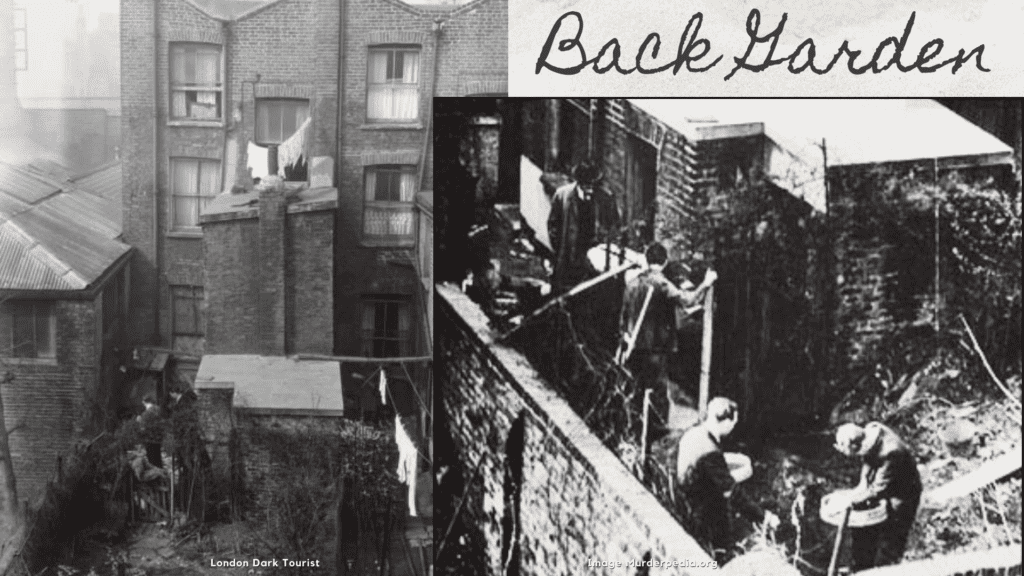
Before it was discovered that Christie had murdered numerous people, he was also suspected of murdering his upstairs neighbors: Beryl Evans and her baby daughter Geraldine Evans.
Their bodies were discovered in 1950 in the back garden washhouse (the small roofed structure off the back of the house pictured above).
But in 1950, Beryl’s husband Timothy Evans was tried, convicted, and hanged for the murders.
It wasn’t until 2014 that Timothy Evans was legally pardoned and the real killer – John Christie – was formally recognized as their true killer.
After Christie was caught, two more bodies were found in the back garden:
- Ruth Fuerst, 21 (killed 24 August 1943)
- Muriel Eady, 31 (killed 7 October 1944)
Ruth and Muriel were thought to be Christie’s first victims, though we’ll likely never know if Christie murdered before that.
Rillington Place Crime Scene Demolition
After the murders, the council renamed the street Ruston Close in 1954, but the house still stood.
Given the stigma of the property, the council finally decided to demolish 10 Rillington Place in the 1970s.
But the council couldn’t stop there, because if they didn’t rename the street, then “Rillington Place” (even though it was now called “Ruston Close”) would always exist as a physical location.
To understand why they worked so hard to overcome the stigma of this particular property – when other famous murder houses aren’t touched – we have to understand the history of the area.
Rillington Place Map: Notting Hill in the 1950s

In Charles Booth’s Poverty Maps from the late 1800s, we can see that where Rillington Place sat was not the posh area that Notting Hill is today.
The dark red surrounding Rillington Place (left) denotes a “mixed” area, with some poor and some getting by. The dark blue nearby is worse off, with “poor” and “very poor” areas.
John Christie used his location to his advantage, preying on young women who were either pursuing sex work or in need of an abortion.
This history and later redevelopment helped propel Notting Hill to what it is today.
The council purposefully tried to gentrify the area, both to quash the stigma that John Christie brought to the neighborhood, and to attract more wealthy residents to Notting Hill.
Rillington Place Map Today
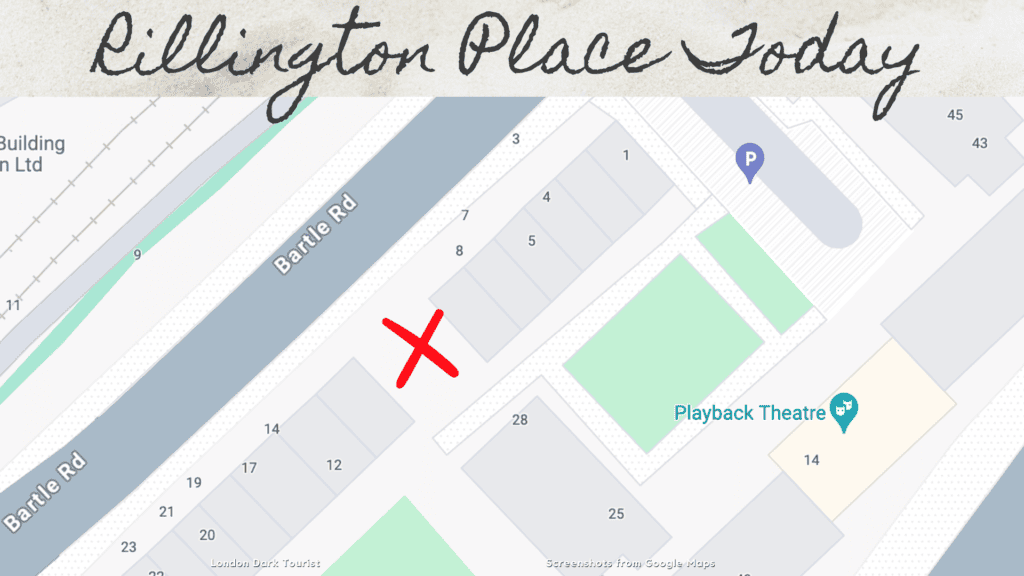
Today, Rillington Place doesn’t exist. But Bartle Road does, and it lies in the now-posh neighborhood of Notting Hill.
Flats along this street can sell for anywhere from £350k to over a million, a far cry from the impoverished area that it once was.
10 Rillington Place Today Doesn’t Exist
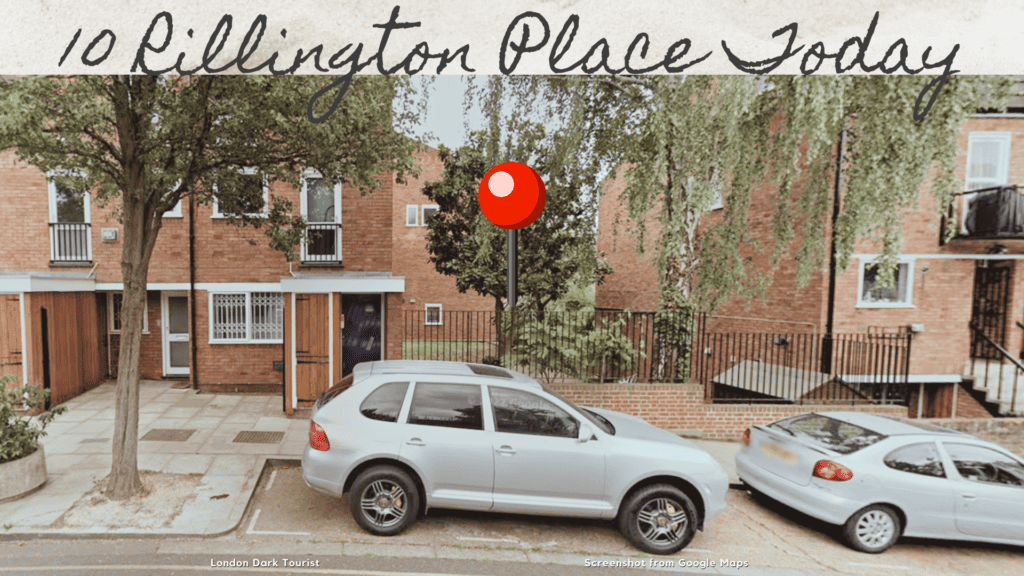
If you’re a dark tourist like me and want to visit the real 10 Rillington Place, you absolutely can, but the house itself doesn’t exist anymore.
The space where 10 Rillington Place stood was never built upon, but was instead turned into a memorial garden.
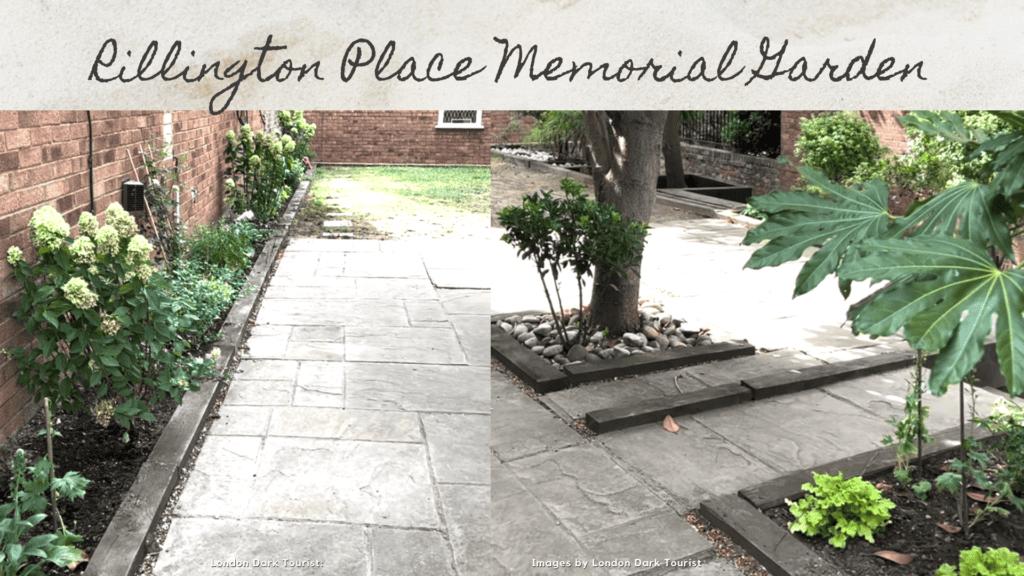
This is a lovely little memorial garden, though it is private only for the residents of the surrounding homes.
I think it’s fitting that this land was never built upon again – much like many other mass graves in London. Nothing can bring back the victims, but it is a mark of respect that this land was left as a beautiful green space, and not paved over with housing.
It it haunted, though? Probably.

If you do visit the former location of 10 Rillington Place, a few things to keep in mind:
- The garden is private, and the homes surrounding it are private residences. Please be respectful.
- Remember John Christie’s victims here. Yes, it used to be a grisly crime scene. But let’s not glorify the killer; instead remember the poor souls he took.
10 Rillington Place Today: Final Thoughts

This is one of the most devastating and harrowing stories in London history. If you want to go pay your respects to John Christie’s victims, the memorial garden is a touching place to see.
Standing on this street, it’s hard to image what it would have been like in the 1950s: crowded with families, laundry drying on the lines, children playing in the street.
Notting Hill today is nothing like post-war Notting Hill. But one good thing has come from the gentrification of London and the passage of time: horrible crimes like John Christie’s are harder to perpetrate.
Policing is more advanced, neighbors are more cautious and eagle-eyed, and women have more options for independence from men.
Had Ethel had more opportunities, and if all the other victims had access to assistance and medical care, they may not have fallen victim to this sick man.
Rest in peace, sweet souls of Rillington Place. We remember you.
And John Christie, I hope you’re treated in the afterlife exactly how you treated others in this one.
More on London’s Dark History
Delia Balmer’s Story: Her Miraculous Survival of John Sweeney
The Workhouse Howl & 13 Other Devastating Facts on Life in the Workhouse
Kray Walking Tour of East London: 7 Free Spots You Can See Today
London Serial Killers: 11 Documentaries on YouTube to Watch Now
What’s the Oldest Pub in London? 13 Curious Contenders
Gross Jobs in the 1800s: 10 Dirty and Dangerous Victorian Jobs
Bricks to Burberry: The 7 Worst Areas in London that are Now Super Posh
10 Ghastly Royal Deaths and What Happened to Their Corpses
London Charterhouse Square: Are There 50,000 Bodies Buried in this Lovely Garden?
Temple Bar London: Why did this London City Gate Sport Rotting Heads on Top?
Rillington Place FAQ
What happened to the women at 10 Rillington Place?
Serial Killer John Christie lured women to his London flat, gassed them, and then assaulted and strangled them. Their bodies were left in hidden compartments in and around the house.
Was 10 Rillington Place filmed in the actual house?
No. 10 Rillington Place doesn’t exist anymore, and the TV series was filmed both on sound stages and in other terraced homes made to look like the original.
What part of London was Rillington Place?
Rillington Place was in Notting Hill, but it was nothing like the posh Notting Hill of today. It was only after the murders that Notting Hill became gentrified, and the house was torn down and streets renamed.
What does Rillington Place look like now?
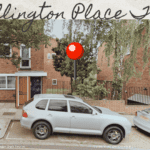
10 Rillington Place is now a beautiful memorial garden. The land on which the former house stood has never been built upon, though new blocks of flats surround the garden.
What happened to John Christie?
Christie was finally apprehended in 1953 and charged with the murder of his wife. He was convicted and later hanged at HMP Pentonville. He was never convicted for his other crimes.
Was John Christie a police officer?
For a short time, John Christie worked as a clerk for the Metropolitan Police, but he didn’t hold the position for long. He was fired for theft.
How was John Christie caught?
Christie wasn’t caught until he decided to move out of 10 Rillington Place in 1953. New tenants discovered the bodies in the kitchen alcove, and then all of Christie’s dark deeds came to light.


