
11 Of The London Natural History Museum Haunted Secrets
Is the London Natural History Museum haunted?
Of course! This is London, after all, where you can’t walk 20 paces without passing some sort of macabre and spooky history.
Though it may not be as notoriously haunted as The British Museum and its cursed mummy, the London Natural History Museum ghosts are just as plentiful.
Let’s go through the history of the building, the objects inside, and some of the spirits who like to hang out here.

During my research, I was lucky enough to be able to speak with an employee of the museum, who gave me the lowdown on the building’s haunted histories.
Although my friend chose to remain anonymous, these ghostly stories are indeed accounts from an insider who knows a lot about this location and its artifacts.
London Natural History Museum Ghosts: The Famous Spectres Who Haunt the Halls
There are several famous men who are said to haunt the hallowed halls of the Natural History Museum.
Here are a few of the most notable, and the connections they had to the museum in life.
1. The Problematic Founder: The Spirit of Sir Richard Owen

The Natural History Museum was founded by Sir Richard Owen (1804-1892), one of the world’s first palaeontologists. But he wasn’t well-regarded.
Sure, he coined the term “dinosaur” and established the museum, but he was known as a “social experimenter with a penchant for sadism…addicted to controversy and driven by arrogance and jealousy”.
He also liked collecting human specimens like severed heads of dead prisoners – he wasn’t exactly a charming guy.
It is because of him, however, that we have this incredible museum. He was dissatisfied with the British Museum’s lack of space for specimens of the natural world, and campaigned for an entirely new museum to be purpose built.
He didn’t exactly do it politely. He was known to steal credit from colleagues, pick fights with Darwin, and basically dismiss and demean anyone who disagreed with him.
But he’s also one of the most famous London Natural History Museum ghosts.
Workers have seen him roaming the halls (he likes the dinosaur galleries, naturally), inspecting his specimens with an arrogant and angry air about him.
His stern spectre with long, white hair often appears when things are being moved around and rearranged at the museum, as if he still thinks he’s in charge.
2. Is the Natural History Museum London Haunted by a Slave Trade Profiteer?
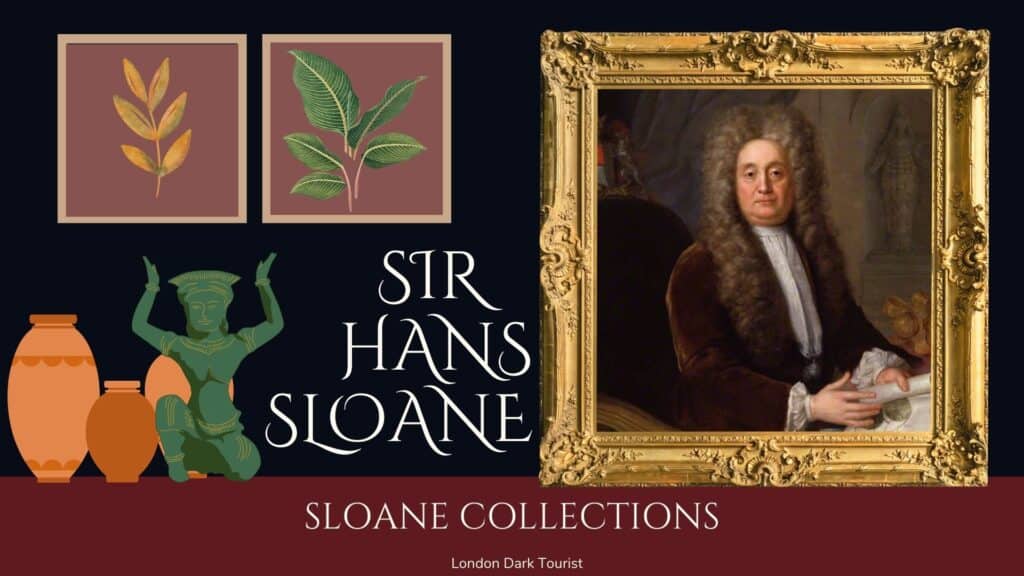
Going back to the very origins of the museum and its objects, you’ll run straight into another problematic historical figure: Sir Hans Sloane.
Sloane was a Northern Irish doctor fascinated with the natural world, and he was fortunate enough to travel extensively while employed as a private physician.
In 1687 he travelled to Jamaica with his boss, a Duke who happened to be the newly-appointed governor of Jamaica (at the time, an English colony).
What else was happening in Jamaica at the time? The transatlantic slave trade, where enslaved Africans were brought to Jamaica to perform manual labour.
Fascinated with the island, Sloane began collecting specimens. But he didn’t know what he was looking at; he relied on enslaved peoples to help him find, collect, and understand his specimens.
He also “collected” slave’s cultural artefacts and brought them back to Britain in 1689, where he catalogued his entire collection.
The slave trade enabled his collecting, both from profits (he married a wealthy slave trade heiress) and through infrastructure. He used slave ships, traders and surgeons to collect and transport his vast collection of objects.
After his death in 1753, his will stipulated that his collection should be put on public display. Public funds were used to buy the collection, and that’s how the British Museum came to be.
Later in 1880, after the Natural History Museum was founded, collections at the British Museum were split between the two. Many of his objects were transferred to the Natural History Museum, where you can still see them today.
The spirit of Sloane is said to make an appearance in The Sloane Herbarium, where his namesake collection now resides.
He’s a gentler spirit than Owen, but also doesn’t like when his things are moved around and rearranged.
3. London Natural History Museum Building Ghosts: The Designer Who Died

An architect called Francis Fowke – known for designing the V&A and Royal Albert Hall – won the contest to design the new Natural History Museum in 1865. But he wouldn’t live to complete the building.
He died suddenly after he won the contract, and work was taken over by Alfred Waterhouse.
The spectre of Fowke has been seen wandering the vast halls and exhibits, examining the architectural features and watching visitors from the balcony.
Is his spirit not over the missed opportunity and his unfortunate end?
4. London Natural History Museum Building Ghosts: The Architect
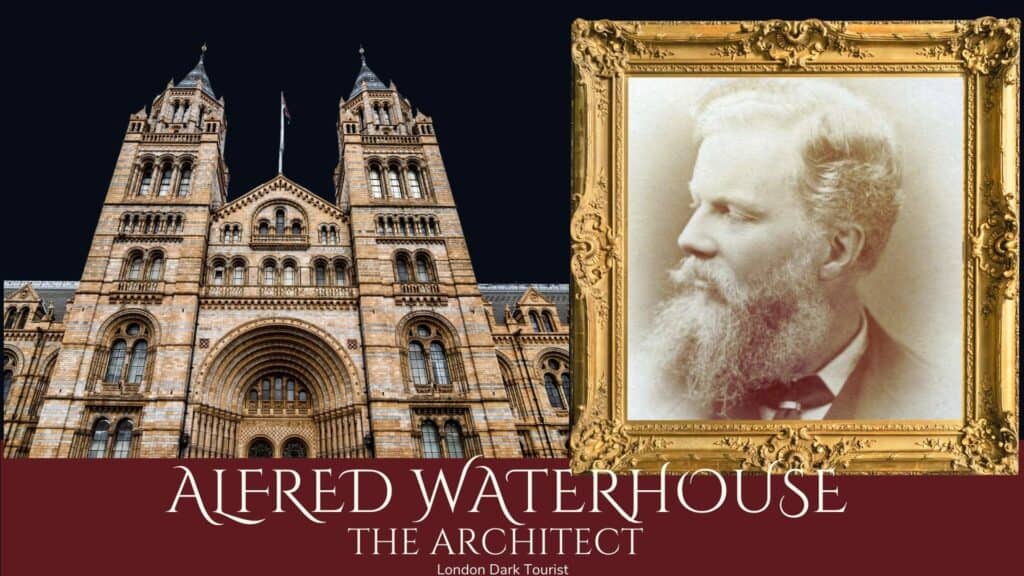
Perhaps the least problematic of all those involved with the foundations of the Natural History Museum is the man who actually ended up designing it: Alfred Waterhouse.
He was an esteemed and prolific architect, known for grand gothic-style buildings in Manchester and London. The Natural History Museum would go on to become his best-known building, and he was immensely proud of the finished project.
Visitors and workers at the museum have reported seeing his ghost in period clothing wandering the exhibits, looking up at the grand ceilings with his signature decorative elements, and admiring the building from the street after dark.
5. Darwin: The Most Famous Spirit of the London Natural History Museum Ghosts

You may not have heard of any of the spirits we’ve covered thus far, but you have definitely heard of Charles Darwin.
The museum holds the largest collection of Darwin’s works and specimens in the world, and his name was given to an entire wing of the museum: the Darwin Centre.
His distinctive apparition is said to wander the museum and admire his own works. Maybe he’s checking in on his specimens, or maybe he’s marvelling at how far science has come since his death in 1882.
He is buried at Westminster Abbey, where there have also been reports of his spirit haunting the halls.
You can pay your respects to this innovative and prolific scientist at his statue, which looms over the museum from the main staircase in Hintze Hall.
Natural History Museum London Haunted & Cursed Objects
The contents of the Natural History Museum is so large that only a small percentage of the objects are on display, and naturally, every object has a story.
Some of these exhibits have such an incredible history that they are said to be “cursed” or “haunted.” Let’s go over the most infamous.
6. The Cursed Amethyst of the Natural History Museum

Since its theft from India in 1857, the so-called Cursed Amethyst or “Delhi Purple Sapphire” has brought misfortune to every single one of its owners.
Originally stolen by Colonel W. Ferris from the Temple of Indra in Kanpur, the gem quickly revealed its curse, leading to his financial ruin and poor health.
After his death, his son inherited the gem, and the same fate befell him!
The gem then passed to a family friend, who shortly thereafter committed suicide, adding to the cursed amethyst’s ominous legacy.
In 1890, writer and scientist Edward Heron-Allen acquired the stone, and soon began having bad luck. He gave it away to friends, but then his friends started having terrible, life-altering luck. They gave it back.
Heron-Allen then attempted to dispose of it in Regent’s Canal, but it was unexpectedly returned to him – a dealer had bought it from a dredger, and somehow returned it to its owner. Coincidence? Luck? Or curse?
He gave up trying to get rid of the gem and secured it in his bank vault inside no less than seven locked boxes. He died in 1943, and his will instructed that the gem should go to the Natural History Museum, along with other items in his collections.
The gem arrived at the museum with a letter, advising them to toss it in the ocean. Instead, the museum curators stashed it away in the museum vaults, where it stayed for several decades.
In 2007, the gem finally saw the light of day, and you can still see it displayed in The Vault Gallery. But the gem isn’t done yet.
Curator Richard Savin stated that everytime he attempted to move the gem, he’s been hit with monstrous storms and violent illness.
Do you dare look at the cursed amethyst?
7. The Winchcombe Meteorite
The oldest item in all of the museum’s collections is The Winchcombe Meteorite, which miraculously blazed down from the sky into Gloucestershire in 2021.
How old, you ask? 4.5 BILLION years. But that’s not the only incredible thing about it.
It also landed in the UK – where it’s super rare to receive meteorites – AND it’s a super rare type of meteorite.
Visitors to the museum have said that this particular rock has a strange, otherworldly energy about it. And it is, most definitely, from another world!
Who knows what kind of extraterrestrial energy may be attached to this object?
8. Guy the Gorilla
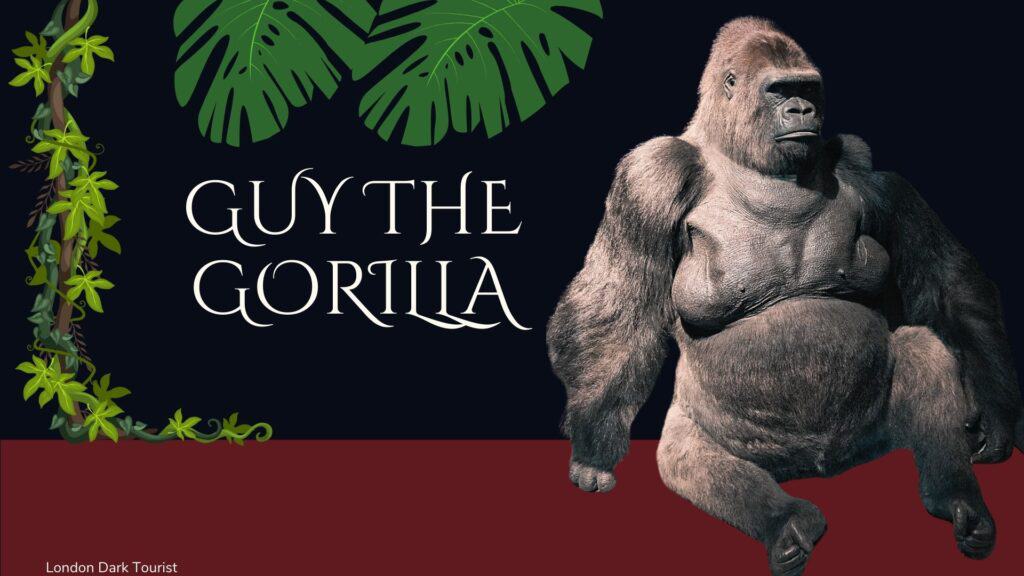
Exploring the upper floors of the museum, you can’t miss the massive stuffed specimen of Guy the Gorilla.
Captive in the London Zoo since 1947, Guy is named after the night he arrived there – Guy Fawkes Night.
On that night, he wouldn’t go to sleep with scary fireworks being set off all over the Capital. He finally fell asleep when a zookeeper snuggled up to him to help him calm down.
Guy was known as a gentle and loving gorilla, and was particularly attached to his keepers. After his death during surgery, he was painstakingly taxidermied and put on display at the museum.
Museum workers say that his eyes will follow you as you pass – he may be searching for his beloved zookeepers. There have even been stories of noises coming from his display in the night, which sound like primate cries of anguish.
Poor Guy the Gorilla – he’s lonely! If you visit the museum, go spend some time with Guy.
9. The Gibraltar Skull
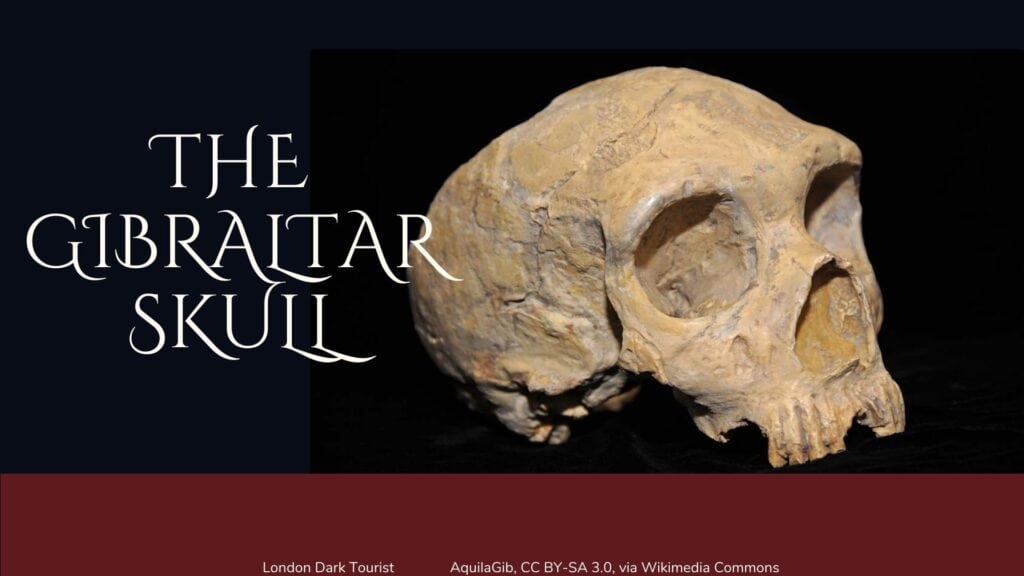
In the Human Evolution exhibit, you’ll notice a very, very old human-like skull.
This particular specimen was discovered in Gibraltar in 1864 and was partially responsible for the naming of a new species: Homo neanderthalensis. Or, as we call them today: neanderthals.
It’s between 45,000 and 70,000 years old, and was the very first human evolutionary specimen that Darwin studied in The Origin of Species.
The skull is said to have a negative energy, as described by workers and visitors to the museum. In the night – just as in the film Night at the Museum – it’s said that sometimes you can hear primitive noises that sound like a human imitating an animal.
Does the Gibraltar skull haunt the Natural History Museum?
10. The Tower of London’s Barbary Lion Skull

In the Treasures Gallery, you’ll find two fierce-looking big cat skulls. They belonged to animals held captive at the (haunted) Tower of London over 700 years ago!
From the 1200s to 1835, the Tower was home to polar bears, leopards, an African Elephant, and more. It served as a mark of power for the monarch to have such exotic pets.
In 1937, while digging around the Tower’s moat, workers were flabbergasted to uncover two barbary lion skulls that were very well-preserved.
Later carbon dating and DNA testing revealed that the specimens were both purebred Barbary Lions, but they didn’t live during the same era.
The first skull was dated from 1420 and 1480, and the second lived between 1280 and 1385. There were likely more lions around than we have records of, and they were likely bred at the Tower.
The saddest part? Both specimens were shown to be malnourished and in bad health. One even had a spinal cord deformity due to poor nutrition during development.
It’s not terribly surprising, as the animals kept in the Tower of London menagerie would have been for display purposes. Their keepers likely didn’t know how to care for such exotic creatures.
Since the Tower is definitely the most haunted place in London, it’s no surprise that these skulls are said to have some supernatural powers. Psychics visiting the museum say that the skull gives off an energy of suffering and confusion.
But in the night, their roars are said to come alive, echoing through the halls while the night watchman keeps an eye on their displays.
Would you survive a night at the museum where ghostly lions roar?
11. Archie the Giant Squid

In the murky depths of the museum lurk creatures from the deep ocean. The most famous of these is Archie the Giant Squid, who is kept in the Spirits Room.
No, it’s not that kind of spirits room, though it’s a fitting name. This is a space only accessible by pre-arranged tours where sea creatures and other animals are preserved in spirits (alcohol).
The largest and most intriguing specimen – with his own giant tank – is Archie. He’s a giant squid who was caught and donated to the museum.
He’s a whopping 8.6 metres (28 feet) long and his tank is so heavy that the floor had to be reinforced.
The Spirit Room itself is said to hold much more than alcoholic spirits. Some workers refuse to enter at night, as a ghostly presence is said to watch over the room.
Some specimens, it’s said, seem to move inside their liquid preservatives of their own volition, and you’ll catch them out of the corner of your eye.
Would you dare enter the Spirit Room after dark?
London Natural History Museum Haunted Stories: Final Thoughts
With such a prolific history inside and outside of its walls, it’s no surprise that the Natural History Museum has some hauntings.
If you’re soon visiting London, this is a museum not to be missed. Say hello to the spirits of the museum, and remember to go hang out with Guy the Gorilla, who just needs some love in the afterlife.
Have you been to the museum and felt a strange energy there? I want to hear your story! Email me at Jen (at) London Dark Tourist (dot) com.
More on Haunted London
Your Ultimate Guide to Dark Tourism in London: 100+ Spookiest Spots
Masterlist: 66+ Haunted Places in London to See Today
What are the Most Haunted Hotels in London? Here are 14 of the Spookiest
13 Famous Victorian Prisons of the Past: Shackles, Plague and Daring Escapes
Spooky Specters: 21 Ghosts of the Tower of London
10 Ghastly Royal Deaths and What Happened to Their Corpses
London Charterhouse Square: Are There 50,000 Bodies Buried in this Lovely Garden?
Temple Bar London: Why did this London City Gate Sport Rotting Heads on Top?
10 Rillington Place Today: Notorious Murder House Then & Now


