
Martha Tabram: Her Mysterious Life & Devastating Death
Martha Tabram was just like all the rest of the notorious Jack the Ripper Victims – she was poor, living a hard life, addicted to alcohol, and pursuing sex work to survive.
Her murder was committed just a few weeks before the first canonical Jack the Ripper victim Polly Nichols.
But was she a victim of the Ripper, or another unknown killer?
Her death is just as mysterious as her life.

Martha Tabram’s Early Life & Marriage

Born 10 May 1849 in Southwark, Martha Tabram was born Martha White. The youngest child of warehouseman Charles Samuel White and his wife, Elisabeth Dowsett, she lived with 4 other siblings in a small house south of the Thames.
In 1865, when Martha was just 16, her father suddenly abandoned the family then died. This would leave Martha looking for the support and love of a man for the rest of her life.
In her teens, she met and moved in with Henry Samuel Tabram, a former furniture packer and laborer 13 years older than her.
Henry was a teetotaler, and disapproved of Martha drinking alcohol. But she drank anyway.
In 1869, the couple married in Trinity Church in Southwark, and moved to a house only a few houses down from where she grew up.
They had two children: Frederick Tabram, born in 1871, and Charles Tabram, born in 1872.
After her children were born, Martha’s drinking grew worse and worse. In 1875, her husband left her because of it. The children stayed with their father.
Martha Tabram: On Her Own

Martha claimed desertion with the courts, and Henry agreed to pay her a weekly maintenance allowance of 12 shillings.
In modern money, this would equate to about £39 per week – not nearly enough for lodging alone.
Martha quickly learned to top up her income with sex work, and made just enough to get by day to day.
But when her estranged husband learned of her new job, he then reduced his payments to two shillings and sixpence, the equivalent of £8 per week. Martha was in dire straits.
She met a man in 1879, William Turner, and they quickly formed a relationship and moved in together. This could have been a romantic affair, but more likely, they needed one another to get by.
When her estranged husband learned she was living with another man, he stopped his support payments altogether.
Martha Tabram Moves to Whitechapel

In the 10 years that Martha remained with William, they began moving closer and closer to the East End. They were transient, never staying in one place for long, alternating between common lodging houses and rented rooms.
Though William was trained as a carpenter, he was having trouble finding work. Martha worked in the sex trade at night, and they both worked as hawkers during the day, selling cheap trinkets to passersby on the street.
At this time, people knew her as Martha Turner, and she and William were as good as married.
But her drinking only grew worse, and she frequented pubs around the East End and the City of London, including the Ten Bells, The White Hart, and Hoop & Grapes, and more.
In March 1888, Martha rented a room at 4 Star Place, Star Street, off Commercial Road. William would sometimes stay there with her, but if she was too drunk, he would leave her on her own.
By July, she left Star Place without paying back rent for the room.
She moved to 19 George Street, Spitalfields (now Lolesworth Close). This is just across the street from Mary Jane Kelly’s lodgings where she was murdered not months later.
Their Last Meeting: The Aldgate Pump

William last saw his partner alive on August 4th, 1988, next to the Aldgate Pump in the City of London.
They talked for about 20 minutes, and he gave her some money so she could buy new inventory for hawking. They said goodbye.
The following Monday, August 6, Martha would be dead.
William wouldn’t even know of her death until a week later.
Martha Tabram’s Movements: August 6, 1888

That bank holiday weekend was wet, with several London streets flooded.
It’s not known what Martha did that day, but that evening she met up with fellow sex worker Mary Anne Connolly, aka “Pearly Poll”.
“Pearly Poll” is an interesting character in this narrative. She knew Martha not by her real name, but by the name “Emma.” None of Martha’s other acquaintances knew of Poll, or knew that Martha was friends with her, so their connection is mysterious.
Her accounts of that night with Martha are similarly muddled. In some accounts, she said that they went out drinking at to one pub at 10 pm. In other accounts, she said they went to multiple pubs starting at 11 pm.
So where were they, and which pub did they go to? It’s all a little cloudy.
Last Confirmed Sighting

The last concrete sighting of Martha was by a family member, who spotted her outside the White Swan Pub on Whitechapel High Street around 11pm (the pub no longer exists today).
According to “Pearly Poll,” they met two soldiers whilst drinking in the pub, and we can assume it’s the White Swan by the family member’s account.
The soldiers reportedly bought them drinks, and after midnight, they left together, walking east along Whitechapel High Street.
George Yard Whitechapel

They separated at the entrance to George Yard (now Gunthorpe Street), where Martha and her soldier went into the alley, and Poll and her soldier went into the next (Angel Alley).
Neither alley was safe in the era, but George Yard had a devious reputation as one of the most dangerous in the East End.
George Yard Buildings

Toward the end of the yard sat “George Yard Buildings,” a tenement apartment block.
Sex workers were known to use the landings and corridors of this poverty-stricken apartment block for work, as the lanterns were extinguished at 11pm.
This made for a dark and private place to do business, tucked away from the hustle and bustle of the high street.
August 7, 1888: The Soldiers

Around 1:45 am, neighbors returned home from their bank holiday weekend and went back out again to get food. They saw nothing in the corridors, but it was very dark.
Around 2am, a police constable was patrolling his beat along Wentworth Street. At the entrance to George Yard, he encountered a soldier.
He remarked to the soldier that it was high time he returned to his barracks. The soldier replied he was waiting for a comrade, who was with a woman in the buildings.
The constable moved along.
Finding Martha Tabram’s Body
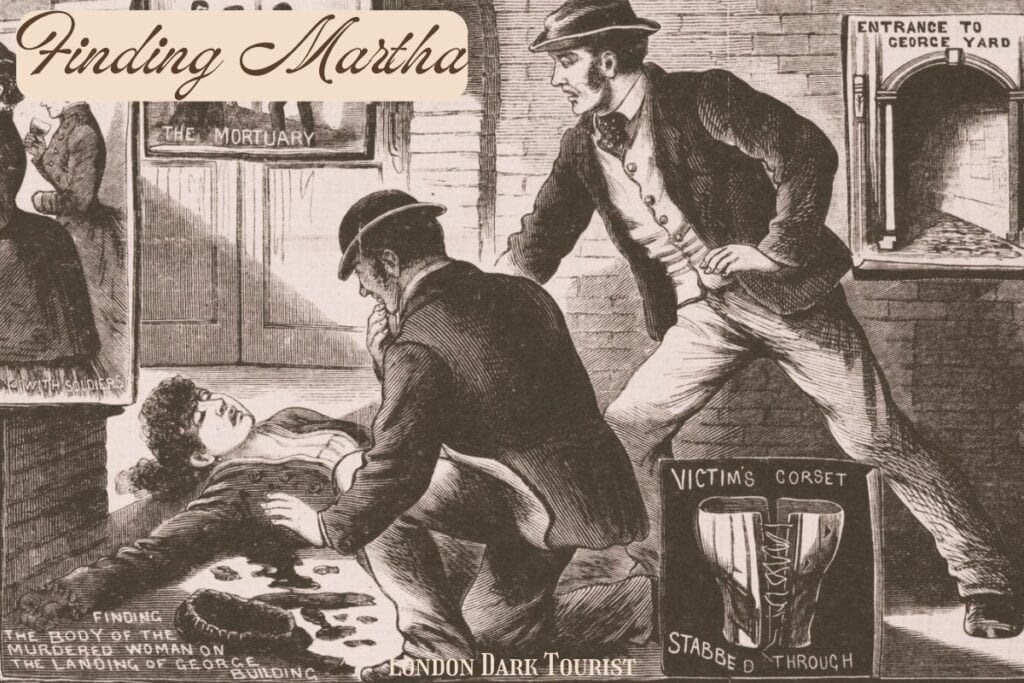
At 3:30am, a cab driver returned home to his apartment at George Yard Buildings. He noticed someone lying on the first floor landing.
This was a common occurrence to find people sleeping in the secluded spot, so he thought nothing of it.
At 4:45am, John Saunders Reeves headed for work at the docks. He saw Martha Tabram, lying on her back in a pool of blood on the first floor landing.
He immediately fetched the patrolling constable, who fetched a doctor.
Martha Tabram: The Crime Scene

The doctor immediately pronounced Martha dead, and recorded a whopping 39 stab wounds to her body.
Martha’s body was removed from the scene before it could be photographed or drawn.
She was taken to the mortuary at Whitechapel Workhouse Infirmary (there was no local mortuary for Whitechapel).
It was at the mortuary where the now-infamous photo of Martha’s body was taken. Police handed out the photo to police officers on their beats, in the hopes that someone could identify the murder victim.

In the following days, three witnesses came forward to identify the victim. But they all gave a different name for the deceased woman – and only one identified her as Martha Turner (also not Martha’s legal name).
Because they couldn’t figure out who the victim was, they ceased the investigation almost immediately.
They postponed the inquest, which likely let the perpetrator escape without capture.
Martha Tabram’s Body & Wounds
⚠️ ⚠️ ⚠️ TRIGGER WARNING ⚠️ ⚠️ ⚠️ : Graphic Descriptions Below
The Coroner’s report stated Martha had at least 39 stab wounds all over her body, including:
- 22 stab wounds to her trunk
- 17 in her breast
- 5 in the left lung
- 2 in the right lung
- 1 in the spleen
- 5 in the liver
- 6 in the stomach
- 1 in the vagina
- 9 in her throat
The report concluded that “death was due to hemorrhage and loss of blood.”
It noted that “sexual intercourse had not recently taken place,” but many reports state that she was raped with a large knife.
The injuries “seem to have been inflicted by a right-handed person, using a penknife; the stab wound to the heart might have been made by a dagger or bayonet by a left-handed person.”
The Investigation: Pearly Poll and The Soldiers

The police officer who had run into the soldier earlier on in the morning was taken to the Tower of London, where the soldiers were paraded before him. He could not identify who the soldier was.
“Pearly Poll” was also shown soldiers at two different barracks, but the men she selected had solid alibis.
This made police question everything that came out of her mouth, as her memory seemed faulty at best.
The investigation slowly ran out of leads, and the murder of Martha Tabram was classified as “murder by person or persons unknown.”
To this day it is unsolved.
Bank Holiday Murders or Jack the Ripper?

At this point in the investigation, there was only one murder of a sex worker recently in Whitechapel.
That was the brutal beating of Emma Smith, who was killed on April 4, 1888. Emma was not stabbed, so there was nothing to connect the M.O. of these two crimes together.
The two crimes came to be known as the “Bank Holiday Murders,” because they both occurred on a bank holiday monday. They were both brutal murders of sex workers in Whitechapel, but nothing else connected the two crimes at the time.

However, in hindsight, could these two could have been early works of Jack the Ripper?
Emma Smith and Martha Tabram both lived in George Street (not the same as George Yard or George Yard Buildings – that’s further south).
This is at the same block that Elizabeth Stride and Catherine Eddowes lived, and very close to where Mary Jane Kelly lived and was killed.
Tom Westcott, in his brilliant book The Bank Holiday Murders, posits that these two killings could have been the work of the notorious serial killer.
Remembering Martha Tabram

Martha Tabram’s gravesite is unknown. It’s likely she was buried in a communal grave somewhere in the East End, but the whereabouts of her remains will likely never come to light.
Whether she was a victim of Jack the Ripper or not doesn’t matter in the grand scheme of things – she was a sex worker down on her luck who did not deserve her life to end.
Martha Tabram, I hope you are resting in peace. Men failed you, police failed you, and society failed you.
Wherever you are, I hope you have found peace, and are enjoying a pint somewhere in the great beyond.
Read More on Jack the Ripper:
7 Important Reasons Jack the Ripper Was Never Caught
Victim 1: Mary Anne “Polly” Nichols
Victim 5: Mary Jane Kelly 21 Curious Jack the Ripper Suspects
Sources
- The Bank Holiday Murders, by Tom Westcott
- The Five, by Hallie Rubenhold
- The Complete History of Jack the Ripper, by Philip Sugden
- The Ultimate Jack the Ripper Sourcebook, by Keith Skinner & Stewart Evans
- Dissecting Jack-the-Ripper: An Anatomy of Murder in the Metropolis by Elizabeth Hurren
- The Whitechapel Murders: The Case of Jack the Ripper, by W G Eckert
More on Spooky London
The Mysterious Story of the 1811 Ratcliffe Highway Murders
11 of the Natural History Museum London Haunted Secrets
Masterlist: 66+ Haunted Places in London to See Today
What are the Most Haunted Hotels in London? Here are 14 of the Spookiest
13 Famous Victorian Prisons of the Past: Shackles, Plague and Daring Escapes


