
Who Was Mary Jane Kelly? Her Mysterious Life & Horrific Death
We’re still in the violent year of 1888 in Whitechapel, and out of all the Jack the Ripper victims, we’re about to examine the worst murder of them all: Mary Jane Kelly.
So far we’ve learned of the lives and deaths of:
- Mary Anne Nichols, murdered on August 31st, 1888
- Annie Chapman, murdered on September 8th, 1888
- Elizabeth Stride, murdered on September 30th, 1888
- Catherine Eddowes, murdered on September 30th, 1888
Now we focus on the final victim, and the most horrible death imaginable: Mary Jane Kelly.
The murderer had been quiet for all of October, but as November came, he came back with a vengeance.

See my map for all of the East End locations associated with Jack the Ripper victims.
Who was Mary Jane Kelly?

The last of the “canonical five” Jack the Ripper victims, Mary Jane Kelly’s death has been examined and dissected ad-nauseum. But we know very little about her life.
The only things we know about her life are the tales she told others – there are no birth records matching her name in all of Europe. “Mary Jane Kelly” may not have even been her real name.
She told some friends that she was born in Limerick, Ireland. She told others she was from Cardiff, Wales.
Either way, she was roughly 25 at the time of her death, which makes her the youngest Ripper victim, and therefore born sometime around 1863.
She told various stories about how she ended up in London, and we don’t know which one – if any – are true.
However she arrived in London, she was here sometime in the mid-1880s. She worked in an upscale brothel in the West End, and hobnobbed with the city’s elite.
“Marie Jeanette” in Paris
During her time as a high-class courtesan, she was recruited to move to Paris. But after she arrived, it turned out to be more of a trafficking situation than a job opportunity.
She told various tales about how she came back to London, but the inability to pin down the truth tells us one thing for sure: “Marie Jeanette” was likely on the run.
She didn’t head back to the West End, where she was used to elegant residences and high class work.
Instead, she headed to the poor East End, where she took up sex work in a much less posh atmosphere. Was she hiding from her traffickers?
From here, she descended deeper and deeper into poverty, until she finally ended up a victim of Jack the Ripper.
Mary’s Descent into Whitechapel Life…and Death
By 1886, she had moved from a house on the Ratcliffe Highway to a boarding house in Spitalfields.
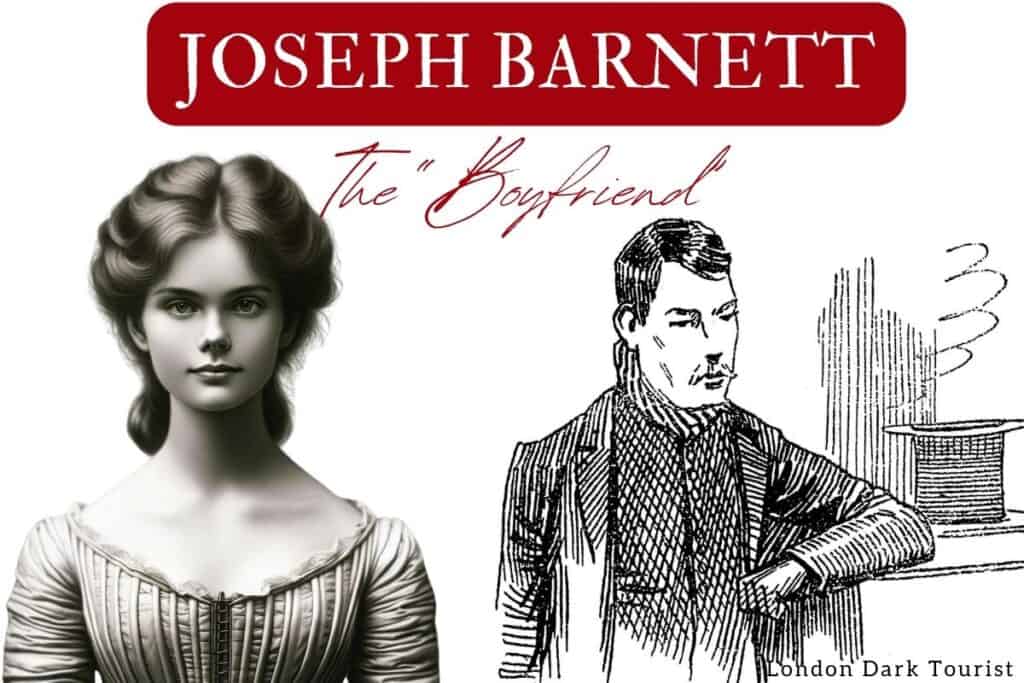
She soon met and moved in with a boyfriend, who promised her opportunities for a better life.
Joseph Barnett was a fish porter and sometimes-horse-slaughterer, but mostly made a decent wage and was a reliable guy. He didn’t want her to go back to sex work, and tried his hardest to provide for her.
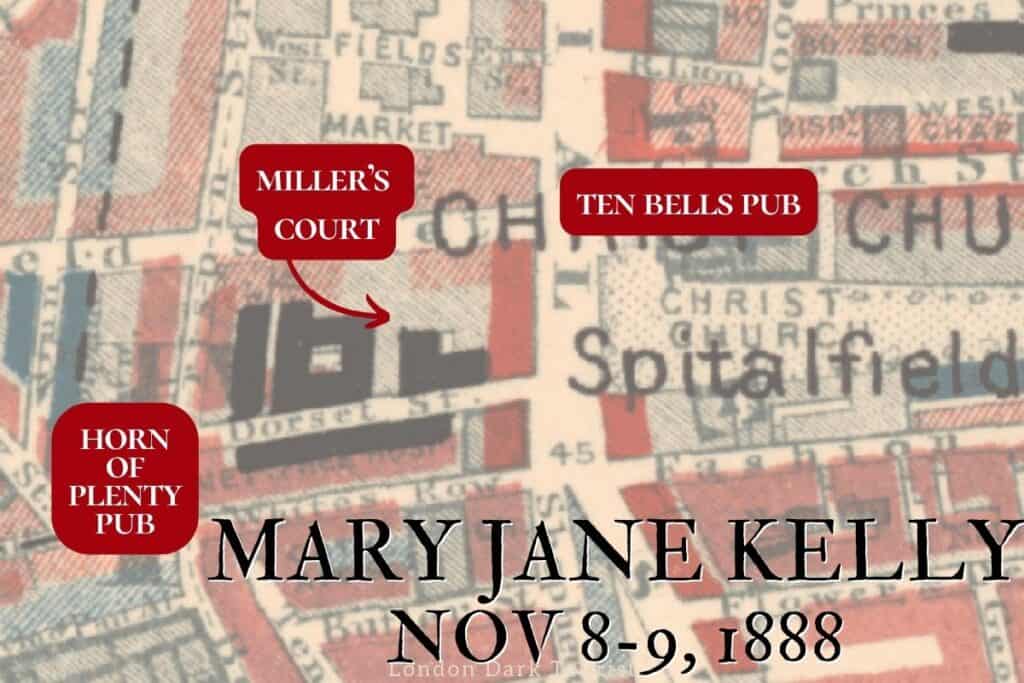
Mary Jane Kelly and Joseph moved into 13 Miller’s Court, off Dorset Street (near where Annie Chapman and Elizabeth Stride also lived).
Miller’s Court, Dorset Street

Dorset Street – often called “the worst street in London – was a tightly-packed block of boarding houses, doss houses, and pubs. It was known for poverty, violence, and chaos.
Miller’s Court was a small, dead-end offshoot of Dorset Street, tucked away in a dark corner.
Mary’s room at Millers Court was in a partitioned house, which used to be the drawing room and therefore faced the street.
It was cheap, and dilapidated, and Mary was behind on her rent.

Her landlord said that Mary was quiet and sweet, but loud and often sang Irish songs at full volume when drunk.
She could be a mean, abusive drunk, others said, but often offered her room to other sex workers in need of a bed.
The most ironic part of Mary’s story is that she always offered her room and her bed to her fellow sex workers – especially since every woman in Whitechapel was terrified of Jack the Ripper.
But her room in Miller’s Court would offer her no safety, and it would soon become the scene of the most horrific Jack the Ripper murder yet.
The Night of the Mary Jane Kelly’s Murder
In the autumn of 1888, Joseph lost his job and stopped bringing in any wages. Mary once again had to take up sex work to survive.
She and Joseph broke up when the stress became too much. They were both drinking heavily, and fought loudly in their tiny, dingy Miller’s Court flat. He moved out.
Mary’s whereabouts the night of November 8th, 1888, are not 100% certain.
It was claimed by a few different witnesses that she was out drinking in pubs, including the notorious Ten Bells across from Spitalfields, and The Horn of Plenty pub on Dorset Street near her home.

Around 11:45pm, she returned home from wherever she had gone with a man.
A Miller’s Court tenant witnessed him wearing a “black felt bowler hat” and he “had a thick moustache, blotches on his face, and was carrying a can of beer.”
Mary was heard drunkenly singing around midnight, but the singing had stopped around 1am.
Around 3:30 am (now November 9), neighbors reported hearing faint cries of “murder!”
Her upstairs neighbor thought she heard someone leave the house around 5:45 am.
Mary Jane Kelly’s Body: Mutilated & Dismembered

Even though there were warning signs of something terribly wrong, no one checked on Mary until the following day.
Around noon on November 9, 1888, Mary’s landlord knocked to collect the rent. She didn’t answer.
He peered through the window and saw the most horrific sight imaginable. This sweet young girl was absolutely torn apart.
⚠️⚠️⚠️TRIGGER WARNING: Graphic images below.⚠️⚠️⚠️
Mary Jane Kelly Crime Scene

When police arrived at the scene, they had to break down the door. They noted that Mary’s window was broken, but it was not a new break. There was no sign of forced entry.
Upon entering her room, Kelly’s clothes were folded neatly on a chair, and her boots were placed next to a fire still burning in the fireplace.
Mary Jane Kelly was nude, except for her torn and bloodied nightdress. Her legs were spread apart; her abdomen flayed and internal organs strewn about.
Some skin and viscera were sitting on the bedside table.
The doctor’s report described:
“The whole of the surface of the abdomen and thighs was removed and the abdominal cavity emptied of its viscera. The breasts were cut off, the arms mutilated by several jagged wounds and the face hacked beyond recognition of the features. The tissues of the neck were severed all round to the bone.”
-Dr Bond’s Post-Mortem Report
Post-Mortem Report

Mary Jane Kelly’s cause of death was noted as “Severance of carotid artery. Willful murder against some person or persons unknown. Violent.”
The Mary Jane Kelly crime scene was the most horrific and brutal killing East London had ever seen, and by far the worst of all the Jack the Ripper killings so far.
Since Kelly was the only canonical Ripper victim to be killed indoors, it seems the killer took his time to stage and pose her corpse.
Did he simply have more time to enact his darkest fantasies? Or was this a different killer than the previous 4 women?
Who was in Mary’s Room that Night?

The police immediately suspected Mary’s on-again, off-again boyfriend Joseph Barnett.
Upon interview, he admitted he did visit her that night, but left around 8pm. He was quickly cleared, providing an alibi, and dismissed as a suspect.
So who was in Mary’s room that night? The timeline is intricate and confusing, as different neighbors all had different recollections of the last time they saw and heard her.
But since Mary was behind on her rent, we can surmise that she attempted to attract a client that night for sex work.
The mystery only deepened.
The press churned into overdrive, and the hunt for the mysterious Ripper intensified. But the case would never be solved, and become London’s most enduring and perplexing mystery.
Remembering Mary Kelly at her Grave

You can visit the resting place of Mary at St. Patrick’s Cemetery in Leytonstone. A memorial stone marks the approximate location of her grave.
Her grave marker reads as “Marie Jeanette Kelly,” as her friends and Joseph Barnett insisted that she would want to be remembered by that name.
Sweet Mary Jane Kelly – Marie Jeanette – you did not deserve such a brutal end.
Like all of Jack the Ripper victims, you were just trying to get by in a world that was cold, hard, and impossible to thrive in for women.
Mary Jane Kelly Locations Today

- The Ten Bells, 84 Commercial St, London E1 6QQ
- Miller’s Court, Dorset Street. Though this road no longer exists, you can visit where it used to be. There is a large office & retail block with Uniqlo at the front. If you walk west on Brushfield Street, you can enter the open-air atrium of the office block. Here is approximately where Dorset Street and Mary Kelly’s home would have been. Uniqlo is at: 54 Brushfield St, London E1 6AG
- Mary’s grave, St. Patrick’s Cemetery in Leytonstone, Langthorne Rd, London E11 4HL You can find the exact location of the memorial here.
Other posts in this series:
- Mary Anne “Polly” Nichols
- Annie Chapman
- Elizabeth Stride
- Catherine Eddowes
- Suspects
- Martha Tabram: The First Victim of Jack the Ripper?
Sources
- The Five, by Hallie Rubenhold
- The Complete History of Jack the Ripper, by Philip Sugden
- The Ultimate Jack the Ripper Sourcebook, by Keith Skinner & Stewart Evans
- Dissecting Jack-the-Ripper: An Anatomy of Murder in the Metropolis by Elizabeth Hurren
- The Whitechapel Murders: The Case of Jack the Ripper, by W G Eckert
More on London’s Dark History
London Necropolis Railway: 6 Shilling Ghost Train to the Afterlife
8 Quid for a Grave-Robbed Corpse: How the London Burkers Turned to Murder
The Moorgate Tube Crash: Why Did 43 People Lose Their Lives?
The Muffin Man Murders: Death on Drury Lane?
10 Rillington Place Today: Notorious Murder House Then & Now
Secrets of a Serial Killer: Uncovering the Truth About John Reginald Christie
The Workhouse Howl & 13 Other Devastating Facts on Life in the Workhouse


