
The Sad Life and Devastating Death of Polly Nichols
Polly Nichols – legal name Mary Anne Nichols – was the first canonical Jack the Ripper victim.
Her life was dark: full of adultery, alcoholism, and poverty. Her death was even more brutal.
How did Polly end up in the arms of a killer?
It’s a sad tale of Victorian slums, sex, and secrecy.
Let’s dive into the world of Mary Ann Nichols and see how she ended up in Whitechapel on that dark London night.

See my massive London Dark History map for all of the East End locations associated with Jack the Ripper & his victims.
Jack the Ripper’s First Victim: How the Murders Began
Whitechapel – in the East End of London – was poor, dark, and chaotic in 1888. It was crowded with immigrants who came from all over Europe to try to make a better life.
Mary Ann Nichols, however, was a local. She was born and raised in London, and she never left.

Mary Anne (“Polly”) Walker was born near Fleet Street in 1845.
At a young age (either 18 or 22 – records are incomplete), she married printer William Nichols and took his surname.
Her friends called her Polly, which was actually a common nickname in the era for women named both “Mary” and “Molly.”
Over the next 15 years, Polly Nichols & William had five children. They made a decent life with William’s printing wages, and lived in various housing around the East End and the City of London.
But in 1879, just after she’d given birth to her fifth child, her husband had an affair. He started sleeping with the nurse who was caring for her postpartum.
This, understandably, marked the beginning of Polly’s troubles, as her marriage and her family slowly crumbled around her.
Polly Nichols’ Slow Descent
William moved out to be with the nurse, and they officially separated in 1880. He kept the children.
William stopped paying the monthly maintenance allowance he owed her, and she took him to court. The court sided with William, and Polly was left destitute.
Women in the Victorian period had very little to rely on if they had no husband. Jobs were hard to come by, and there was no social safety net as there is today.
During this time, Polly turned to drink to soothe her broken heart. It soon got the best of her.
Polly Lands in the Workhouse

The workhouse was the only option for some, and it became the last resort for Polly. She was in and out of Lambeth Workhouse for the next few years, right up until her death.
The workhouse was strict, and Polly likely found it difficult to drink whilst inside. She therefore took to wandering the streets during the day, and soon began to resort to sex work to make money for booze.
She was known to bounce between the workhouse and sleeping rough in Trafalgar square. Sometimes she shacked up with various “boyfriends” to keep a roof over her head.
In May of 1888, she left the workhouse for the last time and was set adrift.
Mary Ann Nichols Death & Life in Whitechapel
In the summer of 1888, Polly was living in various “doss” houses in the East End.
At the time of her murder, she was occasionally staying at Wilmott’s Lodging House, which sat 18 Thrawl Street, Spitalfields.
On the night of August 30, 1888, she was kicked out as she had no money to pay for her nightly bed.

She wandered south to the Frying Pan Pub on Brick Lane (which is no longer a pub but you can still see the logo in the brickwork).
She was wearing a fancy bonnet that her friends hadn’t seen her in before, and she was quite proud of it.
After leaving the pub, she went back to the doss house to check on the status of her bed for the night (to make sure it wasn’t already taken).
She told the landlord at Wilmott’s, “I’ll soon get my ‘doss’ money. See what a jolly bonnet I’ve got now!”

Off she went into the night.
As the 30th turned the clock into the 31st, Polly was seen at various points walking down Whitechapel Road, probably soliciting trade.
Witnesses described her as “very drunk and staggered against the wall.”
She bumped into a friend, who described Polly as saying, “I’ve had my doss money three times today and spent it. It won’t be long before I’m back.”
Soon, that “jolly” bonnet would be found lying next to her mutilated body in Buck’s Row, not far from where she was last seen.
Polly Nichols Death: Body in Buck’s Row
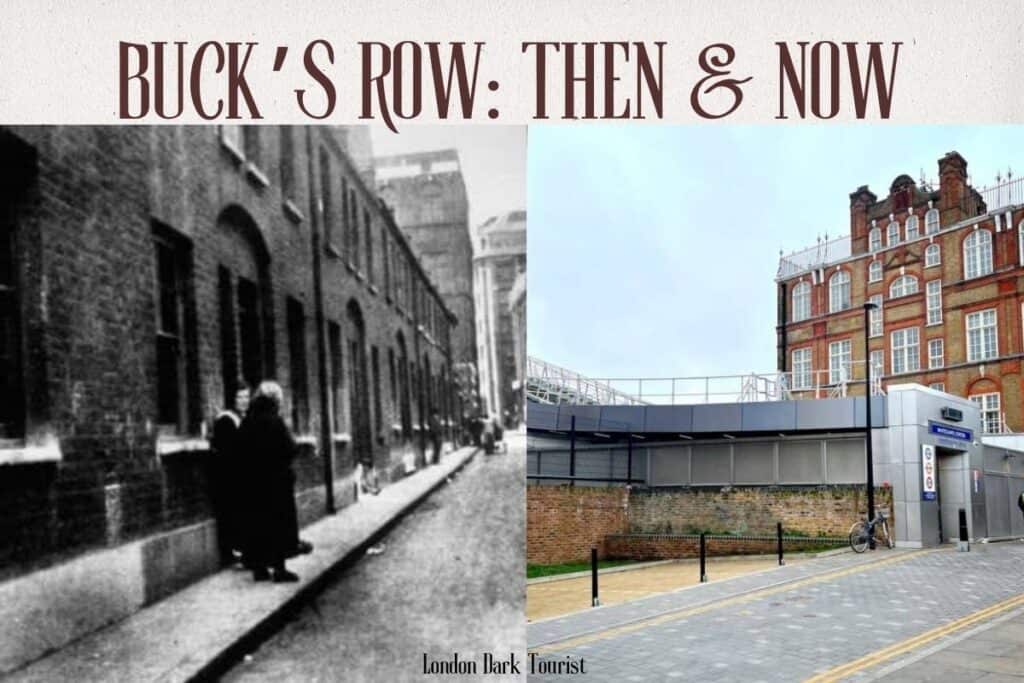
At 3:30 am, a worker named Charles Cross (that wasn’t his real name–it was Charles Allen Lechmere, later a Jack the Ripper suspect) was walking along Buck’s Row.
Buck’s Row is now called Durward street, and would have been right behind where Whitechapel station is today.
Charles spied a bundle across the street, but it was dark and he couldn’t make out what it was.
Reportedly he thought, ‘hmmm…maybe it’s a tarp I could use for my job.’ He poked at it, and he surmised it was a woman either dead or drunk.
Another man on his way to work approached and he called him over. They poked around and noticed she might still be breathing, but her skirt was raised up.
Here’s the angrymaking part: they put her skirt down, and they WALKED AWAY. They didn’t check to see if she was alive. They didn’t help her. They merely protected her “modesty,” and wandered on their merry way.
The Discovery in Buck’s Row
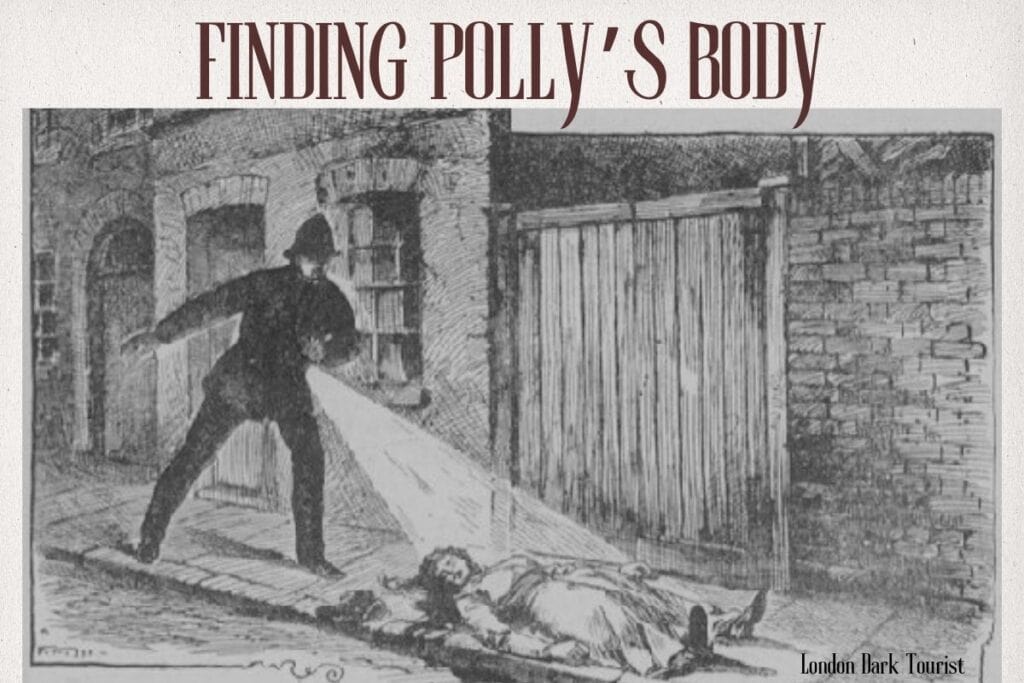
A little while later, a policeman walking his beat discovered her body.
Polly’s throat had been slashed so deeply that it was nearly severed from her body.
“I examined the body by the aid of my lamp, and noticed blood oozing from a wound in the throat. She was lying on her back, with her clothes disarranged. I felt her arm, which was quite warm from the joints upwards. Her eyes were wide open. Her bonnet was off and lying at her side.”
-Police Report
He summoned another cop, and they fetched a doctor who pronounced Mary Ann Nichols dead at the age of 43.
The Investigation: Jack the Ripper First Victim?
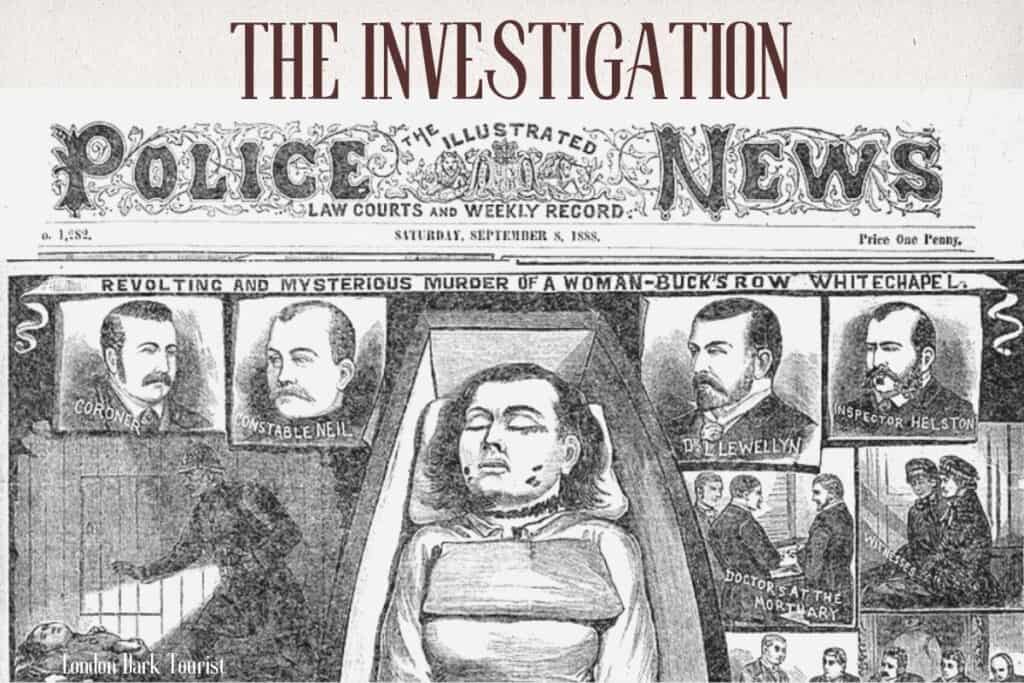
Polly’s body was identified by a friend from the workhouse, and also by her ex-husband.
The police report would later detail that Polly had:
- Bruising around her jaw and face
- A deep incision across her neck, severing her neck down to the vertebrae
- Several jagged wounds across her abdomen
All injuries were determined to have been from left to right, implying that the perpetrator was left handed.
As this was the third recent murder in the area, Scotland Yard sent detectives to Whitechapel to assist H Division.
This is when famed Inspector Abberline joined the case, and it would haunt him for the rest of his days.
Little did anyone know that this was just the beginning, and the murders were about to get a whole lot worse.
Mary Ann “Polly” Nichols Grave

You can visit the memorial to Mary Anne Nichols at City of London Cemetery.
It may not be the location of her actual remains; her grave was either moved or reused, as is the case for many 19th century graves as cemeteries became overcrowded.
But there is a memorial marker there, and many people leave flowers and other offerings.
It’s popular to leave coins, because if she had money that night for the doss house, she may have lived.
Mary Ann Nichols– Miss Polly–you deserved so much better. All the men in your life let you down.
Had there been any social safety net, more help for sex workers, more help for addictions, Polly may have lived a long life.
Rest in peace, dear Miss Polly Nichols.
Polly Nichols Locations Today

- Murder site: 277 Whitechapel Road, London E1 1BY. Today, Whitechapel Station lies just to the right of the murder location. This is actually Durward Street, but Google Maps gives the Whitechapel Road address which will take you there. Polly’s body was found where the three parking spaces next to the station sit.
- Frying Pan Pub where Polly drank that night: 13 Brick Lane, London E1 6PU. It’s no longer a pub but look at the top corner of the building and you’ll see the old logo in the brickwork.
- Polly’s memorial: City of London Cemetery (important: NOT actually in the City of London. It’s much further out). Manor Park, London E12 5DQ.
Read More in my Jack the Ripper Series:
Sources
- The Five, by Hallie Rubenhold
- The Complete History of Jack the Ripper, by Philip Sugden
- The Ultimate Jack the Ripper Sourcebook, by Keith Skinner & Stewart Evans
- Dissecting Jack-the-Ripper: An Anatomy of Murder in the Metropolis by Elizabeth Hurren
- The Whitechapel Murders: The Case of Jack the Ripper, by W G Eckert
More on London’s Dark History
What’s the Oldest Pub in London? 13 Curious Contenders
Gross Jobs in the 1800s: 10 Dirty and Dangerous Victorian Jobs
Bricks to Burberry: The 7 Worst Areas in London that are Now Super Posh
10 Ghastly Royal Deaths and What Happened to Their Corpses
London Charterhouse Square: Are There 50,000 Bodies Buried in this Lovely Garden?


