Secrets of a Serial Killer: Uncovering the Truth About John Reginald Christie
John Reginald Halliday Christie, known as “Reg,” was an English serial killer active in the 1940s and early 1950s in London.
He murdered at least eight people, including his wife, by strangling them in his London flat.
Christie’s crimes were notorious, particularly the murder of his tenants, Beryl Evans and her baby daughter Geraldine Evans.
The story of John Reginald Christie is a wild ride, so buckle in and we’ll explore how he got away with it for so long, and what finally brought this psychopath to the noose.
TRIGGER WARNING: This story contains crimes against children. Read at your own discretion.
John Reginald Christie: Early Impact of Death

John Christie was born on April 8, 1899, in Northowram, near Halifax, Yorkshire.
He was the sixth of seven children in his family, and had a difficult relationship with his father. All the children – but particularly John – were punished for every minor offense.
It seems that Christie was always the black sheep of his family – a bit weird, a bit odd, and bullied by both his siblings and his parents.
His grandfather was the grand master of the family unit and ruled with an iron fist. So when he died in front of young John, Christie was mesmerized. This once great, powerful, and feared man was reduced to a corpse.
This should have been a harbinger of things to come, but Christie’s true demeanor wouldn’t surface until he was years older.
A Rocky Marriage to Ethel Christie

After fighting for the British Army in WWI, Christie married Ethel Simpson on May 10, 1920. It seems that Ethel found some sense of security with John, but it was short lived.
John was hiding all sorts of secrets already, and was a prolific liar. He claimed he was rendered blind and mute for 3 years from a mustard gas attack, and often boasted that he was either sickly or a doctor to gain attention.
Christie was impotent with his wife, and often visited sex workers, which Ethel knew about but could do nothing to stop. He was also up to some shady dealings at work, and was convicted of stealing postal orders on his routes as a postman.
In 1921 he served the first of many prison sentences.
In these mixed years of prison and prostitutes for John, a miracle of miracles happened: Ethel ended up pregnant. But shortly thereafter, she suffered a miscarriage.
After she lost the baby, the couple’s relationship finally unraveled. Four years into their marriage, they separated.

Ethel worked in Bradford and stayed with relatives, while Christie moved to London and had multiple stints in prison for various violent and financial crimes.
The couple had no contact for 9 years, but in 1934 – after Christie’s latest release from prison – he found his estranged wife again. They reunited and moved into 10 Rillington Place a few years later.
Why did Ethel take her no-good husband back? It’s complicated, and it would turn out to be the worst decision of her life.
This is where the darkest chapter of Ethel and John’s lives would begin, and the place? London’s Notting Hill, at the now infamous address of 10 Rillington Place.
10 Rillington Place Murders: Notting Hill Nightmare
The Christie’s flat in Notting Hill was a normal terraced London home from the outside. It was divided into 3 flats, with the couple taking up the main floor residence.
Notting Hill at that time was not the posh area it is today, and impoverished women – often widowed from the war – turned to sex work to make ends meet. This area was a popular spot for them to find clients.
They would find the wrong one. Christy would either pick them up for sex work, or lure them with the promise of a safe and painless abortion. Once inside, he would gas them with carbon monoxide, rape, and strangle the unsuspecting women.
The only problem for this sicko? Where to hide their bodies. And if the bones of 10 Rillington Place could talk, the secrets they would reveal would be terrifying.
What Rillington Place Looks Like Today
First Murder

In 1943, John Christie lured his first victim – Ruth Fuerst, a 21-year-old Austrian munitions worker and occasional sex worker – back to his Rillington Place flat.
He gassed and strangled her, and initially buried her body in the garden.
This murder marked the beginning of a series of killings he would commit over the next decade, primarily targeting women and using similar methods of strangulation.
Christie Wipes Out a Family: Timothy Evans, Beryl Evans & Geraldine Evans

In 1948, young couple Timothy and Beryl Evans moved into the top-floor flat at 10 Rillington Place.
That year, Beryl gave birth to their daughter, Geraldine. But the family wasn’t so happy after their new arrival. They were financially stressed, and often fought with loud arguments, and reports to the police of domestic violence.
They would fight, separate, reunite, and start this tumultuous process over again. When Geraldine was not yet a year old, Beryl found herself pregnant again. Christie offered her an abortion, which was “performed” while Timothy was out of the house.
Christie gassed, raped and strangled Beryl, and placed her body in the outdoor washhouse (was he inspired by this Jack the Ripper murder?). Christie also murdered young Geraldine, who was found wrapped with her mother in the garden.
After the bodies were discovered, Timothy was quickly arrested. He first accused the real killer – John Reginald Christie – but after a long interrogation and his story changing several times, he was charged with the murder of his daughter.
Later, he retracted the confession and again accused Christie of the murders. Despite doubts about the confession’s authenticity and Christie’s criminal history, Evans was convicted after Christie himself testified against him.
Christie denied any involvement in the murders at the time.
Execution of Timothy Evans for the Murder of Geraldine Evans

Given the tumultuous history of their marriage, and Christie’s testimony of such, Evans was found guilty of his daughter’s murder. The prosecution did not pursue the charge for his wife’s murder. Was it because they had so little evidence to connect him to the crime?
Timothy Evans was hanged at HMP Pentonville in March 1950.
Years later, after Christie’s own crimes were discovered, it became widely accepted that Christie was responsible for the murders.
In 2004, the High Court officially recognized that Evans did not kill his wife or child, but it was 54 years too late.
How the Police Fumbled the Beryl & Geraldine Evans Investigation

The investigation into the murders of Beryl and Geraldine Evans was mishandled by the police in several ways:
- Overlooking Christie’s Role: Despite Timothy Evans’ accusations against Christie and Christie’s own criminal history, the police focused primarily on Evans.
- Confession under Duress: Evans’ confession, which was later believed to be coerced or fabricated by the police, was a key piece of evidence against him. However, it had inconsistencies and seemed contrived.
- Inadequate Search: The initial police search failed to find the bodies, which were later discovered in the wash-house, suggesting a lack of thoroughness in the investigation.
- Ignoring Christie’s Testimony Issues: The police did not adequately scrutinize Christie’s testimony against Evans, despite Christie being a key suspect.
These missteps allowed Christie to initially evade suspicion for these and subsequent murders, and led to the wrongful conviction and execution of Timothy Evans.
John Reginald Christie Keeps Killing: More Rillington Place Murders

Was Christie made bolder by his evasion in the Evans case? It’s highly likely.
Between January 19 and March 6, 1953, John Christie committed three more brutal murders at 10 Rillington Place.
The victims were Kathleen Maloney, a sex worker from Ladbroke Grove; Rita Nelson, a pregnant woman from Belfast visiting her sister in Ladbroke Grove; and Hectorina MacLennan, who was living in London with her boyfriend and had met Christie in a café.
For these murders, Christie used a modified gassing technique. He connected a rubber tube to the gas pipe in the kitchen, keeping it closed off with a clip.
He then seated his victims in the kitchen, released the clip, and let gas leak into the room. This exposure to carbon monoxide made the victims drowsy, after which Christie strangled them with a rope.
The Murder of Ethel Christie
During this final spree, Christie got rid of the most important witness: his wife Ethel.
He strangled her in her sleep in December of 1952, and it got even more wild: he sold her belongings, emptied her bank account, and told several different stories to friends and family about where Ethel had disappeared to.
But – at the time – Christie just got away with it again. Despite the mountains of suspicion against him, he kept living his life. Until he ran out of money.
Christie Moves Out
John Reginald Christie did a lot of stupid and crazy things and kept getting away with it. But it was his last idiotic move that would bring his downfall.
In March 1953 – one year and three months after the murder of his wife – Christie decided to move out of his longtime flat at 10 Rillington Place.
You know, the place where he stashed a bunch of dead bodies.
He illegally sublet the flat to a tenant for £7. The landlord showed up that night and – discovering strangers living in the house – kicked them out.
The upstairs tenants (in Beryl and Timothy’s old flat) were having kitchen problems, so the landlord said they could go ahead and use Christie’s kitchen.
What that tenant discovered hidden in the kitchen would scar them for life.
In the kitchen was a hidden alcove, covered by a false wall plastered with wallpaper. The tenant tried to insert a bracket into the wall, and found it hollow.
Inside the hidden kitchen alcove were the decomposed bodies of Maloney, Nelson and MacLennan that Christie had murdered years ago.
Rillington Place Murders: Arrest

After confirming with another tenant that they were indeed dead bodies, the tenant informed the police, leading to a citywide search for Christie.
Christie had been bouncing around cheap lodging in London and sleeping rough, but checked into one lodging house using his real name and address. He was subsequently captured and arrested for his crimes.
Rillington Place Murders Crime Scene

After the discovery of the first three bodies, police tore apart the rest of the house.
They found Ethel Christie’s body buried under the floorboards of the living room.
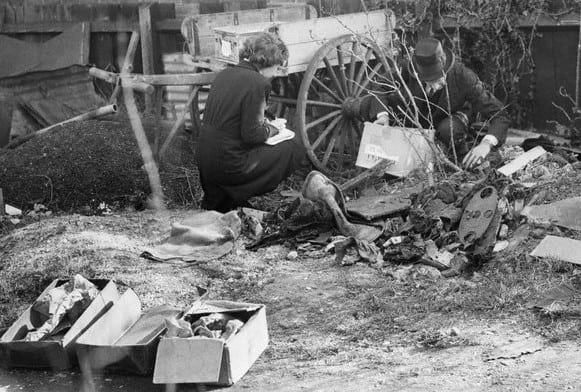
The bodies of Ruth Fuerst (August 1943) and Muriel Eady (October 1944) were found buried in the back garden.
John Reginald Christie: Execution

Initially, Christie confessed to the three bodies in the kitchen alcove and the murder of his wife. Christie never confessed to the murder of Geraldine Evans, although he admitted to killing her mother, Beryl.
John Christie was convicted only for the murder of his wife Ethel and sentenced to death. He was imprisoned and later executed by hanging on July 15, 1953 at HMP Pentonville.
Crowds surrounded the prison that day, waiting for news that this notorious monster was dead.
His conviction and execution brought an end to a series of brutal crimes that had taken place over a decade, mostly within his residence at 10 Rillington Place in London.
Christie’s execution marked the conclusion of one of the most notorious criminal cases in British history.
John Christie Victims

In total, Christie murdered at least 8 people – and possibly more – in horrible and terrifying ways. Let’s hope they are at peace now, for they never should have met this monster.
The known and documented John Christie victims are:
- Ruth Fuerst, 21 (24 August 1943)
- Muriel Eady, 31 (7 October 1944)
- Beryl Evans, 20 (8 November 1949)
- Geraldine Evans, 13 months (8 November 1949)
- Ethel Christie, 54 (14 December 1952)
- Rita Nelson, 25 (19 January 1953)
- Kathleen Maloney, 26 (February 1953)
- Hectorina MacLennan, 26 (6 March 1953)
Rest in peace, sweet souls.
Rillington Place Murders: Sources and More Info
I used the following sources for this summary of the Rillington Place Murders:
- Inside 10 Rillington Place by Peter Thorley
- The Trials of Evans and Christie on Audible
- John Christie: The True Story of The Rillington Place Strangler by Jack Rosewood and Rebecca Lo
- Wikipedia
- Murderpedia
If you’re fascinated with this case like I am, here’s where you can learn more.
- Rillington Place on BBC iPlayer: Fantastic dramatization, told a bit out of order but acting is on point.
- John Christie: English Serial Killer on YouTube
- Bodies in the Walls and Under The Floorboards – The Horrors of 10 Rillington Place on YouTube
More on English Serial Killers & Dark History
Delia Balmer’s Story: Her Miraculous Survival of John Sweeney
10 Rillington Place Today: Notorious Murder House Then & Now
The Acid Bath Murders: John George Haigh Becomes a Monster
4 Big Reasons Jack the Ripper was Never Caught
London Charterhouse Square: Are There 50,000 Bodies Buried in this Lovely Garden?
London Serial Killers: 11 Documentaries on YouTube to Watch Now
The Workhouse Howl & 13 Other Devastating Facts on Life in the Workhouse