
Decoding the Moorgate Tube Crash: What Happened?
The Moorgate tube crash of 1975 changed London forever. It was a catastrophic event that saw 43 lives lost, many more forever altered, and made us think differently about the safety of our iconic London Underground.
But what really happened that day? How did an experienced driver ram head-first into the dead-end tunnel?
Was it an accident, or something purposeful?
Let’s go back over the details of that fateful day and see what we can uncover.
This is the story of the Moorgate tube crash.

February 28, 1975: The Northern Line, London Underground
It’s 1975, a chilly day in February, morning rush hour.
You hustle down the steps and onto the platform, hop into a carriage crammed with other sweaty passengers who have also rushed to make the train, still bundled in their winter coats, though the underground is always sweltering.
You grab the rail and brace your feet as you feel the familiar acceleration.
You’re late for work, but it’s only a moment until Moorgate station where you’ll disembark. You’ll be there soon.
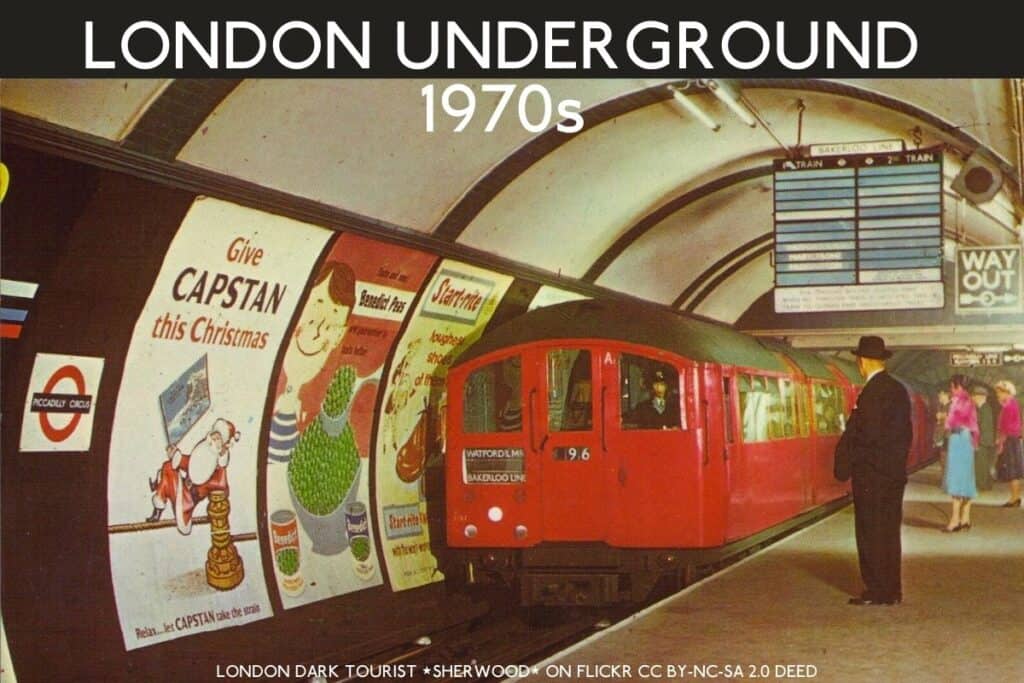
But something is wrong; the train isn’t slowing down as it pulls into Moorgate. Maybe there’s a line obstruction and it’s been re-routed?
No, it can’t be. This line ends at Moorgate.
In a split second, you’re thrown forward and your world goes black.
The Moorgate Tube Crash
This is how the Moorgate Train disaster began, which caused 43 deaths and 74 injuries. Maybe you would have been one of the lucky ones in the back carriages.
But maybe you wouldn’t have been so lucky.
This horrific accident turned the city upside down as the fire brigade, medics, doctors, nurses and volunteers worked around the clock for a week, saving as many as they could.
It was the worst ever peacetime disaster on the London Underground.
Driver Leslie Newson Arrives at Work

That day began like every other. Driver Leslie Newson, 56, had been employed as a tube driver for six years, and had driven the same route for the past three months on the Northern Line.
Newson had come to work with a thermos of milk with sugar, and had shared a cuppa with a coworker before his shift.
He had also come to work with a significant amount of cash (£270, over £2,000 today) with which to buy his daughter a used car after he got off work. Does this show that he intended to live until the end of his shift?
Newson was known as a rule-follower and a model driver. He kept a laminated notebook on how to improve his performance and noted maintenance issues that needed attention.
However, he did overshoot the platform on two separate occasions the week leading up to the accident. Is that a meaningful detail? It’s hard to say.
The Route

At the time, Moorgate station was the terminus of the short Highbury offshoot branch of the Northern Line, which ran from Drayton Park to Moorgate, with Highbury & Islington, Essex Road and Old Street stops in the middle.
It was a very short stretch–only 2.6 miles, 9 minutes end to end–and Newson’s job was simply to drive those same five stops back and forth his entire shift.
Joining Newson on train 272 that morning was 18 year-old guard Robert Harris, who was a newbie. At the time, one guard was stationed in the last carriage of each train, and had their own little control panel with an emergency brake.
At the time of the crash, Harris was wandering about the carriage looking for a newspaper, apparently oblivious that the train was not slowing for its final stop.
Between the last stop and the terminus at Moorgate, it would have taken only 56 seconds to reach the final station.
The Crash at Moorgate Station Platform 9

At 8:46 am, the train did not slow as it pulled into Moorgate. It slammed into the dead end tunnel at Moorgate station, platform 9.
300 passengers were on board at the time. The last three carriages were left pretty much unscathed, but many in those carriages were injured from the impact.
The velocity caused the front three carriages to sandwich into a V-shape: one above, one below, and one in the middle.

If you’ve visited London, you know how quickly tube carriages seem to pass by. There’s the massive gust of wind and then the squeal of brakes, and the train then stops impossibly fast.
There was no squeal of brakes on February 28, 1975. The train didn’t slow down at all. In fact, it seemed to be accelerating toward the dead end.
Witnesses on the platform said they saw the driver staring straight ahead, alert but not reacting.
For a reason that remains a mystery to this day, he failed to stop.
Moorgate Tube Crash Impact

The front 15 seats of the first carriage were crushed to an incomprehensible 2 feet in depth.
The entire first carriage, with Newson at the front, was compressed from 52 feet (16 meters) to a mere 20 feet (6.1 meters).
The first carriage sustained the most damage, the second carriage the second most, and the third carriage the third most. The remaining 3 cars were relatively unharmed, though lots were injured in the crash in those carriages.
But the trickiest part is that three carriages had sandwiched themselves into a tight space.
The twisted metal, in the dark and the heat, with smoke and soot and low oxygen, made rescue efforts extraordinarily difficult.
Moorgate Tube Crash Rescue: Dire Straits

The London Ambulance Service arrived a short 6 minutes after the crash, followed by the fire brigade, police, and a small team from nearby St. Bartholomew’s Hospital.
This is remarkably quick considering they had to run down all of the escalators and steps to reach the deepest platform inside Moorgate.
Moorgate Station itself is fairly deep. It’s not the deepest on the Northern Line, but the depth of the crash quickly hindered rescue efforts.
Fire and police radios couldn’t reach those 70 feet above ground, so they hurriedly sent runners back and forth with messages to get what they needed.
The tunnels quickly filled with soot and sand kicked up by the impact, making it very hard for rescuers to see what was going on.

Fresh air at Moorgate was, at the time, created by the piston effect: trains moving through the tunnels and whooshing air around through the shafts.
But trains on the line had stopped, and it quickly climbed to nearly 49 degrees Celsius (120F). Oxygen levels plummeted.
The most challenging part, however, was that the lights had gone out on the platform.
Six carriages. Three hundred people. Smoke. Heat. Confusion. In the dark.
Passengers that could walk made their way out of the station, covered in soot and debris.
The rest had to wait, and hope.
Timeline: February 28, 1975

From the first 999 call until the ambulance and fire services arrived was remarkably fast.
The first police officer on the scene said:
When I descended the platform by escalator, smoke started coming up from the tunnel.
I ran down the platform trying to smash windows with my truncheon, with some success, but most people were in the front carriages as this was the final stop. I assisted in getting some people off the last carriages and then to the way out.
–Kip Laister Dawe
By 9am – just 14 minutes after the impact – all survivors were removed from the 3rd carriage and all remaining passengers – those who weren’t trapped – were evacuated.
This is an incredibly fast rescue effort, made possible by emergency services who lept into action and never hesitated.
By that afternoon at 3pm, they had removed all but two survivors from the second car.
One of these was 19 year-old Margaret Liles, a police constable who had been on her way to work. Margaret was pinned by her left foot, and tangled up with another survivor: Jeff Benton, a stock broker.
Margaret’s foot had to be amputated to free her. She survived and was quickly rushed to hospital.
Jeff was then extracted, but later died of crush syndrome: toxins that had built up in his compressed body quickly spread upon his release.
February 28 – March 5

By ten in the evening the day of the crash, after the last known survivor was pulled out, rescuers called for complete silence.
Everyone stopped and stood still. In the eerie depths, filled with soot, in the dark, they heard not a sound.
The lead medical officer called out, over and over, for any more survivors to make themselves known. It was devastatingly quiet.
They had not yet reached the front carriage, and had to assume that there would be no survivors there given the crush of the carriages.
The Next Few Days: Brutal Conditions Underground

It took a further five days to reach and remove the remains of the dead. Conditions underground worsened. It only grew hotter.
Crews could finally use flame cutting tools, but those quickly depleted the oxygen, caused more heat, and clouded the air even further.
Workers were limited to 20 minute shifts per hour, with a 40 minute rest above ground.
The smell of decomposition was overwhelming because of the heat and the stagnant air. Workers and survivors would never be the same, forever mentally affected by this horrific scene and the horrible conditions they had to endure.
Crews worked carriage by carriage, winching and hoisting the metal away piece by piece Debris was taken away to the surface.
They finally reached the location of the driver, Leslie Newson, on March 4th.
Finding the Driver

Upon finding his body, “His left hand was close to, but not actually on the driver’s brake handle and his right arm was hanging down to the right of the main controller.
His head was to the left of the dead man’s handle which had been forced upwards, beyond its normal travel, and was resting on his right shoulder.”
His head had been forced through the windshield, and removal of his body was painstaking as so much of the train was crushed around him.
I think it’s important to note that his hands were not in front of his face to brace for the crash. This is an automatic bodily reflex – even if your intention is to crash – which may indicate some sort of medical emergency.
In the aftermath, his entire life was scrutinized, as well as the morning of the crash.
Leslie Newson’s Autopsy
Upon autopsy of the driver on March 5th, it was found that he had a blood alcohol level of 80mg/100ml, which is exactly the legal limit in Britain.
He had no liver damage indicating he was a heavy drinker, and no evidence of a medical event such as a heart attack or stroke that could have caused the crash.
Pathologists’ opinions varied on his sobriety: some felt he had definitely been drinking, and some theorized that five days in extreme heat had led to alcohol forming in his decomposing body.
Other victims exposed to the same conditions also had measurable blood alcohol post-mortem, but at about half the level of Newson’s.
Had he drank a little? Maybe a nip in his coffee? We’ll never know. But even if he did drink, he would not have been remarkably drunk with that blood alcohol level for a man his size.
Investigating the Train

A thorough investigation commenced immediately.
Parts of the train were carefully removed, installed and tested on other identical 1938 rolling stock trains.
It was found that the brakes were functioning normally and investigators could find no mechanical reason why the train didn’t stop.
That left two logical explanations: driver error, or a medical emergency.
Investigating the Driver: Leslie Newson

Since the train had no mechanical defects they could find, that left the investigation to steer toward the driver.
Though his autopsy found nothing of significance except the (debated) blood alcohol level, Newson could have suffered from a medical condition undetectable at autopsy.
Two possible conditions were put forth by experts: transient global amnesia, and akinetic mutism.
In transient global amnesia, blood supply is cut off to the temporal lobe.
Akinetic mutism is a “brainstorm” in which you appear alert, but can’t move, speak, or react.
The latter would explain why he appeared to be looking straight ahead, unreactive. Did Leslie Newson have a medical emergency?
Official Findings
The official accident report was published a year later, in March of 1976. The investigation ruled the accident to be caused by “human error,” though investigators were not able to specify what that error was.
Their research was thorough, inspecting all mechanical aspects of the train, interviewing friends and colleagues of the driver, passengers, witnesses, and everyone connected with the crash.
To this day, no one knows what caused this horrific tragedy.
The Moorgate Train Crash Platform Today

Platform 9 is still in use at Moorgate Station today; not by the Northern Line but by the Great Northern Railway.
Follow National Rail signs to “Trains to Stevenage” and you’ll locate platform 9 in the depths of the station.
The platform is still a dead-end, and the hydraulic buffer is there, though automatic braking systems have since been installed on all terminus train stops.
At the tunnel entrance you can still see what looks like damage from the carriage pile-up nearly fifty years ago, though it’s hard to say whether that is damage from the crash or from something else since then.
The platform is definitely somber; the energy is heavy, and the eerie darkness and soot floating about the air give you a small sense of what it would have felt like that fateful day.
Remembering the Victims

There is a memorial in the southwest corner of Finsbury Square, a few blocks north of the station. It lists the names of all of the victims.
When I visited in March of 2023, flowers had been left below the memorial to mark the 48th anniversary of the crash.
There is also a plaque on the outside of the station.
Victim Names
These are the 43 victims who died at Moorgate station that day. I have linked to victim obituaries or articles where I could find them.
- Jeffrey Benton, 27
- Stanley Boggis, 53
- Peter Bradbury, 23
- Anthony Byczkowski, 19
- Hian Chan, 33
- Janet Cook, 17
- Alfred (maybe Arthur) Corking
- Adrian Crotty
- Janice Donovan
- Kenneth Edwards
- Sidney Eva
- Charles Gale
- Threse Georgiades
- Cecil Genin
- Alistair Gordon
- Barbara Halford
- Theresa Hall
- Henry Hobbs
- Gillian Hughes
- Kathleen Hughes
- Lina Vella Lombardo
- George Mackmurdie
- Michael Maddocks-Watson
- Rosemarie Mansi
- Bernard Marks
- Geoffrey Marsh
- Elizabeth Marsden
- Sherifat Mayaleke
- Alla-Uddin Nasim
- Nazikan Nasim
- Leslie Newson
- Mary O’Brien
- Stephen Payne
- Joan Phelps
- Donald Prevost
- David Redfearn
- Chiman Shah
- Jane Simpson
- Shamern Syed
- Thomas Thrower
- Colin Ward
- David Wilson
- Frederick Wonderling
Lasting Effects: Preventing London Underground Disasters
Since the deadly crash, more protections were introduced to prevent another tragedy like Moorgate.
Auto-braking systems were installed in all terminus platforms that kick on if trains exceed the specified speed entering the terminal. Signaling at terminus stations was also improved.
Though other tragedies have happened on the Underground before and since, nothing as horrific as Moorgate has happened during peacetime.
Visiting Moorgate Tube Crash Locations Today
- Moorgate, Platform 9: Follow signs to National Rail (the little red double-line logo). During morning rush hour, there are no elevators going down and you’ll need to take the 123 stairs into the depths.
- Memorial at Finsbury Square: southwest corner, on the corner of Finsbury Square and the A501.
- The London Transport Museum in Covent Garden has an original carriage from 1938 rolling stock, the type of train involved in the crash. You can go inside the carriage and get a feel for what it would have been like. There is a video here of one of the old trains back in action several years ago which takes you back in time.
More on London’s Dark Past
The London Necropolis Railway: Ghost Train to the Afterlife
4 Big Reasons Jack the Ripper was Never Caught
What’s the Oldest Pub in London? 13 Curious Contenders
The Worst Neighborhoods in London that are Now Super Posh
More on English Disasters
Titanic Artifacts: The 11 Best Places Around the World to See Sunken Treasures
Titanic Museum Southampton: Tour & 9 Treasures of the Collection
London Charterhouse Square: Are There 50,000 Bodies Buried in this Lovely Garden?
Temple Bar London: Why did this London City Gate Sport Rotting Heads on Top?
London Necropolis Railway: 6 Shilling Ghost Train to the Afterlife
8 Quid for a Grave-Robbed Corpse: How the London Burkers Turned to Murder


