
Expert Opinions: 21 Most Curious Jack The Ripper Suspects
Who was Jack the Ripper? Will his identity ever be revealed?
Over the years, countless suspects have been put forward. But who is the most likely of the Jack the Ripper suspects? Who can we disregard right away?
I’ve gathered the most popular suspects put forward by Ripperologists.
It’s important to note that most everyone disagrees on the suspects, and who you think Jack the Ripper is depends on who you listen to.
Here’s 21 of the most curious Ripper suspects, ranked according to their likelihood.

Table of Contents
Before you go on to learn about the suspects of these horrible crimes, please learn about the victims.
They are the heart of this story, and their killer is insignificant compared to what they went through in their short, hard lives:
Jack the Ripper FBI Profile

In 1988 – exactly 100 years after the Whitechapel Murders, renowned criminal profiler John Douglas undertook a criminal profile of Jack the Ripper.
The result is a blueprint of what the suspect would have been like: his age, occupation, temperament, physical characteristics, and more.
It’s useful as we go through this list of suspects to see who fits the profile and who doesn’t.
Most Unlikely Jack the Ripper Suspects
Here are the most unlikely Jack the Ripper theories that just don’t hold water, but still hang about in popular imagination.
1. Prince Albert Victor

The Jack the Ripper theory that the Royal Family was behind the killings is nothing new, but there’s no evidence this is true.
A member of the royal family, Prince Albert Victor was rumored to have been involved in the killings as part of a conspiracy.
However, there is no evidence to support this theory, and most historians believe it to be unfounded.
Was Prince Albert Victor Jack the Ripper?
No. Sorry to all you Royal conspiracy theorists out there. It’s just too unlikely.
This would involve a massive coverup reaching to the highest ranks of government. Something would have leaked eventually.
- White Male ✅
- 28-36 Years Old ✅
- Solo Employment ❌
- Loner ❌
- Physical Deformity ❌
- Interviewed by Police ❌
- Suicide After Last Kill ❌
2. Thomas Neill Cream

A physician and convicted killer, “The Murderous Dr Cream” was in London at the time of the Ripper murders.
He was known to have a hatred of prostitutes, and was linked to the death of a woman in Whitechapel.
However, he was in prison during the last two murders, which casts doubt on his involvement.
Was Thomas Neill Cream Jack the Ripper?
He’s a psychopath, for sure. Known as “The Lambeth Poisoner,” Cream’s crimes have been dissected thoroughly, but his M.O. just doesn’t fit the Ripper murders.
Plus, he was imprisoned for his other crimes during the murders of Mary Jane Kelly and Catherine Eddowes, so it doesn’t make sense.
- White Male ✅
- 28-36 Years Old ❌
- Solo Employment ✅
- Loner ❌
- Physical Deformity ❌
- Interviewed by Police ❌ (not for these crimes)
- Suicide After Last Kill ❌
3. Michael Ostrog

A Russian conman who was in London at the time of the murders, Michael Ostrog was considered a suspect by police at the time.
However, he had a solid alibi for some of the murders and was eventually ruled out.
Was Michael Ostrog Jack the Ripper?
Unlikely. He was a thief, and once pulled a gun on a police officer, but there is nothing to suggest he was violent with women or that he was violent at all.
Any criminologist will tell you past crimes predict future crimes, and Ostrog just doesn’t fit.
- White Male ✅
- 28-36 Years Old ✅
- Solo Employment ✅
- Loner ✅
- Physical Deformity ❌
- Interviewed by Police ✅
- Suicide After Last Kill ❌
Curious Jack the Ripper Suspects
These are those men suspected of being the Ripper that can’t be ruled in or ruled out – they lie somewhere in the middle.
4. Dr John Williams

Jack the Ripper suspect Dr John Williams was first proposed by Tony Williams in his book “Uncle Jack“.
As second book by Mary Jane Kelly’s distant relative Antonia Alexander, “The Fifth Victim“, expanded on the theory. The author found a locket supposedly worn by Mary Jane Kelly, and inside was a photograph of Dr Williams.
Dr John Williams was Queen Victoria’s surgeon, and also held a women’s surgery in Whitechapel for the less fortunate.
He did at one time have a patient named “Mary Kelly,” but there’s no way to know if it’s the Ripper victim Mary Jane Kelly.
Popular lore goes that Dr Williams’ wife was infertile, and he was searching for specimens on which to test fertility treatments.
Was Dr John Williams Jack the Ripper?
It’s not likely. If he only wanted uterine specimens, he could have procured them in any number of ways that wouldn’t involve murder.
He did retire in 1903, and left his favorite surgical knives to be displayed in a library, which is curious.
- White Male ✅
- 28-36 Years Old ❌
- Solo Employment ❌
- Loner ❌
- Physical Deformity ❌
- Interviewed by Police ❌
- Suicide After Last Kill ❌
5. James Maybrick

A wealthy cotton merchant, James Maybrick was linked to the murders after a diary was discovered that purported to be written by him.
However, the authenticity of the diary has been called into question, and there is no other evidence linking him to the killings.
Was James Maybrick Jack the Ripper?
The Maybrick Diary is hotly contested by Ripperologists, but most conclude that it is a forgery.
Would a wealthy merchant from Liverpool travel to Whitechapel several times to murder sex workers? Unlikely.
- White Male ✅
- 28-36 Years Old ❌
- Solo Employment ❌
- Loner ❌
- Physical Deformity ❌
- Interviewed by Police ❌
- Suicide After Last Kill ❌
6. Francis Thompson

English poet Francis Thompson lived in the Spitalfields area, and was medically trained. He dropped out of medical school multiple times.
He lived on the streets on and off, and would therefore have known every dark alley of the East End.
His later poetry alludes to the murder of a woman.
Was Francis Thompson Jack the Ripper?
There’s just too little evidence either way. He does fit the profile somewhat, but he had no known history of violence against women.
- White Male ✅
- 28-36 Years Old ✅
- Solo Employment ✅
- Loner ✅
- Physical Deformity ❌
- Interviewed by Police ❌
- Suicide After Last Kill ❌
7. Francis Tumblety

An American doctor who was in London at the time of the murders, Tumblety was known to have a hatred of women and was arrested on suspicion of the murders.
However, he was released due to lack of evidence.
Was Francis Tumblety Jack the Ripper?
Maybe? The arrest is interesting. But there is no evidence that Tumblety was ever in Whitechapel, and the killer would have known those streets backward and forwards.
- White Male ✅
- 28-36 Years Old ❌
- Solo Employment ✅
- Loner ✅
- Physical Deformity ❌
- Interviewed by Police ❌
- Suicide After Last Kill ❌
8. John Pizer, a.k.a. “Leather Apron”

A Polish immigrant who was known as “Leather Apron” due to his profession as a leather worker, Pizer was arrested on suspicion of the murders.
However, he had a solid alibi for some of the killings and was eventually released.
Was John Pizer Jack the Ripper?
Unlikely. The only connection here is “leather apron,” but there is no evidence the killer wore a leather apron.
That detail was exaggerated by the press and wasn’t congruent with witness statements.
- White Male ✅
- 28-36 Years Old ❌
- Solo Employment ✅
- Loner ✅
- Physical Deformity ❌
- Interviewed by Police ✅
- Suicide After Last Kill ❌
9. Joseph Barnett

A former boyfriend of the last canonical victim, Mary Jane Kelly, Barnett was known to have a violent temper and was in the area at the time of the murders.
He had lived with Mary Jane Kelly shortly before her murder in their former flat.
However, there is no concrete evidence linking him to the crimes.
Was Joseph Barnett Jack the Ripper?
It’s possible. He lived in in the area, and knew one of the victims intimately. He apparently looked down on sex workers and hated that Mary Jane Kelly was working in the industry.
But if his target was his former girlfriend, why would he kill four others before her?
- White Male ✅
- 28-36 Years Old ✅
- Solo Employment ✅
- Loner ✅
- Physical Deformity ❌
- Interviewed by Police ✅
- Suicide After Last Kill ❌
10. Montague John Druitt

A barrister who was dismissed from his job shortly before the murders, Druitt committed suicide shortly after the final killing.
Some believe that he may have been the killer, but there is no evidence to support this theory.
Was Montague John Druitt Jack the Ripper?
Timing is the issue here: he committed suicide right after Mary Jane Kelly’s murder, and after that the murders stopped.
But he also had an alibi for one of the other canonical murders. So who knows?
- White Male ✅
- 28-36 Years Old ✅
- Solo Employment ❌
- Loner ❌
- Physical Deformity ❌
- Interviewed by Police ❌
- Suicide After Last Kill ✅
11. Walter Sickert

A well-known artist, Sickert was accused of being Jack the Ripper by a writer in the 1970s.
The theory was that he painted several pictures that depicted the murders, but there is no concrete evidence to support this claim.
Was Walter Sickert Jack the Ripper?
This one is creepy. Sickert’s paintings depict some of the crime scenes in realistic detail. Author Patricia Cornwell went hard after Sickert and even had some “Ripper” letters compared to his DNA. Results were inconclusive.
And were those letters even sent by the killer? Probably not.
My guess is that Sickert was a little messed up, and obsessed with the murders, and it came out in his art.
If you’re interested in this suspect, Patricia Cornwell wrote an entire book about her mission to find out if Sickert could have been Jack the Ripper.
She has since recanted her claim that she “solved” the murders with Sickert as the supposed perpetrator.
- White Male ✅
- 28-36 Years Old ✅
- Solo Employment ✅
- Loner ✅
- Physical Deformity ❌
- Interviewed by Police ❌
- Suicide After Last Kill ❌
12. Jacob Levy
Jacob Levy was a Jewish butcher living in the area. He was known to be “insane,” and was admitted to an asylum not long after the last murder. He died in 1891.
Was Jacob Levy Jack the Ripper?
In a great episode of Bad Women: Ripper Retold, the life of Levy is dissected in detail.
The creators describe the severity of his mental illness, which would have made it difficult for him to get away with the crimes.
- White Male ✅
- 28-36 Years Old ✅
- Solo Employment ✅
- Loner ✅
- Physical Deformity ❌
- Interviewed by Police ❌
- Suicide After Last Kill ❌
13. James Kelly

In 1883, upholsterer James Kelly murdered his wife by slashing her throat. He was convicted and sentenced to Broadmoor, where he escaped in January 1888.
His whereabouts were unknown for 40 years, until he unexpectedly turned himself back into Broadmoor.
Was James Kelly Jack the Ripper?
His whereabouts are unknown for a very long period, so it’s hard to say. The timing of this one is certainly curious.
- White Male ✅
- 28-36 Years Old ✅
- Solo Employment ✅
- Loner ✅
- Physical Deformity ❌
- Interviewed by Police ❌
- Suicide After Last Kill ❌
14. Frederick Bailey Deeming

English-born, but living most of his criminal life in Australia, Frederick Deeming was long considered a prime suspect by Scotland Yard.
The only trouble? His whereabouts during the murders were unknown.
He was arrested after the murder of his wife and two daughters in Melbourne, Australia, in 1891. He was executed.
Was Frederick Deeming Jack the Ripper?
Frederick Deeming was a criminal and absolute psychopath, but whether he was in London during the Ripper murders is unknown.
- White Male ✅
- 28-36 Years Old ✅
- Solo Employment ✅
- Loner ✅
- Physical Deformity ❌
- Interviewed by Police ❌
- Suicide After Last Kill ❌ (executed a few years later for another murder)
15. HH Holmes

Prolific Chicago murderer – and subject of the popular book Devil in the White City – was also suspected of serial murder in London.
He was likely in London at the time, but his modus operandi for his later killings and the Jack the Ripper murders are totally different.
Was HH Holmes Jack the Ripper?
The timeline is difficult to pin down. Since HH Holmes was only visiting London, it’s unlikely he would have known Whitechapel well enough to get away with the murders so stealthily.
- White Male ✅
- 28-36 Years Old ✅
- Solo Employment ✅
- Loner ✅
- Physical Deformity ❌
- Interviewed by Police ❌
- Suicide After Last Kill ❌
Most Likely Jack the Ripper Suspects
These are the suspects who are – in popular and expert opinion – most likely to have been the notorious murderer.
16. Hyam Hyams

Hyam Hyams was a cigar maker who lived in the area, and would therefore have been handy with a knife.
He was an alcoholic, known to be violent, and was in and out of mental asylums. He had an “irregular gate”, and after the final murder had injured his arm badly.
Was Hyam Hyams Jack the Ripper?
He’s an interesting suspect, for sure. He’s the only one on this list with a physical deformity that matches the FBI profile and witness descriptions.
- White Male ✅
- 28-36 Years Old ✅
- Solo Employment ✅
- Loner ✅
- Physical Deformity ✅
- Interviewed by Police ❌
- Suicide After Last Kill ❌ (severely injured after Mary Jane Kelly)
17. Aaron Kosminski
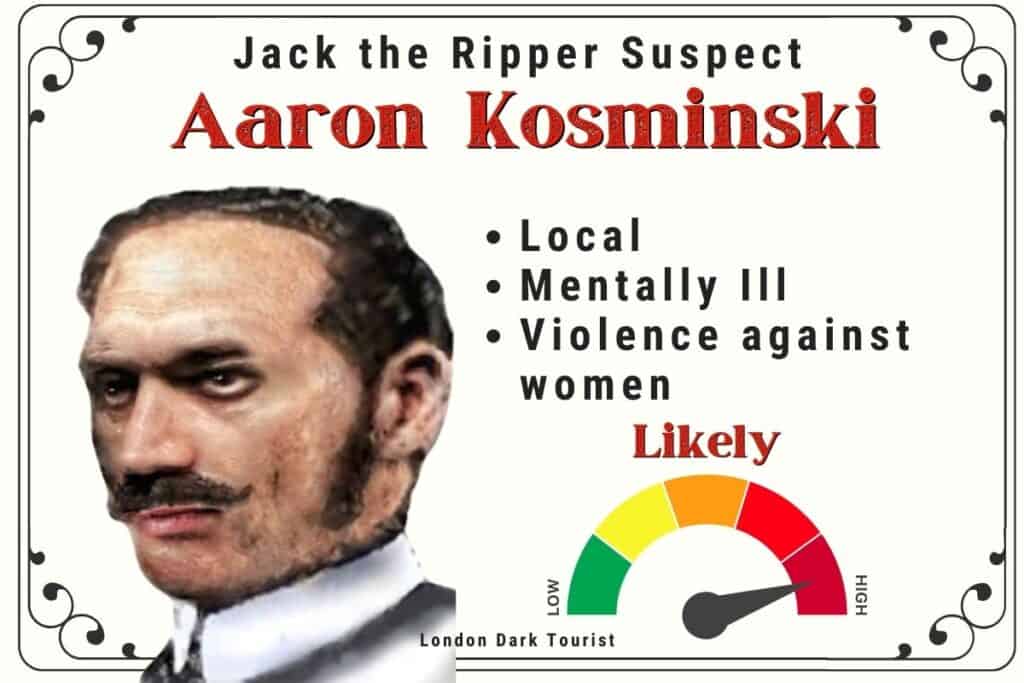
One of the most popular Jack the Ripper suspects, Kosminski was a Jewish barber of Polish heritage who lived in Whitechapel at the time of the murders.
He was known to have a history of mental illness and was identified by a witness, but there is no conclusive evidence linking him to the killings.
The book Naming Jack the Ripper supports him as the primary suspect.
Was Aaron Kosminski Jack the Ripper?
There are several reasons why Kosminski is the favored suspect of both real and armchair detectives.
The theory Jack the Ripper was Jewish is supported by witnesses, and by the curious Goulston Street graffiti found scrawled near a piece of Catherine Eddowes’ bloody apron.
But most importantly: Kosminski was a local. He knew the streets well. He had a documented hatred of women and violence against women, and was mentally ill.
- White Male ✅
- 28-36 Years Old ✅
- Solo Employment ✅
- Loner ✅
- Physical Deformity ❌
- Interviewed by Police ✅
- Suicide After Last Kill ❌ (put in an asylum around 1891)
18. Charles Allen Lechmere

A local to Whitechapel, Charles Allen Lechmere had an important role in the Ripper murders whether or not he was the killer: he discovered Polly Nichols’ body.
When he called over a passerby to “help” him with Mary, no blood was pooling around her body.
But when the pedestrian came over, blood began pooling around her neck, implying that the wound was very fresh. Was the killer standing right there, in plain view?
Was Charles Allen Lechmere Jack the Ripper?
It’s highly possible, and probable. He was there. He knew and frequented every murder location.
He drove for a meat delivery company, so being seen splattered with blood wouldn’t have been odd.
He reportedly refused to help the second witness prop Polly Nichols up, maybe because then it would be obvious that her throat was slashed.
- White Male ✅
- 28-36 Years Old ❌
- Solo Employment ✅
- Loner ✅
- Physical Deformity ❌
- Interviewed by Police ✅
- Suicide After Last Kill ❌
19. Edward Buckley

A more contemporary suspect, Edward Buckley had been released from prison for another knife attack. He lived in the area, matched some physical descriptions, and certainly had a violent temperament.
The knife attack on his wife in her bed very closely resembled the attack on Mary Jane Kelly. Was it a very curious coincidence? Or a harbinger of crimes to come?
Was Edward Buckley Jack the Ripper?
Further research into Buckley is required – he is certainly an interesting suspect in many ways.
For more, watch Richard Jones interview Jonathan Tye here.
- White Male ✅
- 28-36 Years Old ❌
- Solo Employment ✅
- Loner ✅
- Physical Deformity ❌
- Interviewed by Police ❌ (not for the Ripper murders)
- Suicide After Last Kill ❌
20. George Chapman (aka Seweryn Kłosowski)
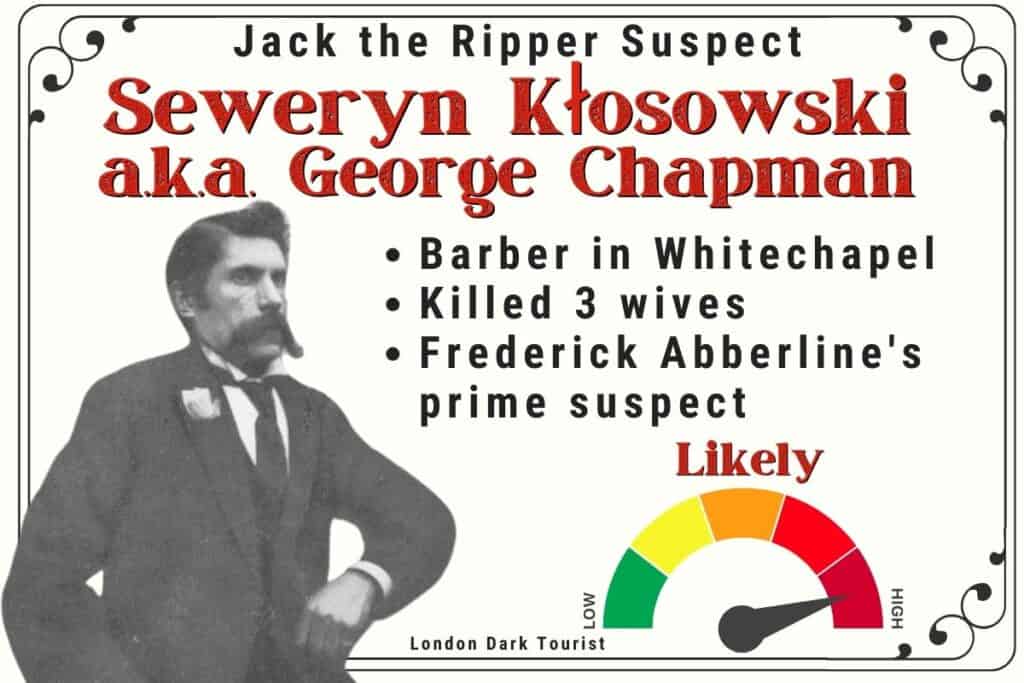
Originally from Poland, Seweryn Kłosowski landed in the East End around 1887-88. He took up work as a barber, and was therefore skilled with a blade.
In 1889, he married, and moved around between Poland, England, and the US.
In 1892, he attacked and brutally cut his pregnant wife. He then fled, took on 3 more wives and/or mistresses, and murdered them by poison.
Was George Chapman Jack the Ripper?
For a time, Chapman/Kłosowski was Abberline’s prime suspect, and he named him in several reports.
There is no evidence tying him to any of the Ripper murder victims, and it would also be strange for a killer to change his M.O. from stabbing to poison, but anything is possible.
- White Male ✅
- 28-36 Years Old ✅
- Solo Employment ✅
- Loner ✅
- Physical Deformity ❌
- Interviewed by Police ✅
- Suicide After Last Kill ❌ (hanged for other murders after fleeing the country)
21. William Henry Bury

Scottish suspect William Henry Bury moved to London in 1887 and lived in Bow, in the East End not far from the murder locations.
He married a sex worker, became a street peddler, and fled London in 1889.
After moving back to Dundee, he strangled his wife with a rope and cut her abdomen with a knife. He was hanged for his crime.
Was William Bury Jack the Ripper?
There is only circumstantial evidence against Bury, but the similarities and coincidences pile up. In prison before his execution, he was “known to have been Jack the Ripper.”
- White Male ✅
- 28-36 Years Old ✅
- Solo Employment ✅
- Loner ✅
- Physical Deformity ✅
- Interviewed by Police ❌
- Suicide After Last Kill ❌ (hanged for another crime)
Who Was Jack the Ripper, Really?
A poll conducted by JacktheRipper.org shows what the public thinks about Jack the Ripper suspects, and here are the results:
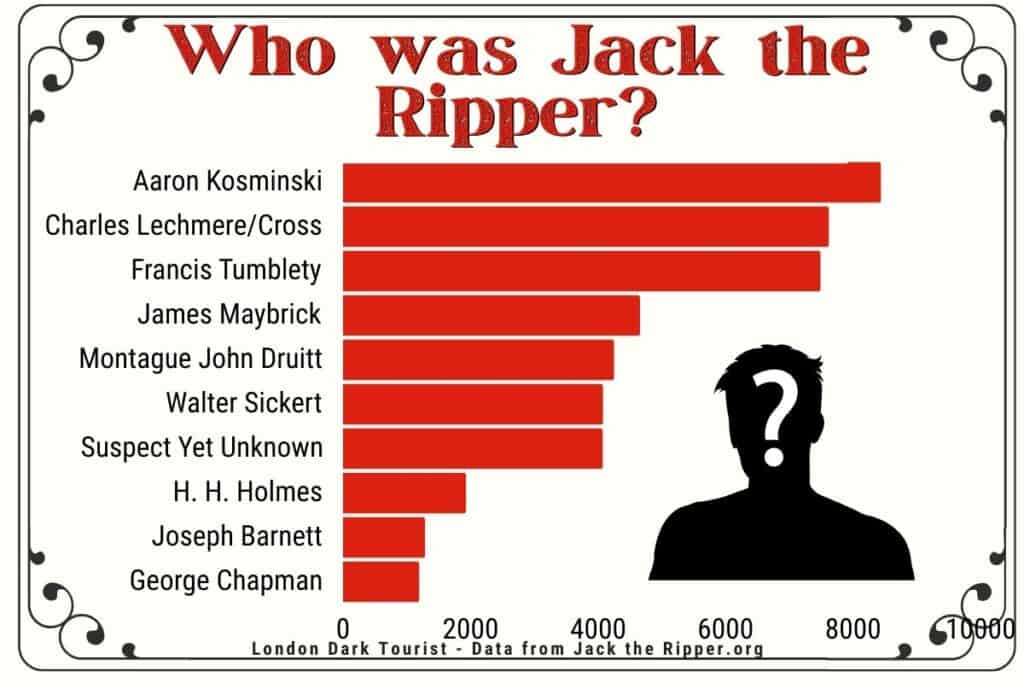
Kosminski, Lechmere, and Tumblety come out on top. But also important to note is that some very unlikely suspects ended up in the top 10!
This just goes to show that everyone believes something different, and your favorite suspect might be low down on the list for someone else.
It’s interesting to theorize about this case, but with files missing, evidence aged or never properly stored, and all witnesses long dead, we’ll never know for sure.
There will be no justice, and the only way we can emulate justice is by remembering the victims and honoring their lives.
Read More Posts in my Jack the Ripper Series:
- 7 Reasons Jack the Ripper was Never Caught
- Mary Anne “Polly” Nichols
- Annie Chapman
- Elizabeth Stride
- Catherine Eddowes
- Mary Jane Kelly
- Martha Tabram: The First Victim of Jack the Ripper?
More on London’s Dark History
Delia Balmer’s Story: Her Miraculous Survival of John Sweeney
Victorian Women: 101 Secrets of their Hidden Lives
Spooky Specters: 21 Ghosts of the Tower of London
Titanic Museum Southampton: Tour & 9 Treasures of the Collection
13 Famous Victorian Prisons of the Past: Shackles, Plague and Daring Escapes
Female Gangsters: How the Powerful 40 Elephants Gang Robbed London Blind
Famous London Murders: The Tragic Love of Joe Orton and Kenneth Halliwell
London Necropolis Railway: 6 Shilling Ghost Train to the Afterlife


