
Catherine Eddowes and the Ripper’s Reign of Terror
Catherine Eddowes was not the first to die on the evening of September 30, 1888.
This fateful night would go down in history as “The Double Event”, where two Jack the Ripper victims would be found within hours.
How did Kate Eddowes end up in the City of London that night, and what led her to sex work, addiction, and poverty?
Here’s the story of her life, her death, and her legacy.

Jack the Ripper Victims in our Timeline So Far:
- Mary Anne Nichols (August 30)
- Annie Chapman (September 8)
- Elizabeth Stride (September 30)
See my map for all of the East End locations associated with Jack the Ripper and his victims.
Who Was Catherine Eddowes?

Catherine Eddowes (Kate, to her friends and family), was born in Wolverhampton in England’s West Midlands.
She moved to London as a baby with her family, where her father found employment in the City.
She was one of 12 children, of whom only 10 survived.
By the time Kate was 15, both her parents had died, leaving her and her siblings destitute.
Bermondsey Workhouse

Kate and 3 of her siblings landed in Bermondsey Workhouse, South London.
She got bits of education here and there, both from a charity school associated with the workhouse, and whilst living back in Wolverhampton with an aunt.
She bounced around between the Midlands and London, and eventually got together with a chap called Thomas Conway whilst living in Birmingham.
Catherine Eddowes’ Family & Children
At first, Kate’s match with Thomas seemed ideal. He was a teetotaler, and kept her on the straight and narrow after a chaotic upbringing.
It’s unclear whether Catherine and Thomas ever married, but they son had two children together: daughter Catherine in 1863, and son Thomas in 1867.
They moved back to London and had another son. But their peace wouldn’t last.
Kate began drinking heavily, which Thomas disapproved of, and cracks in the relationship deepened. Kate was seen with bruises on her face during this time.
It’s unclear whether Thomas began abusing her after the drinking, or whether the drinking was caused by domestic violence. Either way, Kate had to leave. But she had nowhere to go.
Kate Moves Out

By 1880, she finally got the courage to leave her abuser, sadly leaving her three children behind.
Kate moved into Flower and Dean Street (where Elizabeth Stride also lodged; it’s unclear whether they knew one another). This was a “slum” street full of cheap lodging houses, in a very poor part of the East End.
She soon met and shacked up with John Kelly, a fruit salesman, and they tried each day to earn enough for a bed for the night, living hand to mouth.
Her drinking only got worse.
She tried everything she could to survive: begging her remaining family for money, hop picking in Kent, and finally resorted to sex work.
By the summer of 1888, she was a mess. She and John were back in London after the hop picking season, and they split up to get cheaper lodging separately.
Did Kate Know Her Killer?

Upon arriving at her lodging house in September of 1888, the keeper asked her what she’d been up to.
She replied she’s been making money hop picking, but that she would soon get more funds because she was going to claim the police reward for information on the Whitechapel Murders.
“I think I know him,” she claimed.
Did Kate really know who the Ripper was? Or was she making a play to earn some money?
The Double Event: September 30, 1888

On September 29, 1888, Kate was arrested. She was wandering about half a mile from her lodging house.
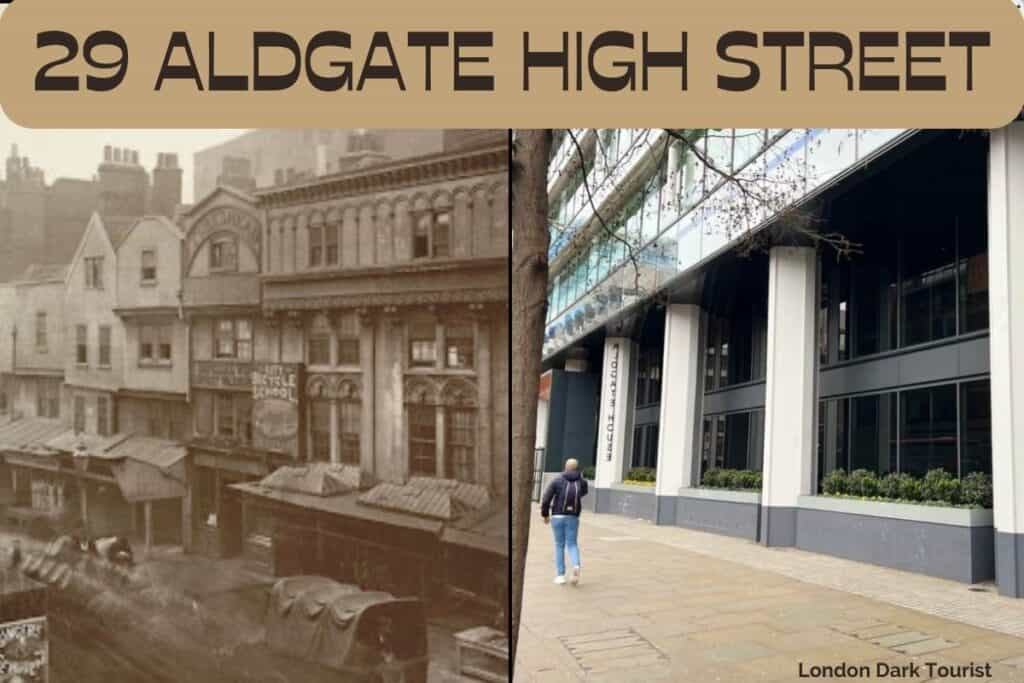
Outside 29 Aldgate High Street, she was entertaining passersby with “a very loud impression of a fire engine.”
She then passed out on the pavement, and was arrested for drunk and disorderly conduct.
Kate was detained at Bishopsgate Police Station – only a few blocks from her point of arrest – and quickly passed out in a cell.
She woke in the early morning hours of September 30th and asked to be released.
The jailer judged her sober enough, and she left the station, walking toward Aldgate.
Here we have to suppose she’d spent all her lodging money on drink and was looking for work, because she didn’t leave in the direction of her lodging house.
Instead, she went the other direction. At around 1:30 am she was witnessed speaking to “a man of medium build with a light colored mustache” and salt-and-pepper coloured jacket.
Three men walking through Church Passage, which led to Mitre Square, were the last to see Kate alive and gave the man’s description to police.
The Discovery of Catherine’s Body in Mitre Square, London
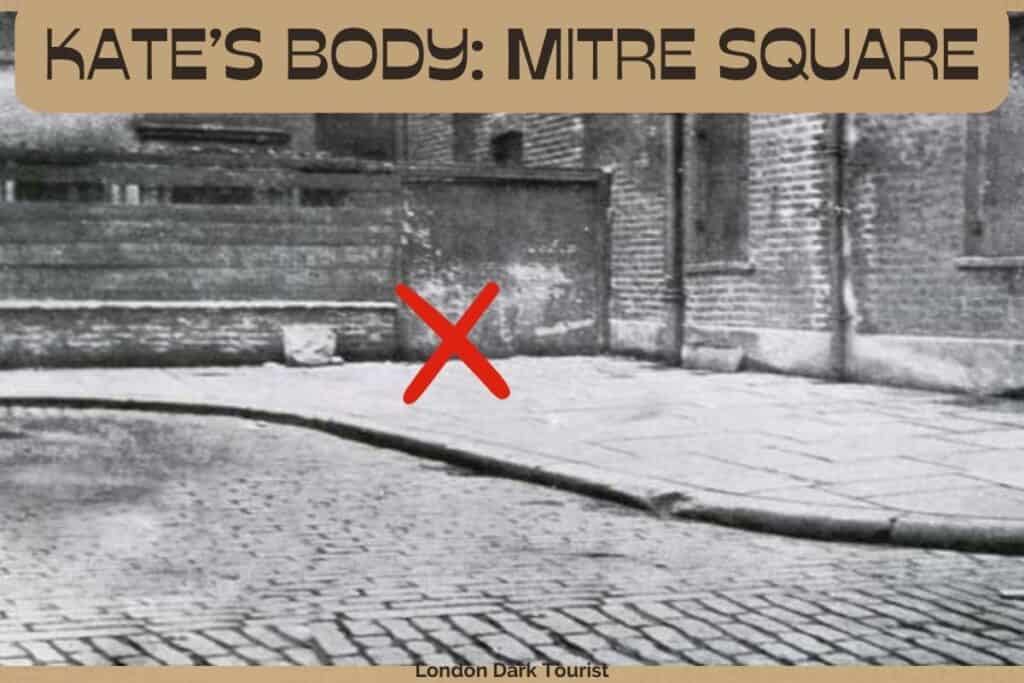
Just fifteen minutes later–around 1:45 am–Kate’s disemboweled body was found in the southwest corner of Mitre Square, London.
PC Edward Watkins was passing through Mitre Square on his beat, only 14 minutes after the last time he had passed through at 1:30am.
After fetching assistance, more police arrived. All the local bobbies on their beats reported nothing unusual that night, and they all patrolled the area vigorously.
This means that the killer was taking a huge risk: there were police all around, in a tightly-packed area, in the middle of a square where all nearby residents could see down into the centre.

Keep in mind that only hours earlier, Elizabeth Stride’s body was found in Dutfield’s Yard, Berner, Street, only half a mile away in Whitechapel.
Elizabeth was found around 1am. Kate’s body was found around 1:45am.
This would give the killer plenty of time to travel between locations – it would have been about a 15 minute walk between Berner Street and Mitre Square.
But it doesn’t leave much time for the killing itself. That part would had to have been fast and brutal. And indeed, it was.
But it was also much, much more gruesome than Liz Stride’s murder just an hour before.
Catherine Eddowes Injuries

The killer took his time and was deliberate in the injuries and staging.
Whereas the murder just an hour ago of Jack the Ripper victim Elizabeth Stride was quick and simple, this one was methodical.
The post-mortem report concluded Kate suffered:
- Cut throat
- Disembowelment
- Mutilated face, including ears, eyes, cheeks, and nose
This amount of injury would have taken a long time. The location was not hidden except by darkness.
This was a bold, brash, and brutal murder by a fearless perpetrator.
Catherine Eddowes Apron: The Only Jack the Ripper Clue

Later that morning, around 3 am, a corner of Kate’s apron was found a few blocks away.
The apron would be taken into evidence. It was stained with blood and “fecal matter”, but as there was yet to blood type matching or DNA technology, not much could be done with it.
The bloody and stained portion of apron was located in the stairwell of a tenement on Goulston Street.
Police had been searching the area, and came across not only the apron, but some horrific graffiti above it.
The Goulston Street Graffito

Scrawled above the apron was anti-semitic graffiti (I will not repeat it here), which was immediately washed away by the police so that the press couldn’t get a photo.
It’s not clear whether the graffiti was trying to blame the murders on a specific demographic, or whether it was just terrible, hateful words that happened to be on the wall near the apron.
We don’t know who wrote it, but the killer had to have been there to either drop the piece of apron, or place it deliberately.
The Goulston Street Graffito would take detectives down several rabbit holes, turning up new suspects and disregarding old ones.
Catherine Eddowes Shawl: A Modern Clue

The Catherine Eddowes apron found on Goulston Street could have been a big break in the case, had there been any technology to identify bodily fluids.
But a second clue – which has come to be of importance in more modern times – is a shawl that belonged to her.
The shawl was supposedly taken from the crime scene by a police officer, passed through several owners, and was recently sold at auction for an eye-watering £2.9m.
Recently, author Russell Edwards had the shawl DNA tested and wrote a book about it called “Naming Jack the Ripper”.
Scientists have questioned the shawl’s provenance and iffy DNA evidence, but Russell is convinced he has discovered the name of Jack the Ripper: Aaron Kosminski.
Catherine Eddowes Grave

Catherine Eddowes was buried in the City of London Cemetery, Manor Park (Mary Anne Nichols is also buried here).
The exact location of her remains is unknown, but there is a grave marker where you can leave an offering.
I hope that she can rest in peace, knowing that she did the best she could. Nothing that happened was her fault – she was living in a brutal time for women, where there was no safety net and women entirely relied on men.
We should try to remember her as the fire-engine-imitating, larger-than-life character she was, rather than one of many Jack the Ripper victims.
Rest in peace, Catherine Eddowes.
Locations
See my London Dark History Map to view all the Jack the Ripper victim locations in one map!
- Flower and Dean Street, now Flower and Dean Walk, London E1 6QT
- 29 Aldgate High Street, where Kate was arrested the night of her murder: EC3N 1DL (the address doesn’t actually exist anymore as it’s all covered by a large office block)
- Mitre Square: EC3A 5DE (Kate was found in the southwest corner, see photos above. There is a memorial plaque on the wall in the square; make sure to check it out)
- Catherine Eddowe’s grave: City of London Cemetery (not in the city of London–it’s much further out), E12 5DQ
Other posts in this series:
- Why Was Jack the Ripper Never Caught?
- Mary Anne “Polly” Nichols
- Annie Chapman
- Elizabeth Stride
- Mary Jane Kelly
- Suspects
- Martha Tabram: The First Victim of Jack the Ripper?
Sources
- The Five, by Hallie Rubenhold
- The Complete History of Jack the Ripper, by Philip Sugden
- The Ultimate Jack the Ripper Sourcebook, by Keith Skinner & Stewart Evans
- Dissecting Jack-the-Ripper: An Anatomy of Murder in the Metropolis by Elizabeth Hurren
- The Whitechapel Murders: The Case of Jack the Ripper, by W G Eckert
More on London’s Dark History
Female Gangsters: How the Powerful 40 Elephants Gang Robbed London Blind
Famous London Murders: The Tragic Love of Joe Orton and Kenneth Halliwell
London Necropolis Railway: 6 Shilling Ghost Train to the Afterlife
8 Quid for a Grave-Robbed Corpse: How the London Burkers Turned to Murder
The Moorgate Tube Crash: Why Did 43 People Lose Their Lives?
Kray Walking Tour of East London: 7 Free Spots You Can See Today


