
Annie Chapman: The Murder at 29 Hanbury Street
It’s the summer of 1888, in the East End of London.
Annie Chapman – like many of Jack the Ripper’s other victims – was trying to survive in the midst of poverty, alcoholism, and sex work.
The Ripper’s first victim Mary Anne Nichols was butchered in the end of August, and now we fast forward to just eight days later.
The death of the Jack the Ripper’s second canonical victim, Annie Chapman, was just as horrific as the first.
But how did Annie go from high society to slumming the streets of the East End? Like so many women of the era, it began with losing the financial support of a man.
This is the story of the murder of Annie Chapman: her life, her death, and how she came to be in such a vulnerable position.

See my map for all of the East End locations associated with Jack the Ripper and his victims.
Annie Chapman: Early Life, Marriage and Family

Annie Chapman was born Eliza Ann Smith in 1850 in Paddington, West London.
Her father was in service to some of the richest Londoners of the era. She grew up amongst high society, and lived in Kensington, Windsor, and Knightsbridge.
Though she grew up in posh areas, her family was troubled. Alcohol was part of her family from an early age, and she was said to have a weakness for drink from her teen years.
Her father completed suicide when she was only 13 years old by slitting his own throat.
Annie married her cousin John James Chapman in 1869, who also worked in service.
Annie Chapman’s Children

The couple had three children together.
Their eldest, Emily Ruth Chapman, didn’t live past the age of 12. She died of meningitis in 1882.
Their middle child, John Alfred Chapman, was born with severe mental and physical disabilities, and had to be put into care. He may have been a victim of fetal alcohol syndrome, though we don’t know this for sure.
Their youngest child, Annie Georgina, was the only child still living with the couple when they separated after Emily’s death.
Annie’s Downfall Begins

After their oldest child died, the couple both took to drink to try to cope. After they had to put their son into care, it got even worse.
The couple officially separated in 1884, and their remaining daughter stayed with her father.
John paid Annie 10 shillings a week for spousal support, which she barely survived on by lodging in a cheap boarding house in the East End.
In 1886, John Chapman died of cirrhosis of the liver, leaving his estranged wife destitute.
This is likely what caused Annie to pursue sex work as a means to survive.
Summer 1888: Dorset Street
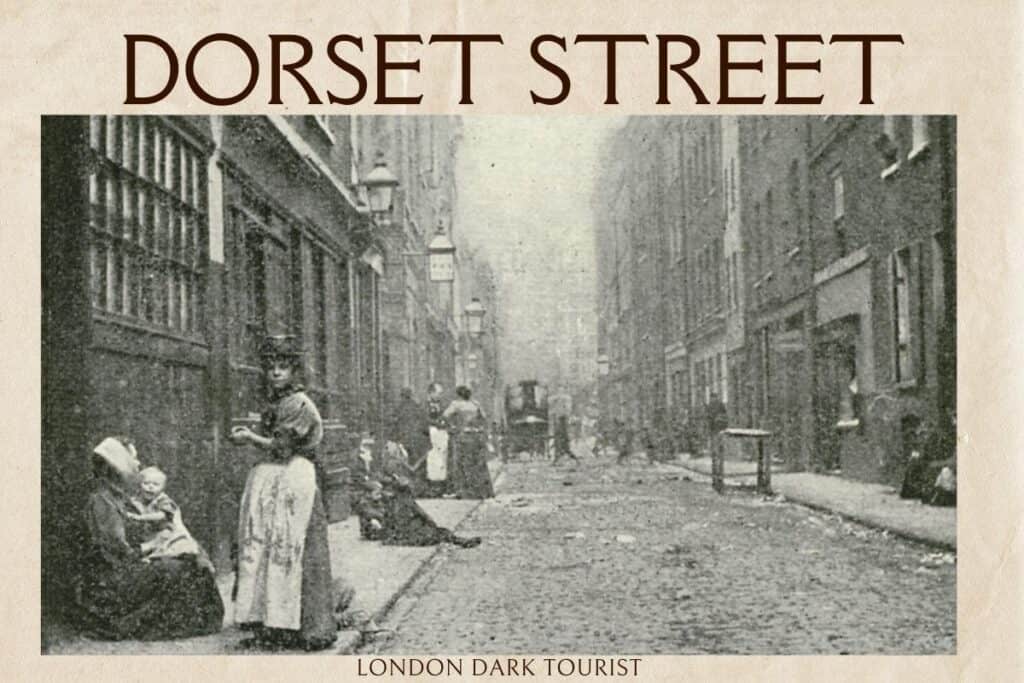
In the summer of 1888, Annie was living at Crossingham’s lodging house in Dorset Street.
This was a notorious slum that features a few times in the the stories of Jack the Ripper victims (we’ll come back to Dorset Street for Mary Jane Kelly).
She was not doing well. She was pale, she’d been in and out of the hospital, and she was living hand to mouth.
The Night of Annie Chapman’s Murder
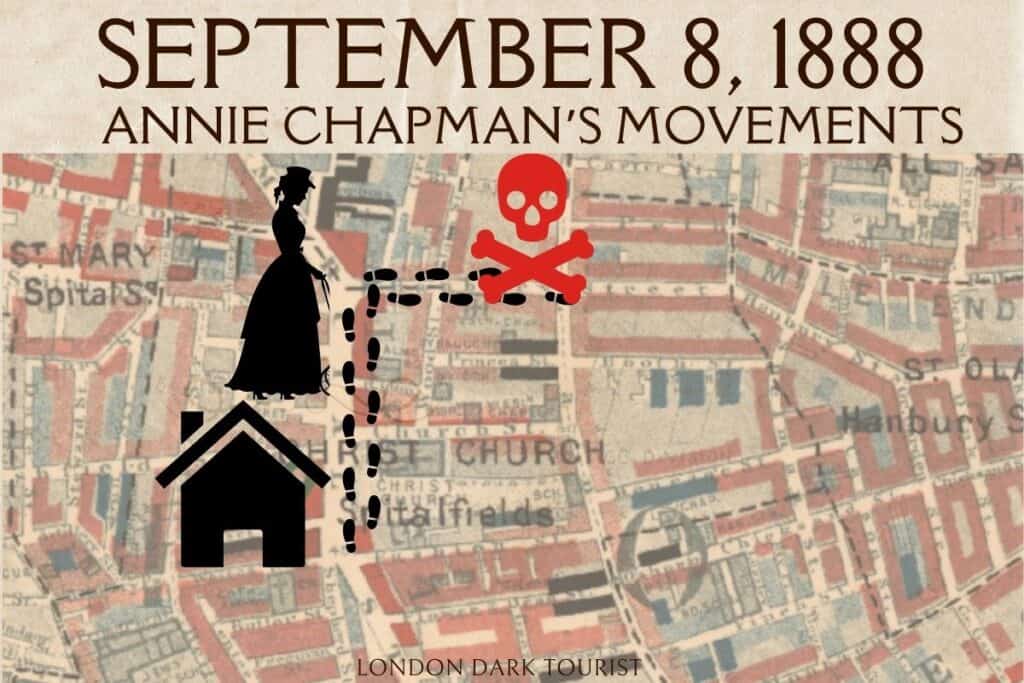
The early morning of September 8th, she was resting in the communal kitchen at the lodging house because she didn’t have the money for a bed yet.
She said to the landlord, “I won’t be long, Brummie. See that Tim keeps the bed for me.”
She left in the direction of Spitalfields. We can assume she went looking for a client to make some money for her bed.
Annie Chapman Meets Jack the Ripper

The last person to see Annie alive was a woman passing by the yard of 29 Hanbury Street at 5:30am.
Hanbury Street wasn’t terribly far from her lodging house, so it’s likely she was with a client to quickly make some money, then go back to pay for her bed.
This witness heard a man ask, “Will you?” And Annie replied, “yes.”
The witness said the man was over 40, slightly taller than Chapman, with dark hair, and of a foreign, “shabby-genteel” appearance.
He was wearing a brown low-crowned felt hat and possibly a dark coat.
Her Body, Found at 29 Hanbury Street

Annie’s body was discovered by a tenant around 6am in the backyard of 29 Hanbury Street.
29 Hanbury street was a private residence; different people rented different rooms, with the landlady living onsite.
This location is key to the investigation.
29 Hanbury Street was a terraced house; you couldn’t walk around the sides of the house to get to the back.

In terraced homes, one stretch of houses takes up an entire block back to back, with no public pass-throughs or alleyways.
The only way to the backyard was through the home’s hallway, or by accessing the alley from one end of the block. But the backyards were generally fenced in.
The big question is: why this house?

Well, we think that Annie knew this house, and the landlady who occupied the main floor.
The landlady said in court testimony that Annie used to come by and sell little crocheted flowers that she made for hats.
It’s possible that Annie would have known that the door and hallway between the front of Hanbury Street and the backyard was always either unlocked or just wide open.
The landlady said she didn’t ever lock the door, as tenants were coming and going all the time.
The theory is that Annie led her attacker to the back of this house for a little privacy, and he killed her there.
Annie Chapman Jack the Ripper Investigation
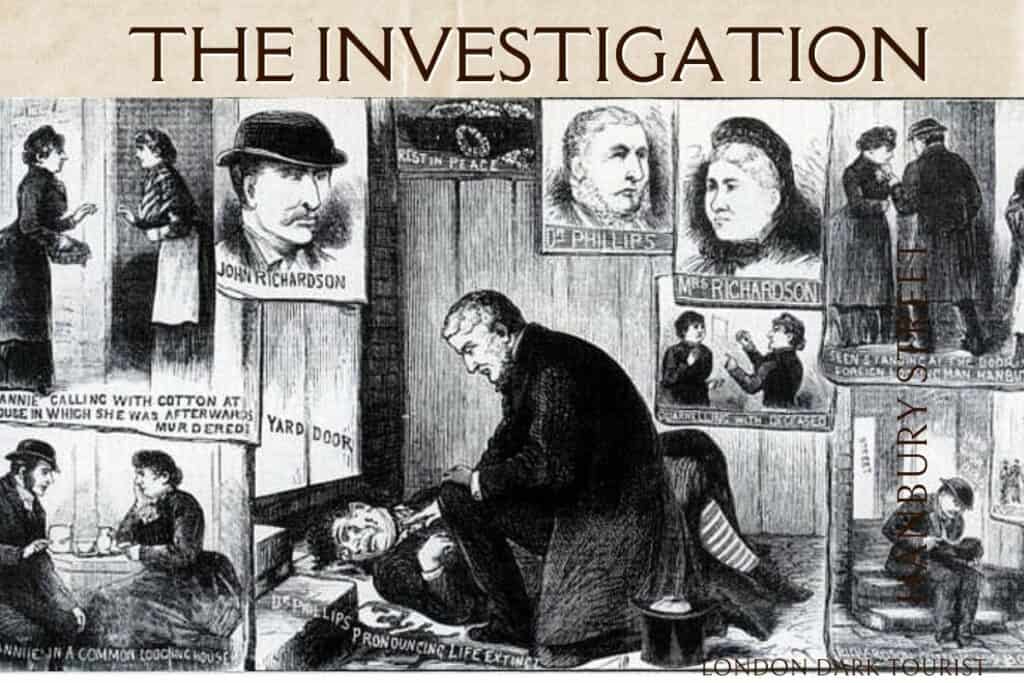
The media immediately connected Annie’s murder with the murder of Polly Nichols. The two cases were eerily similar.
Annie was slashed ear to ear – very deeply – and her abdomen was mutilated. Polly’s body had similar injuries.
Detectives observed the same pattern of wounds, and the knife seemed to be of a similar size.
At this point, “Jack the Ripper” had not yet been coined. But the press was starting to churn, and “The Whitechapel Murders” were big news.
Jack the Ripper Second Victim: Could it Have Been Prevented?
Police interviewed the next-door neighbor whom shared the back fence with 29 Hanbury Street.
The neighbor said he came out sometime in the early morning hours to use the privy, and said he heard a woman scream “no, no!” and then heard something heavy falling against the fence.
He did not investigate or call for help. He just went back inside.
They did find blood splatter on the fence, which corroborated his testimony. Why did the neighbor do nothing to help?
But what’s most terrifying is if he heard the murder, the murderer heard him.
Jack the Ripper wasn’t dissuaded by a witness, which is absolutely bone-chilling.
Annie Chapman’s Grave

Annie was buried in a public grave in Manor Park Cemetery.
Today, the location of her remains is unclear as public graves were added to, moved and rearranged over the decades.
There is a memorial plaque near which you can leave her “doss money” and honor her life.
Annie, Annie, Annie. You deserved so much better. Rest in peace.
Jack the Ripper Annie Chapman Locations Today:

See my London Dark History Map for all locations related to Jack the Ripper’s victims.
- 29 Hanbury Street: the original home was demolished and replaced with a large building that contains a brewery and some shopfronts.
- Dorset Street no longer exists. It would have run parallel to what is now Brushfield Street and White’s Row, but now the whole block is covered by a large office/retail complex. If you walk through the open atrium of the office block (during office hours only), Dorset street would have been right in the middle.
Complete Jack the Ripper Victim Series:
- Mary Anne “Polly” Nichols
- Elizabeth Stride
- Catherine Eddowes
- Mary Jane Kelly
- Suspects
- Martha Tabram: The First Victim of Jack the Ripper?
Sources
- The Five, by Hallie Rubenhold
- The Complete History of Jack the Ripper, by Philip Sugden
- The Ultimate Jack the Ripper Sourcebook, by Keith Skinner & Stewart Evans
- Dissecting Jack-the-Ripper: An Anatomy of Murder in the Metropolis by Elizabeth Hurren
- The Whitechapel Murders: The Case of Jack the Ripper, by W G Eckert
More on London’s Dark History
What’s the Oldest Pub in London? 13 Curious Contenders
Gross Jobs in the 1800s: 10 Dirty and Dangerous Victorian Jobs
Bricks to Burberry: The 7 Worst Areas in London that are Now Super Posh
10 Ghastly Royal Deaths and What Happened to Their Corpses
London Charterhouse Square: Are There 50,000 Bodies Buried in this Lovely Garden?
Temple Bar London: Why did this London City Gate Sport Rotting Heads on Top?


