
Why Was Jack the Ripper Never Caught? 7 Important Reasons
 Why was Jack the Ripper never caught?
It’s one of the most fascinating and mysterious serial murder cases in the world , and has been captivating the world since 1888.
But how did Jack the Ripper get away? What really happened inside the Jack the Ripper investigation, and how did it fail so spectacularly?
Let’s look at 7 big reasons why the killer was never caught, and what went wrong.

See my London Dark History Map for all of the East End locations associated with Jack the Ripper and his victims.
Why Was Jack the Ripper Never Caught?
First of all, let’s get one thing straight: “Jack the Ripper” isn’t real.
You heard me! “Jack the Ripper” doesn’t exist. He’s a fictional character created by the media storm that this case created in the press.
The murders were real. They were called “The Whitechapel Murders” in the police files of the day.
But the suspect’s nickname “Jack the Ripper” is a moniker likely created by a crafty journalist to sell more papers.
The murderer of Mary Jane Kelly, Annie Chapman, Elizabeth Stride, Catherine Eddowes, and Polly Nichols (and maybe more victims) actually existed, and he actually got away.
I point out this common confusion because lost in all the “Ripperology” and “Ripper” lore are the victims.

We focus so much on who Jack the Ripper was, and pour over suspects, and study every Ripper crime scene.
But the heart of this tragic story is five women–sometimes more, sometimes less, depending on what you believe, but I’m going to cover the “canonical five”–who were struggling in poverty and with addictions.
They had no one to help. Jack the Ripper victims were trying to help themselves with the only resources they had, and they got killed taking that risk.
How did their killer get away?
It all comes down to the circumstances of 1888. Let’s look at what Whitechapel was like, and how this notorious killer slunk away into the darkness.
1. Jack the Ripper Murders Were Committed in Total Darkness

Each of the canonical five Jack the Ripper murders was committed under cover of total darkness.
Electric lighting wasn’t a thing yet in 1888, and streetlamps weren’t common either.
Torches and gas lamps were few and far between in the East End. To have an outdoor light, you needed to pay for fuel, and also pay someone to carry a torch and light a tall streetlamp each night.
Some private homes had street lamps outside, but the city didn’t install consistent street lighting in the poor East End until later.
These crowded, dirty streets were very dark, creating a perfect ambiance for a killer to skulk away into the night.
This is the total opposite of a case like the notorious murder of Jill Dando, whose killer committed the heinous act in broad daylight.
But still, both killers remain anonymous, so there’s much more to it than daylight. Let’s look at the other reasons.
2. Jack the Ripper Victims Lived in Poverty

Whitechapel and the surrounding areas were full of people struggling to get by, and many of them were just trying to avoid the crime and violence to keep themselves alive.
For a lot of poor women, sex work is how they did that.
Not only was violence against women pretty normal and tolerated at this time (even though that’s absolutely abhorrent), sex workers were treated as “unfortunates,” whom society didn’t really care about.
Jack the Ripper victims were out at night, in the pitch black dark, with very little protection and little recourse if something did happen.
If five women in the wealthy West End were murdered, you can bet that the Jack the Ripper investigation would have made a lot more progress.
3. How Did Jack the Ripper Get Away? Anonymity.

Whitechapel was an immigrant area.
People were pouring into the East End from all over Europe to try to make a go of it.
Because of the cheap lodging and jobs at the nearby docks, hordes of people were coming and going all the time.
It would be pretty easy for a killer to go unnoticed because strange faces weren’t even strange. It was normal to walk past a million different people, never think twice about it, and not know your neighbors (same as London today, honestly, in many places).
The Jack the Ripper murders were nearly impossible to solve because the population was so transient, and there was no way to track people’s comings and goings.
4. Jack the Ripper Police Methods Were Unsophisticated

Policing was still in its infancy when these horrendous – and complex – crimes occured.
Forensics as we know them didn’t exist in 1888, and preserving a crime scene wasn’t even considered.
Police relied heavily on witnesses and any physical clues left behind. And if they did find clues, they still relied on witnesses to put the pieces together.
In this case, they found only one concrete clue in the entire series of crimes (the corner of an apron), but they then needed to find a witness to say that it did, in fact, belong to the victim.
There was no way to match blood type, so the clue itself told them very little.
They could take fingerprints, but there was no database.
They did measure skulls of perpetrators, but measurements weren’t all calibrated the same way, so this too was unreliable.
Jack the Ripper police just had few tools to work with, and a lot of policing relied on plain luck.
5. The Media Interfered in the Jack the Ripper Investigation

We only say the name “Jack the Ripper” because of media interference.
The infamous “Dear Boss” letter – from which this nickname arose – was likely fraudulent, and penned by a reporter to amp up the intrigue.
This case created a media storm, and reporters interfered with crime scenes, witnesses, timelines, and riled up the public. It was the opposite of helpful.
6. Murder Was Rare
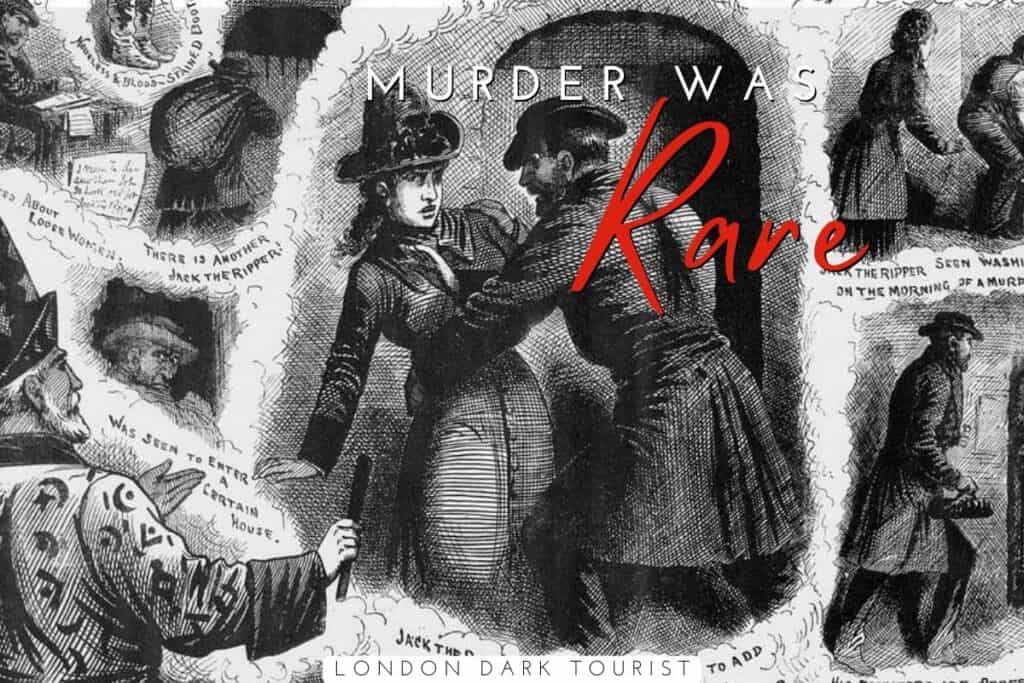
Though it seems like the East End was a lawless land of poverty and crime, the murder rate was actually pretty low.
London had a total of 80 murders in the year prior (1887), and none of them took place in Whitechapel.
What does that mean? The police had very little experience. Many of them had never worked a murder case before, let alone a serial murder case.
7. Jack the Ripper Victims were “Nobodies”

The most important reason that Jack the Ripper slipped away was because he killed women that no one cared about.
His victims didn’t have money, or status, or families with influence. They were sex workers mired in poverty and addiction.
They had no one to pressure the police; no one to fight in their corner. And therefore, their murders were not as “important” as that of a wealthy West End woman.
It’s a sad reality that no one cared about these women, in life or in death.
It’s No Wonder the Jack the Ripper Murders Went Cold
With this perfect storm of factors, it would have been next to impossible to catch the Ripper.
He was stealthy, and lucky, and the police had poor resources to catch him.
No attention was paid to the victims, and all attention went (and still goes) to the mysterious killer.
So let’s give Jack the Ripper victims a little love, and put them in their rightful place in history.
They were not just “prostitutes,” but real women who had real lives, trying to survive in a difficult place and time, and suffered immensely.
Read on in this series to discover more about the victims and how they came to live in Whitechapel.
Jack the Ripper Series: Read More
- Mary Anne “Polly” Nichols
- Annie Chapman
- Elizabeth Stride
- Catherine Eddowes
- Mary Jane Kelly
- Jack the Ripper Suspects
- Martha Tabram: The First Victim of Jack the Ripper?
More on London’s Dark History
The Muffin Man Murders: Death on Drury Lane?
10 Rillington Place Today: Notorious Murder House Then & Now
Secrets of a Serial Killer: Uncovering the Truth About John Reginald Christie
The Workhouse Howl & 13 Other Devastating Facts on Life in the Workhouse
Kray Walking Tour of East London: 7 Free Spots You Can See Today
London Serial Killers: 11 Documentaries on YouTube to Watch Now


