
Female Gangsters: How The Powerful 40 Elephants Gang Robbed London Blind
While the Peaky Blinders ruled Birmingham, one real-life rival gang of female gangsters ruled London: the Forty Elephants.
Alice Diamond and her cronies took London by storm, pioneering new methods of theft and leaving a wake of chaos and confusion.
This is the story of the 40 Elephants gang: how they smashed, grabbed, and used the patriarchy against itself.

Much of this post was gleaned from two fantastic books: 40 Elephants by Erin Bledsoe and Alice Diamond and the 40 Elephants: The Female Gang that Terrorized London by Brian McDonald.
40 Elephants: London’s First Female Gangsters?
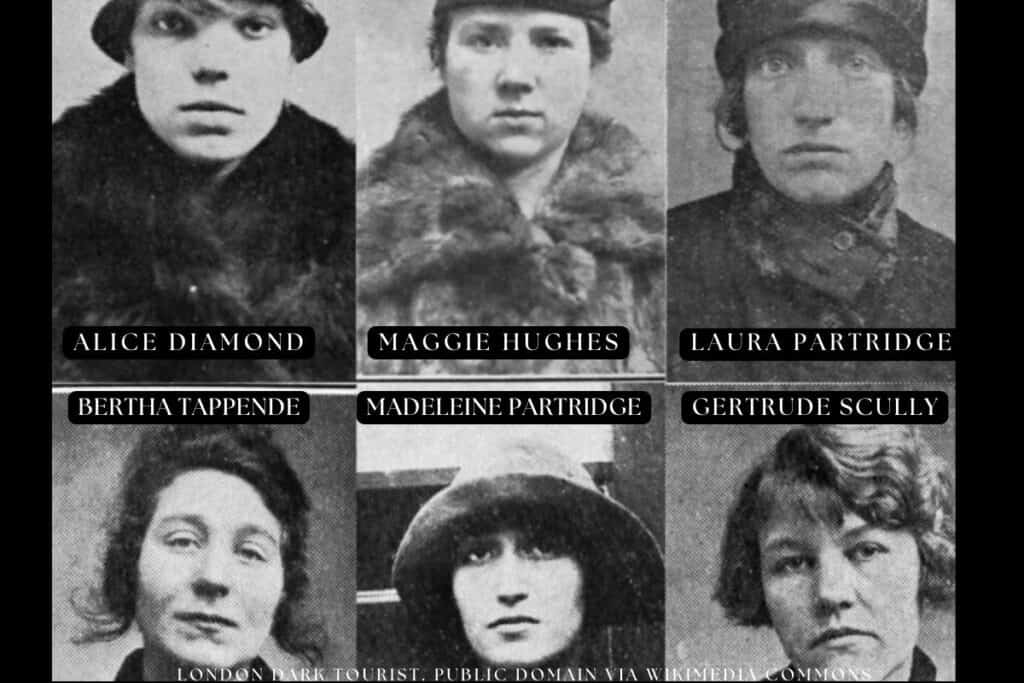
Based in Southwark’s Elephant and Castle neighborhood, the gang was entirely comprised of women from the area.
The first mention of the gang in newspapers was in the late 1800s, at which time they mostly targeted individuals with theft and blackmail.
At that time, they were known as ‘The Forty Thieves’, though some records suggest that there may have been some iteration of this gang as early as the 1700s.
Their leader in the beginning was Mary Carr, a notorious thief well known to the police. Mary was a pro at fencing stolen goods, quickly selling them so they couldn’t be traced.
Under Mary, the gang was loosely organized, and sometimes partnered with the all-male Elephant & Castle mob of the same area for mutual benefit.
The Birth of the Hoister

Mary had started something big: the dawn of the female hoister.
1900-1920 was the peak of the industrial revolution, when working-class women had limited choices: marry and have a family, work their fingers to the bone to make poverty wages, or do both simultaneously.
Wealthy women, however, lived a life of pleasure and leisure.
The Forty Thieves gang decided to use their diminished existence as women to their advantage: they posed as rich women shopping for leisure, and became hoisters.
It was quickly very lucrative, but at the time of Mary Carr’s rule of the gang, they were still comparatively small-time thieves.
40 Thieves: Alice Diamond Hones the Craft

40 Thieves leader Mary Carr was always in and out of jail. This allowed a new queen bee to take over: Alice Diamond, aka “Diamond Annie”.
She took over leadership of the gang at just 20 years old, and quickly evolved their small thefts into a big-time operation.
If Mary Carr created the hoister status, Diamond Annie turned it into a proper profit machine.
Alice Diamond ran the group with a strict code of conduct: no drinking on the job, early to bed, and no outsiders. The gang was only to associate and have relationships with others from Southwark whom they could trust.
“Diamond Annie” planned simultaneous heists all over the West End, leaving coppers scrambling to chase them all.
Her nickname came from her fists of diamond rings, which she used to land a punch to anyone who got in her way; even the police.
The Forty Elephants Gang is Born

The 40 Thieves became very active under Alice’s rule in the 1910s and 20s, and soon became known as ‘The Forty Elephants Gang.’
This is a likely a cheeky nod both to their home turf (Elephant & Castle), as well as their occupation: they looked like elephants leaving a shop with furs stuffed under their bustles.
The Retail Explosion
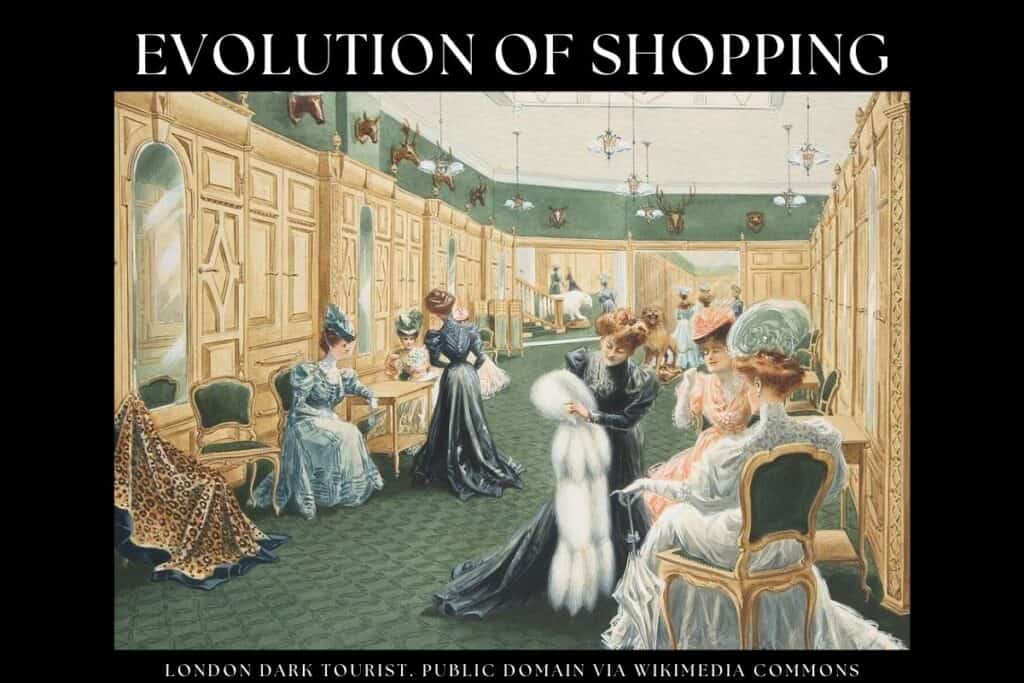
Before department stores became as prolific as they are now, high-end shopping was very different.
Ladies of leisure would sit, and staff would bring them products to suggest and try on. There were no displays – items for sale were mostly kept in a back room tucked away.

But with the rise of the “retail experience,” pioneered by Harry Selfridge, goods had never been so easy to steal.
Selfridges was one of the first department stores to actually display items for customers to touch and try on, hence lots of merchandise was available on the shop floor.
It was a lot easier to steal when you didn’t have to ask the clerk for an item to be brought out.
Of course, jewelry was still kept safely tucked away. But the gang had a way around that.
Female Gangsters, Female Clothing: Innovative Tactics

The Forty Elephants Gang had a few innovative tactics that the male thieves of the era never used, and it’s precisely because they were women that allowed them these methods.
Men’s wardrobes of the era left little room for stolen goods to be stashed unnoticed.
But women’s clothing of the era was voluminous, with lots of layers and accessories. There was tons of space below bustles and under skirts, and Alice Diamond and the 40 Elephants used that to their advantage.
They created ingenious devices within their clothing that enabled them to steal away without being caught.

The first was the false arm: one female gangster would hide her real arm under a fake one, nested in a muff or under a cape. She would then use free – but hidden – fingers underneath to pilfer from the shelves.
The gang also sewed custom pockets and compartments into their skirts and knickers in which to stash the goods. That way their thefted items were safely tucked away, and wouldn’t fall out as they made their escape.
Alice ensured the gang never wore the goods they stole. Stolen goods were fenced immediately, and then the ladies purchased couture with the profits.
They alway wore the latest fashions to pose as women of status, which in turn granted them access to high end shops.
Female Gangsters, Dressed as Male Gangsters

Since the 40 Elephants didn’t allow men into their group, they had to play both parts to convincingly look like a wealthy couple shopping.
At this point, retailers were on the lookout for a gang of women, so the thieves resorted to crossdressing. It was an ingenious move, and allowed them to continue even as their notoriety hit the news.
Sometimes the “couple” would sit at a posh restaurant, then create a diversion to steal ladies purses or fur coats.
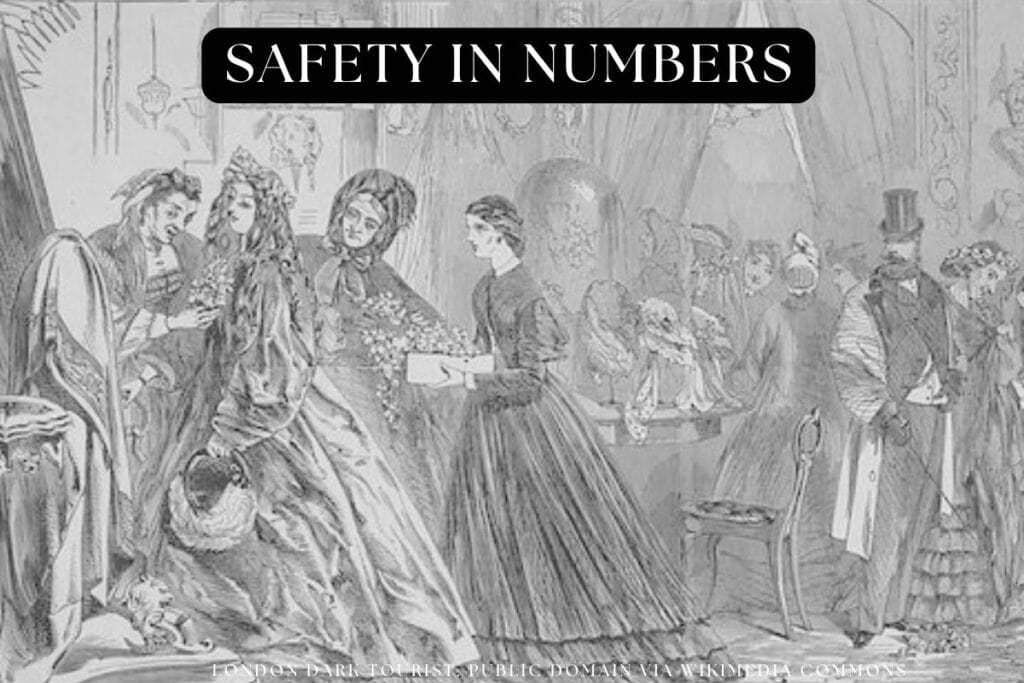
Another popular tactic as the gang’s reputation became known was “the crush.” A group gang members would rush the jewelry counter, ogling the goods and passing them around, confusing the clerk and dispersing quickly.
Sometimes one Elephant would stick the jewelry to the bottom of the counter with chewing gum during the crush, walk away, and another would retrieve it later.
They were also known to create precise replicas of expensive pieces, switching the fake for the real under the nose of the clerk.
Once Alice Diamond’s face was all over the papers, they would use her notoriety to their advantage. While Alice was followed closely by staff, an unknown or new member would steal away.
The Gang Diversifies
As their reputation in the retail world became inescapable, the gang resorted to new and innovative tactics.
The women would take on maid positions in posh residences with fake references, robbing the families blind right from under their noses.
They even resorted to stealing from their ‘fences’ – the clients who bought the stolen goods.
In one instance, Alice and her gang sold gold filings to a “fence” for £1,000. The filings turned out to be brass with a few gold filings on top, not worth even £20.
The fence didn’t dare speak on the matter, and he later ended up dead. Coincidence?
The Violent Downfall of the 40 Elephants
In the mid 1920s, Annie’s strict and violent ways would mark the beginning of the end for the gang.
One member, Marie Britten, fell in love and became pregnant by a man not from their neighborhood. The couple married against Alice’s wishes, and the boss flew into a rage.
One night at the Canterbury Social Club (on what is now Upper Marsh Street), drunk and probably high on cocaine, Alice instructed the gang to “take out” Marie’s husband.
Armed with bottles, rocks, and concrete, they broke into Marie’s home (Johanna Street, Lambeth. The street still exists today) and beat him senseless while poor Marie watched.
This violent incident, which became known as the ‘Lambeth Riot,’ saw many of the members sentenced at The Old Bailey to hard labor.
Annie was put away for 18 months, and 9 other gang members were sentenced as well.
During this time another leader rose to prominence.
Lillian Rose Kendall ; the “Bobbed-Haired Bandit”

The next 40 Elephant boss was Lillian Rose Kendall, who was nicknamed the “bob-haired bandit” for her signature roaring twenties hairstyle.
The gang was notorious at this point, so Lillian took them in another direction: the smash-and-grab.
In the cars that they bought with money from stolen goods, they would run full speed into shop windows in the middle of the night. Grabbing everything they could, they would sneak away into the darkness, leaving the shopkeepers to clean up the wreckage in the morning.
Eventually the gang petered out as wartime gripped London and the world changed. Gang members were arrested, moved away, or got real jobs as the men were shipped off to war.
After Alice Diamond was finally released from prison, she ran a brothel before dying of MS in 1952.
Female Gangsters Lasting Mark on Society
The Forty Elephants are remarkable not for their thrilling story, but for the ingenious way that they used class and sex stereotypes to their advantage.
Shopkeepers watched poor people like hawks, but didn’t give a second thought to rich women. Alice and her cronies used every play in the book against the patriarchy that kept them down. And though they didn’t come out on top, they tried their hardest.
We shouldn’t laud them because of the violence and chaos they indeed caused. But even though it was lawless, they made strides for women in the only way they could.
The rights to the Elephants’ story was recently purchased by a major film production team, so let’s hope that it gives the mostly-male Peaky Blinders a run for its money. I know I’ll be the first to watch.
Forty Elephants Locations Today
- The Elephant & Castle Pub. The gang did lots of their socializing and scheming in this pub, and although the original is gone, the same business is now located down the street.
- Selfridges Department Store. The store that revolutionized retail is still in its original location. Just don’t shoplift!
- From the night of the ‘Lambeth Riot’: Upper Marsh Street (where the Canterbury Social Club was located) and Johanna Street (where the Brittens lived). Both streets are the same but the buildings have changed.
Sources:
- Ridiculous History Podcast
- Book: 40 Elephants by Erin Bledsoe
- Book: Alice Diamond and the 40 Elephants: The Female Gang that Terrorized London by Brian McDonald
- British Newspaper Archive stories, various publications
- Danny Dutch
- Bitch Media
More on Life in Historic London
The London Necropolis Railway: Ghost Train to the Afterlife
4 Big Reasons Jack the Ripper was Never Caught
What’s the Oldest Pub in London? 13 Curious Contenders
Gross Jobs in the 1800s: 10 Dirty and Dangerous Victorian Jobs
Bricks to Burberry: The 7 Worst Areas in London that are Now Super Posh
10 Ghastly Royal Deaths and What Happened to Their Corpses
London Charterhouse Square: Are There 50,000 Bodies Buried in this Lovely Garden?
Temple Bar London: Why did this London City Gate Sport Rotting Heads on Top?


