
Kray Walking Tour of East London: 7 Free Spots You Can See Today
London’s East End had a few significant monsters in the last few centuries: the Ratcliffe Highway murders, Jack the Ripper, and the Kray twins. All were bloody, all were brutal, and all were notorious. But the Kray twins strangely leave a legacy more like Robin Hood than the bogeyman.
Come along on a free Kray walking tour of all the East London haunts notorious because of the Kray twins – the most famous london gangsters of all time.
Kray Walking Tour: Follow Along on My Map

Take a Kray walking tour with me through Bethnal Green, now part of the London borough of Tower Hamlets. At the time of the Kray twins, this area was comprised of Bethnal Green, Poplar and Stepney, and collectively is East London.
We’re near Jack the Ripper territory here but just a bit further north and east. The Krays and the East End are synonymous, and there are still places and people here who remember them fondly, and some who remember them as monsters.
The Kray Twins: East London’s Most Notorious Residents

Ronnie and Reggie Kray were famous London gangsters in 1950s and 1960s. They grew up in Bethnal Green, and went on to run a criminal empire that included protection rackets, gambling, armed robbery…and even murder. The Krays were known for their brutal violence and were feared by both their rivals and those who worked for them.
Despite their criminal activities, the Krays had a certain level of charm and charisma that made them popular with some members of the public, particularly those from working-class backgrounds. The legend of the Krays lives on in pop culture and in the streets we’re about to walk down.
1. Kray Walking Tour Stop 1: The Blind Beggar Pub


We’re beginning our Kray walking tour where their gangland empire effectively ended: The Blind Beggar Pub on Whitechapel Road.
On the 9th of March, 1966, George Cornell, member of the Kray’s biggest rival gang the Richardsons, was drinking in the Blind Beggar. Ronnie Kray and his associate Ian Barrie walked in and confronted the man in a verbal altercation. Barrie fired two warning shots into the ceiling, then Ronnie pulled out his gun and shot Cornell in the head. He died later in hospital.
The beef supposedly started when Cornell called Ronnie a homophobic slur. Ronnie was, in fact, gay, but not ashamed of it. Everyone knew, and he didn’t try to hide it. And he wouldn’t abide anyone bashing him or his lifestyle.
In the years that followed the murder, it took police a long time to get witnesses to testify against the Krays. Eventually some witnesses caved, though, including the barmaid that day. Ronnie was sentenced at The Old Bailey in 1969 to life in prison. He died in 1995 while still incarcerated.
Rumor is you can still see those original bullet holes, though it’s unclear if they’re the real deal or reproductions. At any rate, it’s a hauntingly good pub with a dark past. Let’s not glorify the Krays over a pint here. Instead, remember the life of George Cornell who, no matter what he was up to, didn’t deserve to die. He left behind a family, who didn’t deserve this heartache either.
2. Kray Walking Tour Stop 2: The Repton Boys Boxing Club

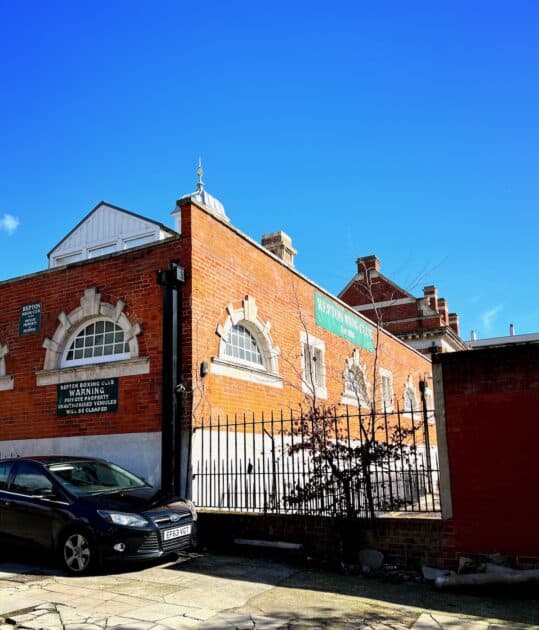
The Kray twins, like many lads growing up in the East End, were keen boxers and trained here. Once they began their criminal empire, they supported the club with financial donations, and even today some Kray merchandise goes to support the club.
The building was originally a Victorian Bath House, as you can see in the stone work, but opened as a youth and boxing club in 1884, making it the oldest and first boxing club in London. The murder of Ginger Marks by Kray associate Freddie Foreman took place outside the club in 1965.
Learn More About the Kray Twins (affiliate links)


3. Kray Walking Tour Stop 3: The Carpenters Arms, Cheshire Street


In 1963, the Kray twins purchased this pub as a gift for their mother Violet. Violet loved this pub, and would hold court on weekends to all of the twins’ friends and associates, as well as her old East End pals.
The previous owners of the pub claimed that the twins used an old coffin lid as a bar top, though it’s unclear if it’s still in use today. Google says the pub is temporarily closed and it was when I walked by; check before you head for a pint.
4. Kray Walking Tour Stop 4: William Davis Primary School

The Kray twins attended primary school here when it was Wood Close School. The boys were known to get into schoolyard scraps, so it was suggested they start boxing. There are supposedly bullet holes from the murder of Ginger Marks near the school sign on Cheshire street, but I couldn’t locate them when I visited.
5. Kray Walking Tour Stop 5: The Kray’s Childhood Home, Vallance Road


The Kray family lived at 178 Vallance Road, also called “Fort Vallance” by friends and associated. Charles and Violet Kray moved their family to this address when the twins were 5, and the couple later moved to Braithwaite House in Islington (also on my map) when the twins were grown. The original terraced houses were torn down and replaced by this block of flats in the 1980s.
Reggie later wrote of his time at the house in his autobiography Born Fighter: “Number 178 was a lucky old house. It had a big oak door with a large knocker, and the people used to call it ‘Fort Vallance.’ It was a terraced house with a toilet out in the yard. Ron and I used to love the kitchen. We had a big coal fire and we used to sit around it while our mother used to be doing the ironing or making pots of stew or cups of tea.”
This is a private residence. Please be respectful and mindful of privacy.
6. Kray Walking Tour Stop 6: E. Pellicci

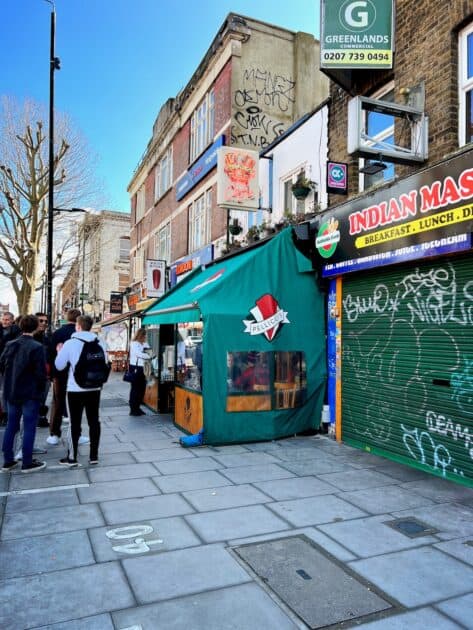
The Krays met for breakfast daily in this Bethnal Green greasy spoon to go over accounts and give orders to their associates. Scenes from the Tom Hardy film Legend were also shot on location here, though in the film the green awnings are gone.
Reggie Kray later wrote in East End Stories: “A memory popped into my head of sitting in Pellicci’s Cafe on the Bethnal Green Road savouring a coffee and talking to good friends. Does the cafe, which has been there since the turn of the century, still open its doors every day? Does pencil-moustache Nevis Pellicci still bustle around shouting orders trough to his wife Maria, or Mama as she was known? That place served the best food outside of your own mothers kitchen and it still makes my mouth water at the thought.“
7. Kray Walking Tour Stop 7: St Matthew’s Church, St. Matthew’s Row

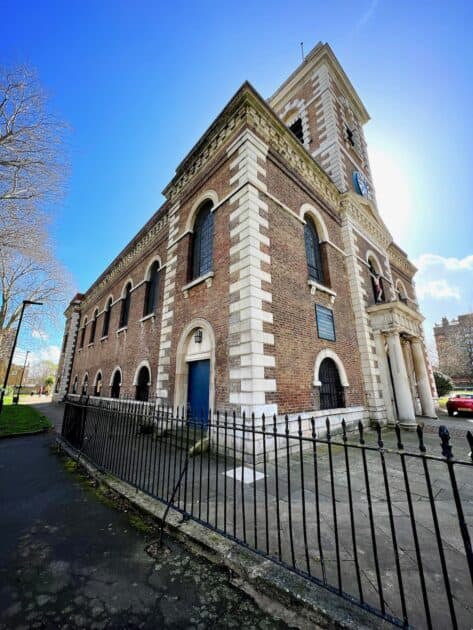
We end our Kray walking tour where the Krays ended. All three Kray brothers had their funerals here in this 1743 church: Ronnie Kray in 1995, Reggie Kray in 2000, and Charlie Kray (their older brother) also in 2000.
Each time mourners lined Cheshire Street and the processions went all the way through the East End. Google Kray funeral photos and you’ll see how beloved they were to their community. However, the Krays are not buried here, but at Chingford Mount Cemetery in Waltham.
Remembering the Kray Twins: Fear and Fame

The Kray twins leave a strange legacy, both as notorious murderers who would deck you if you looked at them, but also as gentlemen, who would pay the tab for all the little old ladies dining at Pellicci’s. They weren’t Robin Hoods, but they didn’t go down as pure evil, either.
Kray Walking Tour: Final Thoughts
I hope you learned a lot about these East End haunts on my Kray walking tour. These were men who caused a lot of terror and heartache: they killed people, they maimed people, they ruined lives. But they are also still held in high regard around these parts, and those who remember them recall both that fear and the fawning.
It’s an odd legacy, and a fascinating one. There’s a news story here from after their deaths that explores their fame in the East End.
Sources on the Kray Twins (may contain affiliate links):


More on Crime in London
London Serial Killers: 11 Documentaries on YouTube to Watch Now
What’s the Oldest Pub in London? 13 Curious Contenders
Gross Jobs in the 1800s: 10 Dirty and Dangerous Victorian Jobs
Bricks to Burberry: The 7 Worst Areas in London that are Now Super Posh
10 Ghastly Royal Deaths and What Happened to Their Corpses
London Charterhouse Square: Are There 50,000 Bodies Buried in this Lovely Garden?
Temple Bar London: Why did this London City Gate Sport Rotting Heads on Top?


