
13 Famous Victorian Prisons of the Past: Shackles, Plague and Daring Escapes
London’s notorious crime and punishment spans centuries of torture, incarceration, daring escapes, executions, and public hangings.
But what were the most notorious London prisons? And is there any old London prison you can still see today?
Most medieval prisons of old London are long gone, but some of the more recent Victorian prisons you can still see pieces of while walking the streets of the Capital.
Here’s a list of every notorious London prison throughout the centuries, from the medieval age all the way through to the Victorian age, and if – and where – you can still see evidence of them today.
Every old London prison has a story to tell. Here are all the grisly details.

1. The Clink: The Medieval Prison that Named All Others
- The Clink
- Used from: 1144 -1780
- Notorious for: shackles, harsh treatment & heretics
- Famous Prisoners: Sir Thomas Wyatt The Younger, John Rogers, Royalists, Puritans

The famous prison The Clink operated from the 12th century until the late 18th century, though there is evidence of a prison on this site (owned by the Bishop of Winchester) since the 800s.
It was used to hold debtors, heretics, and religious dissenters, and was notorious for its harsh conditions, overcrowding, and brutal treatment.
But if you had money, the Clink could be an okay place to be! Jailers were very poorly paid, so they set up several rackets to make some extra coin. Prisoners could buy food (at twice the outside price), beds, candles, and even pay to have their shackles removed.
Prisoners were chained with heavy iron shackles, hence the term “clink”: the sound the chains would make when prisoners tried to move around.

Nearby are the remains of Winchester Palace, whose connection to The Clink goes back centuries. In the 1400s, a rebellion ended with the murder of Winchester residents and the release of all the prisoners, and everything burned to the ground. The palace and jail were afterwards rebuilt.
The prison was eventually closed in 1780 and demolished in the 19th century, but its legacy lives on in popular culture, with the name “The Clink” now used as a slang term for any prison or jail.
Today, visitors can learn about the history of the prison at the Clink Prison Museum, which is located on the site of the original prison.
The museum is privately owned and a bit pricey, but worth it if you’re very into this particular piece of London history.
It contains original chains and shackles, torture implements, and most interestingly, a piece of the original jail wall.
2. Medieval Prison to Victorian Prison: the Tower of London
- The Tower of London
- Used as Prison from: 1101-1955
- Notorious for: famous prisoners and executions
- Famous Prisoners: Anne Boleyn, Lady Jane Grey, the Kray Twins & more

The Tower of London was originally built in the 11th century as a royal palace and fortress, but over time it came to serve a dual purpose: a residence for the monarchs, and a place of imprisonment for “enemies of the state.”
The Tower’s role as a prison became particularly prominent during the Tudor period, when it was used to incarcerate high-profile figures such as Anne Boleyn and Sir Walter Raleigh.
Throughout the centuries, the Tower of London remained a symbol of the power of the English monarchy and a place of fear for those who found themselves imprisoned within its walls.
Prisoners entered through the infamous “Traitor’s Gate” on the Thames side of the Tower, and it was at this spot where Anne Boleyn infamously took her last steps into the Tower before her execution.

Despite its reputation as a grim and foreboding place, the Tower of London was not always a place of misery for its prisoners. Only the most notorious or high-ranking prisoners were kept here.
Many were allowed to bring their own furniture, servants, and even pets into their cells, and some were even granted the privilege of writing and receiving letters.
Nonetheless, imprisonment in the Tower was still a harsh punishment, and many prisoners endured long periods of isolation, uncertainty, and physical discomfort. “Little Ease” was a tight cupboard reserved for the worst prisoners, where they couldn’t sit or stand.
The last prisoners known to be held at the tower were the notorious Kray twins: Ronald and Reggie Kray. The Krays were gangsters who ran the East End with crime and brutality.
Because of their connections and notoriety, the Krays were kept far away from ordinary prisons and isolated in the Tower for failure to report to national service in 1955.
The last known execution at the Tower was Nazi spy Josef Jakobs, who was executed by firing squad in 1941.
If you pay to see one attraction in London, make it the Tower of London. The price of admission is more than worth seeing the incredible history and hearing the stories of this iconic landmark.
3. Newgate Prison: Harsh, Dirty & Unforgiving Medieval Prison
- Newgate Prison
- Ran from: 12 century – 20th century
- Notorious for: Hangings & executions, vermin & lice, brutal treatment
- Famous Prisoners: Jack ‘The Lad’ Sheppard, Daniel Defoe, Amelia Dyer, Oscar Wilde

Newgate Prison was the most notorious of London prisons, operating from the 12th century until its closure in 1902.
Originally the building was an actual city gate and entrance into the City of London, but was soon used as a prison for debtors and criminals.
The building was destroyed and rebuilt several times over the centuries, and Newgate Prison became a symbol of the harsh treatment of prisoners in England.
It was known for overcrowding, poor conditions, and high death rates. Plague, starvation, torture, isolation, infestations of rats and insects, and dirty water (or no water) were just a few of the harsh conditions at Newgate.
Lice was said to be so prevalent that there was a crunching underfoot. Doctors and judges would not enter the prison for fear of catching illness, so a court was built next door with an exterior holding pen for prisoners – this court would eventually become The Old Bailey.
Entire trials would last only 30 minutes, including prosecution, defense, and witness testimony. Public executions were held outside the prison once a month, which drew large crowds and were made public holidays.
One of Newgate Prison’s most infamous prisoners, and a celebrity in his own right, was Jack ‘The Lad’ Sheppard.

Sheppard was a petty thief and criminal who had a penchant for escaping law enforcement. He escaped Newgate not once but twice, and also fled the confines of Coldbath and Bridewell prison.
He became one of the first celebrities who wasn’t royalty, and hailed as a kind of man of the people. He was finally caught and executed at Tyburn in 1724 and the tender age of 22.
During the 18th and 19th centuries, various reformers called for changes to the prison system, and Newgate Prison was eventually replaced by modern jails.
Today, the site of the former prison is occupied by the Central Criminal Court, also known as the Old Bailey, which is still one of the most important courts in the UK.
Only one wall remains of Newgate Prison. If you loop around Amen Court (it’s private property, so you’re doing this at your own risk), the remains of the wall line the West side of the parking area of the surrounding homes.
4. Marshalsea Prison: the Medieval Prison that Charged Debtors for Food
- Marshalsea Prison
- Operated from: 1373–1842
- Notorious for: being the first private prison and charging for necessities, imprisoning Charles Dickens’ father for debt
- Famous Prisoners: Edmund Bonner, John Dickens, Sir John Eliot, John Baptist Grano, Ben Jonson, Thomas Malory, John Selden, George Wither

Marshalsea Prison in Southwark began as a medieval prison 14th century until its closure as a Victorian prison in 1842.
Originally, the prison was under the jurisdiction of the Marshal of the King’s Household, who was responsible for maintaining law and order in the royal court.
In the 18th century, Marshalsea became known as a notorious debtors’ prison.
Many famous figures were imprisoned there, including the father of Charles Dickens, who was incarcerated for debt in 1824. Dickens himself later used the prison as a setting for some of his novels, including Little Dorrit.
Conditions at Marshalsea were often dire, with inmates living in cramped and squalid conditions, and being forced to rely on their families for basic necessities (ironic and extremely harsh, when they were imprisoned for owing money).
In 1842, the prison was closed and demolished, as part of a wider reform of the British prison system.
Today, the site is marked by a plaque and a nearby road still bears the name “Marshalsea Road,” serving as a reminder of the prison’s troubled history.
5. Tothill Fields Bridewell: Prison? Hospital? Or Both?
- Bridewell Prison
- Operated from: 1556-1855
- Notorious for: Jailing “able-bodied but indolent paupers” (i.e. punishing people for being poor).
- Famous Prisoners: Edward Marcus Despard Gregor MacGregor James Tilly Matthews John Trumbull Samuel Drybutter

Bridewell House of Correction was originally built as a palatial residence for Henry VIII in 1523. However, soon after in the mid-16th century, it was converted into a prison hospital for the poor and for homeless children.
The facility was run by the City of London and served oddly as both rehabilitation for “vagrants” and a home for the poor (since it was basically a crime to be poor at this time).
Dangerous criminals were sent to Newgate, and lesser criminals or the disadvantaged were sent to Bridewell.
The building was destroyed in the Great Fire of London in 1666, but was rebuilt in the 18th century.
It continued to be used as a prison hospital until the mid-19th century, when it was finally closed and later demolished in the 1860s.
The prison’s legacy can still be seen today in the term “Bridewell” which is sometimes used to refer to any institution or place of correction, and in the many artworks and writings that depict its history and influence on London society.
6. Coldbath Fields Prison: We Bathe Prisoners Here!
- Coldbath Fields Prison
- Operated from: 1794-1885
- Notorious for: Inhumane treatment & use of the treadmill
- Famous Prisoners: Jack Sheppard (escaped), Edward Dando, Edward Despard, John Gravener Henson, Owen Suffolk, Robert Wedderburn, Arthur Thistlewood

Coldbath Fields Prison was a Victorian prison located in Clerkenwell built in 1794.
The prison was designed to be a state-of-the-art facility, with separate cells for each inmate, a chapel, and a system of pipes to bring in fresh water for bathing (this is especially novel, as most prisons have no running water at this time, and disease was everywhere).
However, over time, the prison became notorious for its harsh conditions and overcrowding.
Many famous criminals were held at Coldbath Fields, including the notorious Jack “The Lad” Sheppard, who famously escaped in 1724.
The prison became notorious for using the treadmill as punishment, where prisoners would have to walk up stairs for hours on end.
In the 19th century, Coldbath Fields Prison became a hub for radical political activity. Many Chartists and other activists were imprisoned there, and the prison was known for its strict discipline and harsh conditions.
The prison was closed in 1877 and demolished in 1889. Today, the site of the former prison is occupied by Mount Pleasant Sorting Office, a large postal sorting office operated by Royal Mail.
7. Fleet Prison: the Most Dickensian of London’s Prisons
- Fleet Prison
- Operated from: 1197-1846
- Notorious for: The highest prison fees in England & appearance in Dickens
- Famous Prisoners: John Donne, Samuel Byrom, Richard Onslow, William Penn, Sir Thomas Lodge
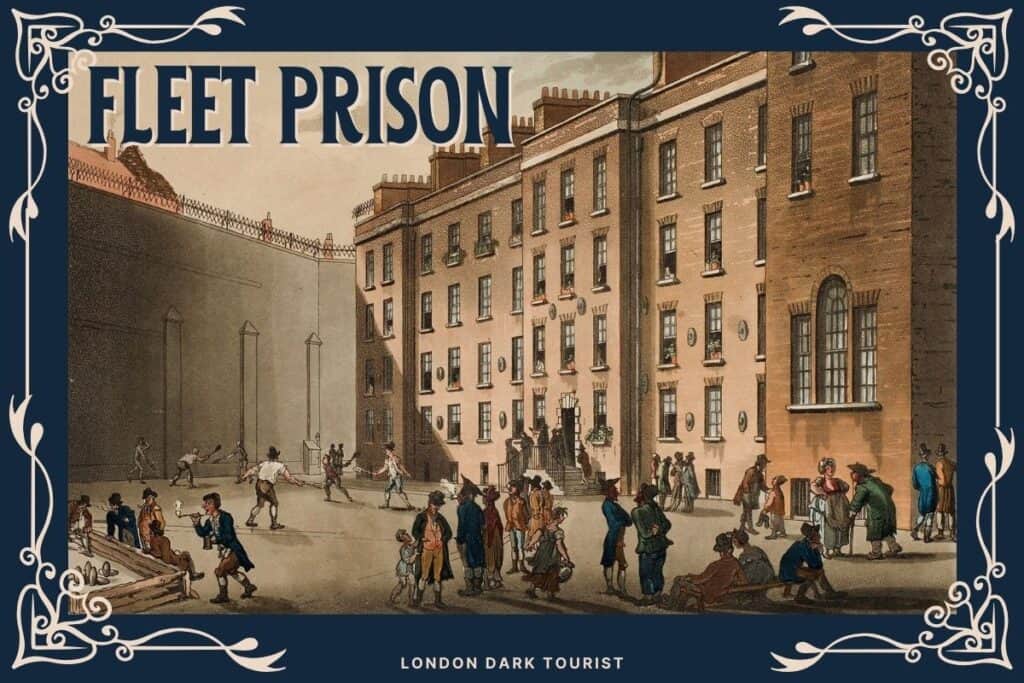
Fleet Prison operated from the 12th century until the 19th century. It was originally built to house debtors, but over time it became a general prison where a wide variety of criminals were held.
The conditions in Fleet Prison were notoriously harsh, with overcrowding, disease, and violence being common problems. But if you had money, you could buy yourself a private room, a bed, and plentiful food.
If you didn’t, you could beg through the grates, and passersby might give you a scrap.
Many famous figures, including Daniel Defoe and Charles Dickens, wrote about the horrors of the prison.
In 1842, Fleet Prison was finally closed down due to public pressure and concerns about the inhumane conditions.
Today, nothing remains of the prison except for a small section of the wall, which can be found in the courtyard of the old Daily Telegraph building on Fleet Street.
8. Clerkenwell House of Detention: Inhumane Victorian Prison
- Clerkenwell Prison
- Operated from: 1847-1890
- Notorious for: Clerkenwell Outrage
- Famous Prisoners: Ricard O’Sullivan Burke, arms supplier to the Fenians.

Clerkenwell House of Detention, also known as Clerkenwell Prison, was a Victorian prison in operation from 1847 to 1877. It replaced the older “New Prison,” and the two names were synonymous.
Like every other prison of the era, it was known for its harsh living conditions and overcrowding.
Many prisoners were held in the prison for minor offenses, such as debt or drunkenness, and were subjected to brutal treatment by the prison guards as they awaited trial.
The most notable prison event happened here in 1867, when Fenians lit gunpowder at the wall of the prison in an attempt to break out their arms dealer, Ricard O’Sullivan Burke.
The blast killed 12 and injured many more, and became known as the “Clerkenwell Outrage”. The leader of this disaster, Michael Barrett, would become the last person to be hung outside Newgate.
The prison was closed due to the inhumane conditions and was eventually demolished in the early 20th century.
Today, little remains of the Clerkenwell House of Detention except for the entrance gate, some parts of the walls, and the Clerkenwell catacombs, which were used as air raid shelters in the Blitz and are sometimes open for tours.
Walk down Sans Walk and you’ll see some of the original pieces of the prison. The area is supposedly haunted by past prisoners, and is featured on London ghost walks and was on Most Haunted!
9. Gatehouse Prison: Westminster Abbey’s Own Prison
- Gatehouse Prison
- Operated from: 1370-1776
- Notorious for: Imprisoning clerics
- Famous Prisoners: Sir Walter Raleigh, Richard Lovelace, Samuel Pepys

Gatehouse Prison was the gatehouse for Westminster Abbey. It was originally built in 1370 as a residence for the Bishop of Carlisle, but was later converted into a prison in the 16th century.
There were two sections of this small prison: one for lay people, and one for clerics.
Some of the most notable prisoners here were writers, which gave it the nickname “Poets Prison.” Sir Walter Raleigh was held here before his trial at the Old Bailey, and wrote a poem on his last day of life.
Richard Lovelace wrote these famous lines inside the prison:
“Stone walls do not a prison make,
Nor iron bars a cage;
Minds innocent and quiet take,
That for an hermitage.
If I have freedom in my love,
And in my soul am free,
—Angels alone, that soar above,
Enjoy such liberty.”
Today, you can stand where the Gatehouse would have been at the Crimea and India Mutiny Memorial, just outside Westminster Abbey.
10. King’s Bench Prison: Immortalized by Dickens
- King’s Bench Prison
- Operated from: medieval-1880
- Notorious for: Literary Connections
- Famous Prisoners: Thomas Dekker, John Clavell, Frances Kidder

King’s Bench Prison operated from the 12th century until it was finally closed in 1880.
Originally located in the City of London, it was later moved to Southwark, where it became known as the Surrey County Gaol.
The majority of prisoners were debtors, and they were often joined by their families. Dickens wrote about it in David Copperfield, with Mr Micawber being imprisoned here for debt.
But not all prisoners were debtors. In fact, rich prisoners convicted of white-collar crimes made King’s Bench “the most desirable place of incarceration in London.”
The courtyard was full of food and goods stalls, and some of the most wealthy prisoners even had their own cooks to prepare meals.
King’s Bench Prison was where the famous diarist Samuel Pepys was briefly held in 1679 after being accused of being involved in a plot against the king.
The prison was also the location of the trial of the radical writer and politician John Wilkes in 1763.
Today, the site of the former prison is occupied by the Southwark Crown Court.
11. Horsemonger Lane Gaol (Jail)
- Horsemonger Lane Gaol
- Operated from: 1799-1878
- Notorious for: Executions at the rooftop gallows
- Famous Prisoners: Marie and Frederick Manning of the ‘Bermondsey Horror,’ murderer William Chester Minor, Leigh Hunt, Edward Marcus Despard

Horsemonger Lane Gaol in Southwark – near Borough High Street – operated from 1791 to 1878.
It was built to replace the old county jail in Newington, and was designed as a “model,” purpose-built prison. It soon outgrew its design, and prisoners suffered overcrowding, unsanitary conditions and harsh treatment.
Atop the gatehouse was a gallows, and Charles Dickens famously witnessed hangings here. Afterwards he wrote to the papers urging the abolishment of the death penalty.
One of the most famous executions to take place here was of Maria and Frederick Manning, executed for their murderous plot against her former lover in an event termed ‘The Bermondsey Horror.‘
The prison was closed in 1878, and the site was later used for a new court building.
Today, only a few remnants of the prison remain, including the gates and some of the outer walls, now located in Newington Gardens.
12. Millbank Prison: Victorian Prison Pioneers of Solitary Confinement
- Millbank Prison
- Operated from: 1816 – 1890
- Notorious for: Terrible design and disease

Millbank Prison operated from 1816 to 1890. It was built to address the growing problem of overcrowding in London’s prisons at the time.
The prison was located on the banks of the River Thames, just south of Westminster, where the Tate Britain stands today.
It was designed to hold up to 1,000 prisoners, but at its peak, it held an astounding 4,000 inmates. The prison was infamous for its harsh conditions and high mortality rate, which led to its closure in 1890.
During its operation, Millbank Prison housed a range of prisoners, including debtors, political prisoners, and convicts sentenced to transportation to Australia.
In the early 19th century, it became known for its use of solitary confinement as a form of punishment, which was believed to be a more humane alternative to the physical punishment used in other prisons at the time.
However, over time, it became clear that the use of solitary confinement could be just as damaging to prisoners’ mental health.
But the building was most notorious for its marshy land. This resulted in terrible construction, mould, and damp. The wet environment fostered disease and caused deaths, resulting in the prison’s closure in 1890.
Today if you wander between Cureton Street and John Islip Street, you’ll see a dip where the original perimeter ditch of the prison was located. That stretch, and the rest of the site where the Tate Britain now lies, was the site of this dreaded prison.
On the river bank there is a large bollard that survived, and holds a memorial plaque.
13. Ludgate Jail
- Ludgate Jail
- Operated from: 1378- 1760
- Notorious for: The statue of Elizabeth I
- Famous Prisoners: William Heminges

Ludgate was one of the original city gates of London, but it doubled as a prison.
In the 14th century, Ludate was one of two city gates being used as a prison – the other being Newgate.
It evolved into a debtor’s prison and expanded over the years, and was one of the few debtor’s prisons that didn’t require inmates to pay for their food and lodging.
Still, the conditions were horrendous. During its later years, the building was falling down and crumbling beneath the inmates’ feet. It was wiped out by the Great Fire of London in 1666, then rebuilt and continued to house prisoners until it shut down in 1760.
Today you can see the site of the former Ludgate outside Guild Church of St Martin within Ludgate. There’s a blue plaque marking it’s existence, but there also might still be a piece of it left.
On nearby Pilgrim Street, there’s a rounded piece of stone on the curb, which might be the cornerstone to this old historic gate and prison.
London’s Victorian Prisons: Final Thoughts
London prisons were often unforgiving, and nearly impossible to break free of once you got into the cycle of poverty, debt, and imprisonment.
These are now famous prisons, but back when they were medieval prisons and Victorian prisons, they were the last place you wanted to visit.
Today you can see remnants of famous prisons all over the city, and when you do, take a moment to remember the unfortunate prisoners who didn’t deserve to be there.
More on London’s Dark History
What’s the Oldest Pub in London? 13 Curious Contenders
Gross Jobs in the 1800s: 10 Dirty and Dangerous Victorian Jobs
Kray Walking Tour of East London: 7 Free Spots You Can See Today
London Serial Killers: 11 Documentaries on YouTube to Watch Now
Bricks to Burberry: The 7 Worst Areas in London that are Now Super Posh
10 Ghastly Royal Deaths and What Happened to Their Corpses
London Charterhouse Square: Are There 50,000 Bodies Buried in this Lovely Garden?
Temple Bar London: Why did this London City Gate Sport Rotting Heads on Top?


